Facts
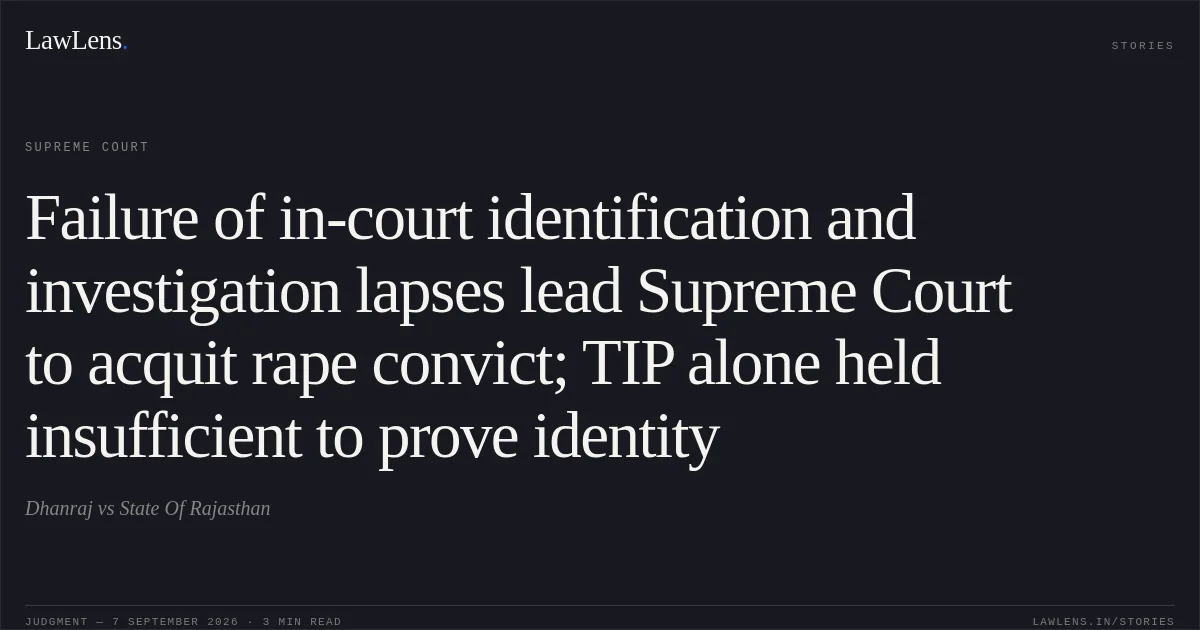
The appellant was prosecuted for the alleged abduction and sexual assault of a five-year-old child on 5 December 2016. The victim’s father lodged the FIR on 7 December 2016 against an unknown person, explaining the delay on account of apprehension of social stigma. The appellant was arrested nearly two months later, and the victim identified him in a test identification parade (TIP).
Source reference: paras. 3–6, 24, 27The trial court convicted him under Sections 376, 376(2)(i)(j), 363 and 323 of the IPC and imposed life imprisonment for the remainder of his natural life for the principal offence. The Rajasthan High Court affirmed the conviction on 20 August 2025.
Source reference: paras. 2, 8–10Issues
Whether the appellant’s identity as the perpetrator was proved beyond reasonable doubt when he was not named in the FIR, the victim did not identify him in court, and the prosecution relied substantially on the TIP?
Source reference: paras. 37–44Whether the failure to produce the alleged sketch of the assailant and the absence of scientific evidence linking the appellant to the biological material materially weakened the prosecution case?
Source reference: paras. 31, 35–36Whether the discrepancy between the medical opinion regarding the age of the injuries and the prosecution’s alleged date of occurrence created a reasonable doubt about the prosecution version?
Source reference: paras. 33–35, 51–55Whether the trial court and the High Court were justified in sustaining the conviction despite these cumulative infirmities?
Source reference: paras. 50–58Law Applied
The Court applied the principle that identification of an accused by a witness in court is substantive evidence, whereas identification during a TIP is only corroborative and investigative in character; a TIP cannot, by itself, establish identity.
Source reference: paras. 41–43This rule was derived from Rameshwar Singh v. State of J&K, (1971) 2 SCC 715.
Source reference: paras. 41–43The Court also relied on the duty of the trial court to actively elicit material evidence necessary for a just adjudication under Section 165 of the Indian Evidence Act, 1872, corresponding to Section 168 of the Bharatiya Sakshya Adhiniyam, 2023, read with Section 311 CrPC, corresponding to Section 348 of the Bharatiya Nagarik Suraksha Sanhita, 2023.
Source reference: paras. 45–46This principle was explained in Zahira Habibulla H. Sheikh v. State of Gujarat, (2004) 4 SCC 158.
Source reference: paras. 45–46The prosecution must prove the accused’s identity and guilt beyond reasonable doubt, and medical evidence establishing sexual injuries does not, without more, establish the identity of the assailant.
Source reference: para. 35Reasoning
The Court held that the prosecution failed to establish the appellant’s identity through reliable substantive evidence. The FIR named no accused and contained no description or identifying features of the assailant.
Source reference: paras. 24–25Although the victim identified the appellant in the TIP, she admitted that the police had disclosed his name to her and had earlier assembled the appellant and other persons for identification at the police station.
Source reference: paras. 37–40Since she did not identify the appellant in the witness box, the TIP could not independently prove that he was the perpetrator; the absence of dock identification was particularly significant because identity was the central disputed fact.
Source reference: paras. 41–44The prosecution also failed to produce the sketch allegedly prepared with the victim’s assistance, preventing the Court from comparing the original description with the appellant’s features.
Source reference: para. 31The medical evidence further stated that the injuries were 5–7 days old, which did not correspond with the alleged incident two days earlier, and no DNA, serological, or other forensic evidence linked the appellant to the injuries or biological material.
Source reference: paras. 33–36, 51–55Although a trial court is expected to ensure that material evidence is properly elicited, the trial court failed to obtain identification of the appellant even though he was present when the victim testified that she could identify him.
Source reference: paras. 47–49These deficiencies, considered cumulatively, created a reasonable doubt that could not be cured by a remand or fresh trial after the lapse of time.
Source reference: para. 56Holding
The Supreme Court held that the prosecution had failed to prove beyond reasonable doubt that the appellant was the assailant.
The TIP was only corroborative and could not substitute for substantive identification in court; the non-production of the sketch, the absence of scientific linkage, and the material inconsistency regarding the age of the injuries further undermined the prosecution case.
Source reference: paras. 50–57The judgments of the trial court dated 5 September 2019 and the Rajasthan High Court dated 20 August 2025 were set aside.
Source reference: paras. 58–60The appellant was acquitted of all charges and directed to be released forthwith, unless required in any other case.
Source reference: paras. 58–60Acts & Sections Cited
11 provisions across 5 statutes referred to in this judgment. Each provision opens on LawLens.
Indian Penal Code, 18603
Code of Criminal Procedure, 19732
Bharatiya Sakshya Adhiniyam, 20231
Bharatiya Nagarik Suraksha Sanhita, 20231
Original Court PDF
DhanrajvsState Of Rajasthan
Click to open original judgment
Original judgment, available to read, download and summarize on LawLens.in