Facts
Sanofi India Ltd., a public limited pharmaceutical company, supplied medicines to the Rare Materials Project of Bhabha Atomic Research Centre pursuant to tender processes conducted during 2011–12, 2013–14 and 2015–16.
Source reference: paras. 3–6The CBI alleged that Dr. P. Anand, a BARC public servant, conspired with the company to procure medicines at inflated prices or in excessive quantities, causing wrongful loss to BARC and corresponding gain to the accused.
Source reference: paras. 3–6It was further alleged that Dr. Anand received illegal gratification from the company and that the company abetted the offence under Section 11 of the Prevention of Corruption Act, 1988.
Source reference: paras. 3–6The company was chargesheeted under Section 120B read with Section 420 IPC and relevant provisions of the Prevention of Corruption Act, but no employee, director or officer of the company was identified or arraigned as an accused.
Source reference: paras. 3–6The High Court of Karnataka refused to quash the proceedings under Section 482 CrPC, holding that a corporate entity could be prosecuted without arraigning its directors or persons in charge, and that the allegations required examination at trial.
Source reference: paras. 7–9Issues
Whether criminal proceedings against a company for an offence requiring mens rea are liable to be quashed solely because no natural person through whom the company allegedly acted was identified.
Source reference: paras. 14, 175–187Whether the non-arraignment of any director, employee or other natural person renders the prosecution against the company legally unsustainable.
Source reference: paras. 14, 188–194Whether the chargesheet and accompanying material disclosed, prima facie, the commission of the alleged offences by the company so as to warrant continuation of the proceedings.
Source reference: paras. 195–198Law Applied
A corporation is capable of being prosecuted for offences involving mens rea and is not immune merely because it cannot be physically imprisoned where the statute also prescribes a fine, as held in Standard Chartered Bank v. Directorate of Enforcement and Iridium India Telecom Ltd. v. Motorola Inc.
Source reference: paras. 118–120, 131–134Corporate mens rea is established by attributing the act and state of mind of a natural person to the corporation; ordinary criminal law does not impose vicarious liability unless a statute expressly creates it.
Source reference: paras. 138–141Adopting the principles from Tesco Supermarkets Ltd. v. Nattrass, Meridian Global Funds Management Asia Ltd. v. Securities Commission and the Barclays cases, the Court formulated a sequential attribution framework: first, whether the company’s constitutional documents or company law vest the relevant power in the person; secondly, whether the power was expressly or impliedly delegated to that person with sufficient discretion and independence; and thirdly, whether the statutory purpose requires a special rule of attribution.
Source reference: paras. 142–151, 164–173At the Section 482 CrPC stage, the court must examine whether the allegations, taken at face value, disclose an offence, without conducting a mini-trial or assessing the sufficiency of evidence.
Source reference: para. 177Identification or arraignment of a natural person is not a general statutory prerequisite to prosecuting a company, unlike cases governed by provisions imposing derivative or vicarious liability, such as Section 141 of the Negotiable Instruments Act, 1881.
Source reference: paras. 188–193Reasoning
The Court held that corporate mens rea necessarily originates in the state of mind of one or more natural persons, but the question of attribution is ordinarily fact-intensive and must generally be determined at trial.
Source reference: paras. 178–185Non-identification of the specific individual did not invalidate the prosecution because the chargesheet attributed the relevant dealings, tender-related conduct and alleged gratification to the company itself through persons acting on its behalf.
Source reference: paras. 183–187The absence of a named employee or officer therefore went to the strength of the prosecution case, not to its maintainability.
Source reference: paras. 183–187Likewise, non-arraignment was not fatal because the present prosecution was based on the company’s direct criminal liability through attribution, rather than statutory vicarious liability.
Source reference: paras. 188–193Aneeta Hada v. Godfather Travels and Tours Pvt. Ltd. and Hindustan Unilever Ltd. v. State of M.P. were distinguished as cases involving statutory schemes under which the company’s prosecution was a condition precedent to imposing derivative liability on individuals.
Source reference: paras. 188–193Applying the ordinary Section 482 test, the Court found that the materials prima facie showed that natural persons had acted on behalf of Sanofi in relation to the alleged offences and that the surrounding circumstances made the requisite mens rea possible, rather than inherently improbable.
Source reference: paras. 195–197Holding
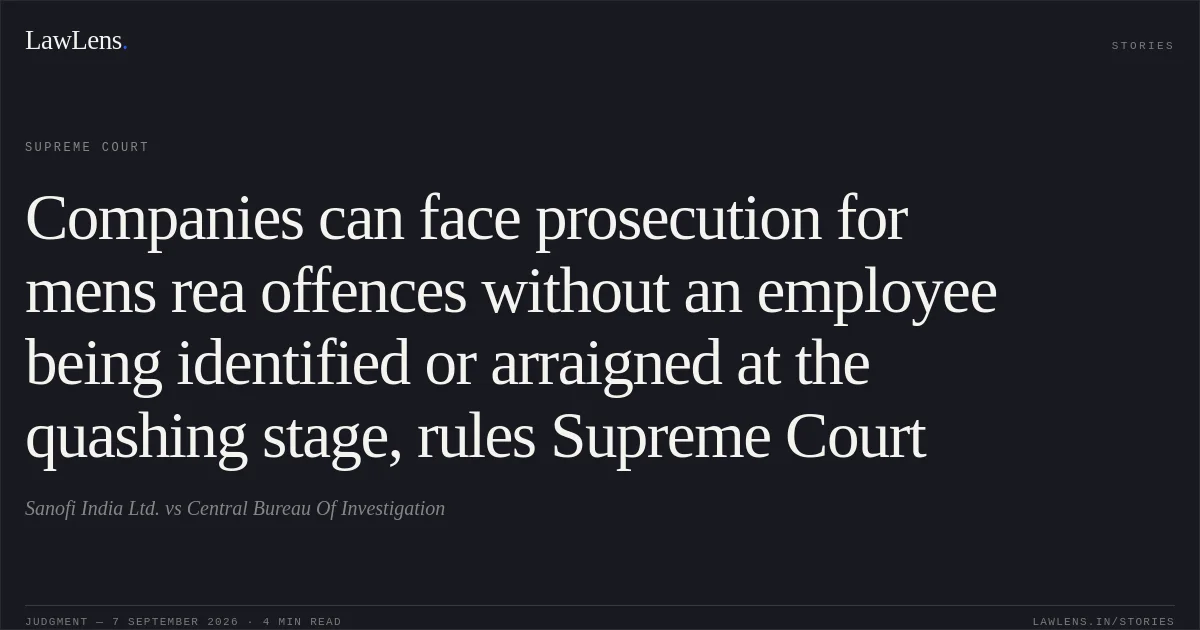
The Supreme Court held that a prosecution against a company for an offence involving mens rea cannot be quashed solely because the natural person through whom the company allegedly acted has not been identified or arraigned.
Identification and arraignment of such a person are not general prerequisites to the maintainability of corporate criminal proceedings, subject to any contrary statutory scheme creating vicarious liability.
Source reference: paras. 187, 193–194Since the chargesheet disclosed a prima facie case against Sanofi India Ltd. and did not render the existence of corporate mens rea inherently improbable, the High Court was correct in refusing to exercise its inherent jurisdiction under Section 482 CrPC.
Source reference: paras. 197–200The appeal was dismissed and the criminal proceedings were permitted to continue.
Source reference: paras. 197–200Acts & Sections Cited
9 provisions across 4 statutes referred to in this judgment. Each provision opens on LawLens.
Indian Penal Code, 18602
Prevention of Corruption Act, 19884
Code of Criminal Procedure, 19731
Negotiable Instruments Act, 18812
Original Court PDF
Sanofi India Ltd.vsCentral Bureau Of Investigation
Click to open original judgment
Original judgment, available to read, download and summarize on LawLens.in