Facts
The petitioner, a former employee of the respondent company, signed a surety agreement on 25 February 2022 undertaking to serve for four years or pay ₹5,00,000 if she left earlier.
Source reference: para. 2–3The respondent obtained a cheque from her as security when she joined.
Source reference: para. 2–3After she left before completing four years, the respondent demanded ₹8,35,000 for alleged training and other expenses.
Source reference: para. 2–3, 6–8The cheque for ₹5,00,000 was dishonoured with the endorsement “payment stopped by drawer,” and the respondent initiated proceedings under Section 138 of the Negotiable Instruments Act, 1881.
Source reference: para. 2–3, 6–8The petitioner sought to quash those proceedings under Section 482 CrPC (Section 528 BNSS).
Source reference: para. 2–3, 6–8The High Court found the respondent’s assertion that the cheque had been issued after its demand notice to be open to serious doubt, noting that the cheque amount matched the sum in the original surety agreement and that the material indicated it had been obtained at the commencement of employment.
Source reference: para. 8Issues
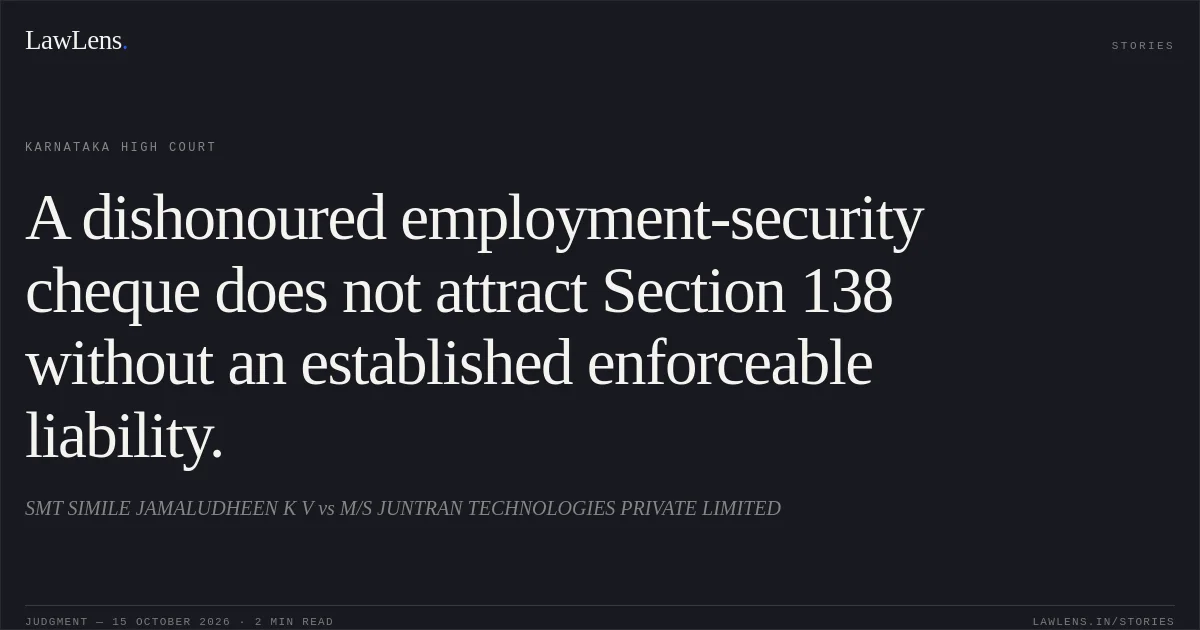
Whether the cheque was issued in discharge of a legally enforceable debt or other liability so as to attract Section 138 of the NI Act.
Source reference: para. 6Whether continuation of the Section 138 proceedings, in the circumstances of the employment dispute and the disputed claim for damages, would amount to an abuse of process.
Source reference: para. 9–12Law Applied
Section 138 of the NI Act applies where a cheque is drawn for discharge, wholly or partly, of a legally enforceable debt or other liability; dishonour alone does not establish that ingredient.
Source reference: para. 11Relying on Indus Airways Private Limited v. Magnum Aviation Private Limited, the Court treated the existence of a legally enforceable debt or liability as necessary for Section 138 liability.
Source reference: para. 11A contractual claim for damages, including a unilateral demand for an amount allegedly caused by breach, does not by itself establish that the amount is a legally enforceable debt; its enforceability and quantification may require adjudication in civil proceedings.
Source reference: para. 10–12Reasoning
The Court considered the circumstances in which the cheque was obtained, the difference between the ₹5,00,000 stipulated in the surety agreement and the respondent’s later ₹8,35,000 demand, and the absence of material establishing that the cheque had subsequently been issued towards discharge of a legally enforceable liability.
Source reference: para. 8, 12It viewed the dispute as concerning the contractual consequences of the petitioner’s early departure and the respondent’s claim for damages, rather than independent criminal misconduct.
Source reference: para. 9–11The respondent’s demand did not, without adjudication, establish the existence or amount of a legally enforceable debt, and the alleged dishonour by stop-payment did not cure that deficiency.
Source reference: para. 9–11The Court therefore held that permitting the criminal case to continue would amount to an abuse of process.
Source reference: para. 12Holding
The High Court allowed the petition and quashed the proceedings in C.C. No. 6424/2024 pending before the XIV Additional Small Causes Judge and Additional Chief Metropolitan Magistrate, Bengaluru (SCCH-10).
The order did not preclude the respondent from pursuing any civil remedies available for recovery of an amount found legally due and payable.
Source reference: para. 13Acts & Sections Cited
6 provisions across 4 statutes referred to in this judgment. Each provision opens on LawLens.
Bharatiya Nagarik Suraksha Sanhita, 20231
Code of Criminal Procedure, 19732
Negotiable Instruments Act, 18811
Indian Contract Act, 18722
Original Court PDF
SMT SIMILE JAMALUDHEEN K VvsM/S JUNTRAN TECHNOLOGIES PRIVATE LIMITED
Click to open original judgment
Original judgment, available to read, download and summarize on LawLens.in