Facts
Exponent Energy Private Limited applied to register the word mark “EXPONENT” in Class 42, claiming use from 8 April 2021, for scientific and technological services, research and design, industrial analysis and research, industrial design, and vehicle design.
Source reference: p. 3, paras. 2–3The Registrar objected under Section 11(1) of the Trade Marks Act, 1999, citing an earlier “EXPONENT” mark and “EXPONENTIAL TECHNOLOGIES GROUP”.
Source reference: p. 3, para. 3After the appellant’s reply, affidavit of use, written submissions, and several hearings, the Assistant Registrar refused registration on 25 July 2025, finding phonetic similarity and similarity of services likely to cause confusion.
Source reference: pp. 3–4, paras. 4–6The appellant appealed, contending that the refusal was inadequately reasoned and that its requests for consideration under Sections 12, 18(4), and 20, as well as its offer to restrict the services, had not been addressed.
Source reference: pp. 5–7, paras. 7–10Issues
1. Whether the impugned refusal recorded sufficient reasons under Section 18(5) of the Act.
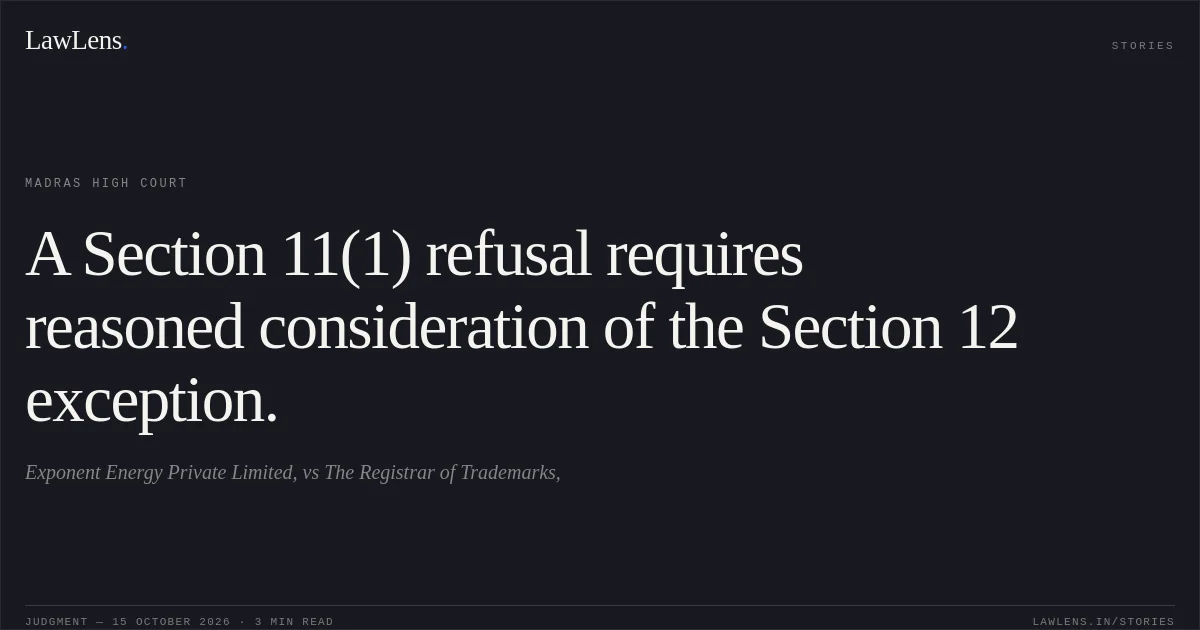
Source reference: p. 7, para. 12(i)2. Whether a refusal under Section 11(1) could stand without considering Section 12, which Section 11(1) expressly saves.
Source reference: p. 7, para. 12(ii)3. Whether the Registrar properly considered the appellant’s requests under Sections 12, 18(4), and 20 of the Act.
Source reference: p. 7, para. 12(iii)4. Whether the appellant was entitled to a direction for acceptance and advertisement, or whether the matter required remand.
Source reference: p. 7, para. 12(iv)Law Applied
Section 18(5) requires the Registrar, when refusing or conditionally accepting an application, to record in writing the grounds for the decision and the materials relied upon; reasons must disclose an intelligible basis for the decision and enable appellate scrutiny.
Source reference: p. 8, paras. 13–14Section 11(1) begins “Save as provided in section 12,” making Section 12’s discretion to permit registration in cases of honest concurrent use or other special circumstances relevant to a Section 11(1) refusal.
Source reference: pp. 10–11, para. 19Section 18(4) vests in the Registrar the power to accept, conditionally accept, or refuse an application; the proviso to Section 20 permits advertisement before acceptance in the circumstances specified there.
Source reference: pp. 11–13, paras. 20, 22Section 16(1), concerning associated marks, does not confer an automatic right to register a new mark or overcome an objection based on another proprietor’s rights.
Source reference: p. 12, para. 21Reasoning
The Assistant Registrar’s general finding of phonetic similarity did not explain the comparison between the applied-for mark and either cited mark—particularly given that the first cited mark was identical to “EXPONENT” while the second comprised three words—and the order did not identify which services overlapped or explain the likelihood of confusion.
Source reference: pp. 8–9, paras. 15–16It also failed to address the objected status of the second cited application, the appellant’s evidence and submissions, or its invoked Section 12 exception.
Source reference: pp. 9–11, paras. 17–19The requests under Sections 18(4) and 20 and the proposed restriction of services likewise required consideration, although the Registrar was not bound to grant them.
Source reference: p. 11, para. 20Direct acceptance was unwarranted: the application’s specification was broad, the applied-for word was identical to the word in the first cited mark, and the Registrar had not assessed whether the evidence—including an earliest invoice for inward purchases—established use for the services claimed.
Source reference: pp. 13–14, paras. 22–23Because the necessary statutory discretions and evidentiary assessment had not been undertaken, remand, rather than appellate determination on the merits, was appropriate.
Source reference: p. 14, para. 24Holding
The Court set aside the refusal and remanded the application to the Registrar for fresh consideration after giving the appellant at least two weeks’ notice of a hearing.
The appellant may file the precise wording of any restricted services specification before the hearing.
Source reference: p. 16, para. 26The Registrar must separately assess the two cited marks, compare the marks and service specifications, verify the cited marks’ current status, consider the evidence of use, and give reasoned findings on the requests under Sections 12 and 18(4) and the proviso to Section 20.
Source reference: p. 16, para. 26The Registrar must decide the matter within three months of the first hearing; all merits questions were left open.
Source reference: p. 16, para. 26The appeal was disposed of, the connected petition was closed, and no costs were awarded.
Source reference: p. 16, para. 26Acts & Sections Cited
5 provisions across 1 statute referred to in this judgment. Each provision opens on LawLens.
Trade Marks Act, 19995
Original Court PDF
Exponent Energy Private Limited,vsThe Registrar of Trademarks,
Click to open original judgment
Original judgment, available to read, download and summarize on LawLens.in