Facts
An FIR was lodged on 12 December 2021 after government construction materials intended for projects at Ampati were reported stolen. The case was registered under Sections 379/34 IPC against unknown persons.
Source reference: p. 2, para. 2During investigation, the Investigating Officer sought a non-bailable warrant (NBW) against the petitioner, and the Chief Judicial Magistrate, Ampati, ordered its issuance on 29 September 2023.
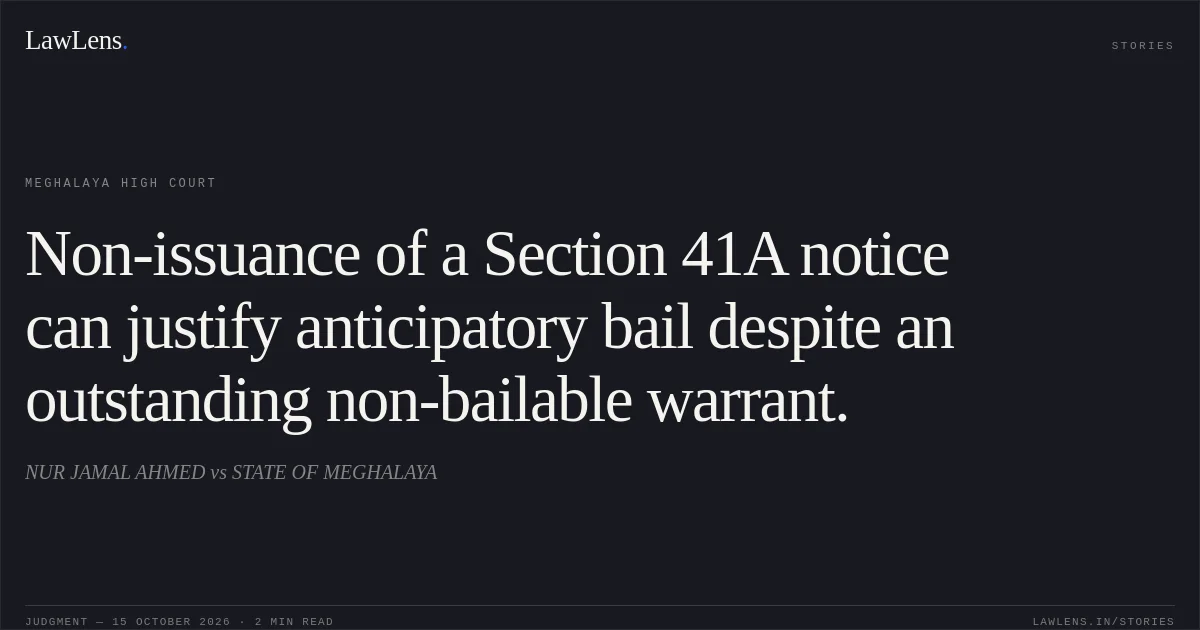
Source reference: p. 2, paras. 3–4The petitioner sought anticipatory bail, arguing that he had not first been served a notice under Section 41A CrPC, now Section 35(3) BNSS, as the offence carried a maximum sentence of three years. The State opposed the application on the basis that the NBW remained in force.
Source reference: p. 2, para. 5; p. 3, para. 8Issues
1. Whether, for an alleged offence under Section 379 IPC punishable with imprisonment up to three years, the Investigating Officer was required to issue notice under Section 41A CrPC, now Section 35(3) BNSS, before seeking an NBW.
Source reference: p. 2, para. 5; p. 3, paras. 10–112. Whether the subsisting NBW prevented the petitioner from obtaining anticipatory bail.
Source reference: p. 3, paras. 8, 12Law Applied
Section 379 IPC provides for punishment for theft, including imprisonment for a term that may extend to three years.
Source reference: p. 3, para. 10The Court stated that, in light of the offence’s punishment, the first course of action for the Investigating Officer was to issue notice under Section 41A CrPC, now Section 35(3) BNSS.
Source reference: p. 3, para. 11The Court also relied on the Supreme Court’s order in Asha Debey v. State of Madhya Pradesh, SLP (Crl.) No. 13123/2024, dated 12 November 2024, which the petitioner cited for the proposition that anticipatory bail may remain available even where a declaration under Section 82 CrPC has been issued.
Source reference: p. 3, para. 6The High Court held that the Supreme Court’s observation covered the issue concerning the NBW.
Source reference: p. 3, para. 12Reasoning
The alleged offence was punishable by imprisonment for up to three years, and the State admitted that no notice under Section 41A CrPC/Section 35(3) BNSS had been issued. The Court therefore found that the prescribed notice had not been given at the first instance.
Source reference: p. 3, paras. 10–11It further considered the subsisting NBW in light of the Supreme Court’s observation in Asha Debey, concluding that the warrant did not, in the circumstances, defeat the petitioner’s application for anticipatory bail.
Source reference: p. 3, para. 12Holding
The High Court allowed the anticipatory-bail application and directed that, in the event of arrest, the petitioner be released on bail upon executing a personal bond of ₹20,000 with one surety for the like amount.
The conditions included not absconding or tampering with evidence or witnesses, appearing before the Investigating Officer when required, and not leaving Meghalaya without prior permission. The petition was disposed of.
Source reference: p. 4, para. 15Acts & Sections Cited
5 provisions across 3 statutes referred to in this judgment. Each provision opens on LawLens.
Indian Penal Code, 18602
Bharatiya Nagarik Suraksha Sanhita, 20231
Code of Criminal Procedure, 19732
Original Court PDF
NUR JAMAL AHMEDvsSTATE OF MEGHALAYA
Click to open original judgment
Original judgment, available to read, download and summarize on LawLens.in