Facts
The petitioners, defendants in the pending suit, relied on an Agreement of Sale dated 16 September 1999, coupled with possession, to contend that a sale deed executed in their favour on 21 February 2000 arose from that agreement.
Source reference: para. 1The plaintiffs objected to the agreement’s admission in evidence for deficit stamp duty. The Trial Court accepted the objection and impounded the agreement under Section 34(1) of the Karnataka Stamp Act, 1957.
Source reference: para. 2The petitioners challenged that order under Article 227 of the Constitution.
Source reference: para. 4Issues
1. Whether the Agreement of Sale, after being followed by a duly stamped and registered sale deed, could independently be subjected to stamp duty under Article 5(e)(i) and impounded under Section 34
Source reference: para. 5(i)2. Whether the limitation under Section 46-A of the Act bars a Civil Court from impounding an insufficiently stamped instrument under Sections 33 and 34
Source reference: para. 5(ii)3. Whether Anil v. Babu correctly held that expiry of the Section 46-A period disables the Court from impounding an instrument, in light of the Division Bench decision in Digambar Warty
Source reference: para. 5(iii)Law Applied
Sections 33 and 34 of the Karnataka Stamp Act require a Court to examine and impound an instrument that appears insufficiently stamped when it is tendered in evidence; Section 46-A limits the revenue authorities’ proceedings for recovery of deficient duty, not the Court’s power or obligation to impound.
Source reference: paras. 11–14, 25–27Sections 37–39 provide for transmission of the impounded instrument and the Deputy Commissioner’s role, including consideration of penalty reduction.
Source reference: paras. 15–17, 28–29In Digambar Warty and Others v. District Registrar, Bangalore Urban District and Another, ILR 2013 KAR 2099, the Division Bench distinguished impounding and adjudication from recovery and held that no time limit applies to the former.
Source reference: paras. 12–13The Court held that Anil v. Babu and Others, W.P. No. 112448 of 2017, was not good law to the extent it treated Section 46-A as limiting the Court’s impounding power.
Source reference: paras. 18–21Applying Smt. Nagamma and Others v. Rudrayya and Others, W.P. No. 105278 of 2018, the Court held that an agreement of sale followed by a duly stamped and registered conveyance cannot thereafter be independently subjected to stamp duty under Article 5(e)(i).
Source reference: paras. 6–8Reasoning
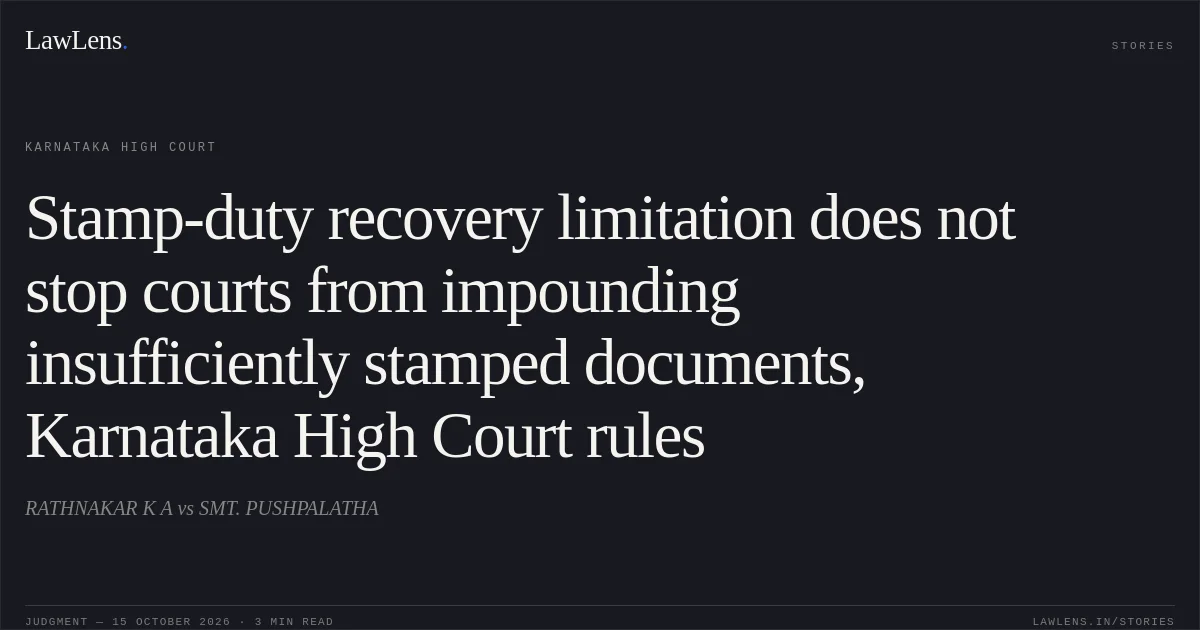
The Court held that the Section 46-A limitation concerns coercive recovery and does not displace the Court’s separate statutory duty under Sections 33 and 34 to impound an insufficiently stamped instrument tendered in evidence. It therefore rejected the petitioners’ limitation argument and held Anil incorrect to the extent it conflicted with the binding Division Bench ruling in Digambar Warty.
Source reference: paras. 19–21, 24–29However, the agreement in this case had been followed by a duly stamped and registered sale deed dated 21 February 2000. Under Nagamma, the agreement had merged into the completed conveyance and could not be treated as an independently chargeable instrument under Article 5(e)(i), notwithstanding that it was coupled with possession. The Trial Court’s impounding order was therefore unsustainable on that distinct ground.
Source reference: paras. 7–9, 30–32Holding
The Court allowed the writ petition and quashed the Trial Court’s order dated 15 February 2017 impounding the Agreement of Sale.
It clarified that the agreement, having culminated in the duly stamped and registered sale deed, could not be independently subjected to stamp duty under Article 5(e)(i).
Source reference: para. 34, order (iii)The Court further clarified that Section 46-A does not bar impounding under Sections 33 and 34, and that Anil is not good law to that extent; no order as to costs was made.
Source reference: para. 34, order (iv)–(v)Acts & Sections Cited
10 provisions across 1 statute referred to in this judgment. Each provision opens on LawLens.
KARNATAKA STAMP ACT, 1957
Original Court PDF
RATHNAKAR K AvsSMT. PUSHPALATHA
Click to open original judgment
Original judgment, available to read, download and summarize on LawLens.in