01Facts
The landlords instituted an ejectment suit alleging, among other grounds, default in payment of rent.
¶ 1–2After receiving summons on 29 September 2022, the tenant appeared on 28 October 2022 and filed applications under Sections 7(1) and 7(2) of the West Bengal Premises Tenancy Act, 1997 (“1997 Act”).
¶ 1–2The Section 7(1) application was allowed on 28 February 2023; the tenant deposited arrears and current rent on 20 March 2023, including rent for February 2023.
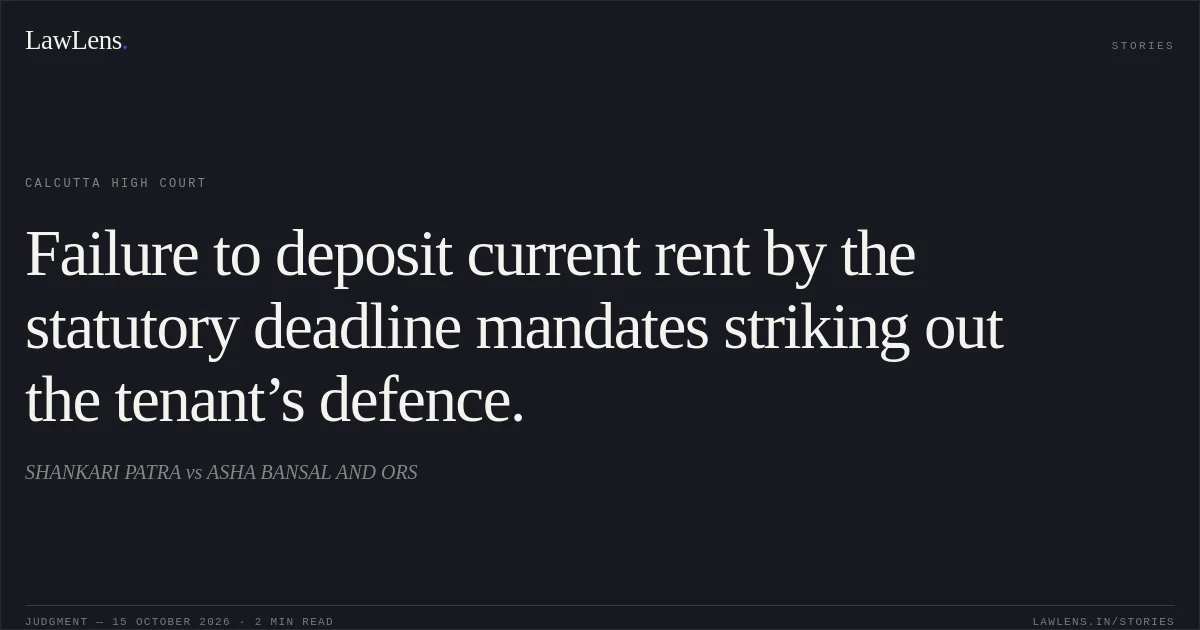
¶ 1–2The Section 7(2) application remained pending. The Trial Court rejected it and struck out the tenant’s defence under Section 7(3), holding that the February 2023 rent had been deposited after the statutory deadline.
¶ 1–2The tenant challenged that order under Article 227 of the Constitution.
¶ 1–202Issues
i.1. Whether the Trial Court was justified in rejecting the tenant’s Section 7(2) application and striking out her defence when rent for February 2023 was deposited after the deadline under Section 7(1)(c), notwithstanding the delay in deciding her Section 7(1) application.
¶ 6–12ii.2. Whether transposition of some plaintiffs as proforma defendants affected the time for compliance with Section 7(1), where the tenant admitted being a tenant of other plaintiffs.
¶ 15–1703Law Applied
Section 7(1)(a)–(b) of the 1997 Act requires a tenant to pay or deposit arrears of rent, with statutory interest, within one month of service of summons or, if appearing without service, within one month of appearance; Section 7(1)(c) requires current rent to be paid or deposited month by month by the 15th of each succeeding month.
¶ 11Under Section 7(3), failure to comply with the applicable payment or deposit requirements within the prescribed or extended time requires the tenant’s defence against delivery of possession to be struck out.
¶ 11The Supreme Court’s decision in Seventh Day Adventist Senior Secondary School v. Ismat Ahmed confirms the consequences of non-compliance with Section 7(1).
¶ 11The Court also applied Kaluram Onkarmal v. Baidyanath Gorain, holding that the statutory month-by-month payment mechanism prevails over any contrary payment arrangement.
¶ 24Section 7’s timelines remain applicable where the tenant admits being a tenant of at least one plaintiff, notwithstanding transposition of other plaintiffs.
¶ 15–17Provisions in the judgment · 4 · Linked ones open on LawLens
West Bengal Premises Tenancy Act, 1997 Section 6Section 7
Code of Civil Procedure, 1908 Section 151
west bengal premises tenancy act, 1956 Section 17
04Reasoning
Even assuming the tenant could deposit the arrears within one month of the 28 February 2023 order, that assumption did not excuse the separate obligation to deposit current rent by the 15th of each succeeding month.
¶ 9–12The February 2023 rent was due by 15 March 2023 but was deposited on 20 March 2023; the deposit was therefore late and attracted Section 7(3).
¶ 9–12The Court held that the delay in deciding the Section 7(1) application and the cited decisions concerning court-caused delay did not assist the tenant because the current-rent default independently triggered the statutory consequence.
¶ 13–14, 20–22The transposition argument also failed: the tenant admitted tenancy under plaintiffs 1–3, so the statutory timelines continued to apply.
¶ 15–1705Holding
The High Court held that the February 2023 rent was deposited in breach of Section 7(1)(c), and that the Trial Court’s rejection of the Section 7(2) application and striking out of the defence under Section 7(3) could not be faulted.
¶ 10–12The revisional application was dismissed without costs.
¶ 25Original Court PDF
SHANKARI PATRAvsASHA BANSAL AND ORS
Click to open original judgment
Original judgment, available to read, download and summarize on LawLens.in