01Facts
The petitioners (landlords) filed Ejectment Suit No. 35 of 2023 before the Civil Judge (Senior Division), 8th Court, Alipore, seeking eviction of the opposite party (tenant) for default in payment of rent.
¶ 2The tenancy was created by a deed of lease dated 01.06.1978 at a monthly rent of Rs. 1,000.
¶ 37The trial court found the rate last paid to be Rs. 1,200 per month, and this finding was not challenged.
¶ 38The tenant entered appearance on 13.10.2023, without summons having been served. On the same day he filed applications under Sections 7(1) and 7(2) of the West Bengal Premises Tenancy Act, 1997 ("the 1997 Act"), depositing rent for February 2019 to October 2023 with interest.
¶ 2, 23The tenant denied default from 2015 and asserted that he had deposited rent up to January 2019 in an earlier eviction suit (T.S. No. 101 of 2024), where the amount was withdrawn by the landlords.
¶ 22Challans were produced in support of the tenant's assertion of prior deposit.
¶ 34The landlords' counsel attempted to explain a clerical error in the suit number on the challans, which the trial court accepted.
¶ 36The trial court held the tenant to be a defaulter for January 2015 to January 2019, specified the arrears, and directed deposit within a fixed time.
¶ 3, 39–40The landlords challenged this order under Article 227 of the Constitution.
¶ 102Issues
i.1. Whether the rent for January 2015 to January 2019 was an "amount admitted by the tenant to be due", such that Section 7(2) was not available and the arrears had to be paid under Section 7(1)(a) without adjudication.
¶ 4, 30–31ii.2. Whether the tenant's applications under Sections 7(1) and 7(2) were filed within the statutory period, so that the bar in Seventh Day Adventist did not apply.
¶ 24, 26–28iii.3. Whether the trial court, on a Section 7(2) dispute, could adjudicate the disputed arrears and direct their deposit.
¶ 29, 32–33, 40iv.4. Whether the trial court's finding on the rate of rent warranted interference.
¶ 3803Law Applied
Section 6 of the 1997 Act bars eviction except on specified grounds, including default in rent for three months within twelve months.
¶ 7Section 7(1)(a)–(c) of the 1997 Act requires a tenant sued on such grounds to pay or deposit all arrears at the last-paid rate with 10% interest within one month of service of summons or appearance, and to continue paying monthly rent.
¶ 10–14Section 7(2) of the 1997 Act, subject to which Section 7(1)(a) operates, applies where the rent payable is disputed. The tenant must deposit the admitted amount with an application for determination, and the Civil Judge must then decide the dispute and specify the amount due.
¶ 15, 18Section 7(3) of the 1997 Act strikes out the defence for non-compliance, and Section 7(4) bars a possession decree on default where compliance is made.
¶ 16–17Bijoy Kumar Singh v. Amit Kumar Chamariya (2019) 10 SCC 660 holds that Section 7 is a complete mechanism to avoid eviction for arrears when the tenant deposits the determined arrears.
¶ 19–20Seventh Day Adventist Senior Secondary School v. Ismat Ahmed (2025 SCC OnLine SC 1696), read with Debasish Paul v. Amal Boral (2024) 2 SCC 169, holds that the Section 7(1)/(2) filing and deposit deadlines are mandatory and that the Section 7(2) proviso extension applies only at the rent-determination stage.
¶ 26–27The court considered Sk. Mongla, Jay Prakash Gupta, Sumit Singh, Nilima Paul, and Khaitan Consultants Ltd. and distinguished each of them.
¶ 45–51Provisions in the judgment · 5 · Linked ones open on LawLens
West Bengal Premises Tenancy Act, 1997 Section 6Section 7
west bengal premises tenancy act, 1956 Section 17
Code of Civil Procedure, 1908 Section 151
Limitation Act, 1963 Section 5
04Reasoning
The 2019–2023 arrears were deposited with the Section 7(2) application on the date of appearance, without summons. The applications were therefore within time, and Seventh Day Adventist did not apply.
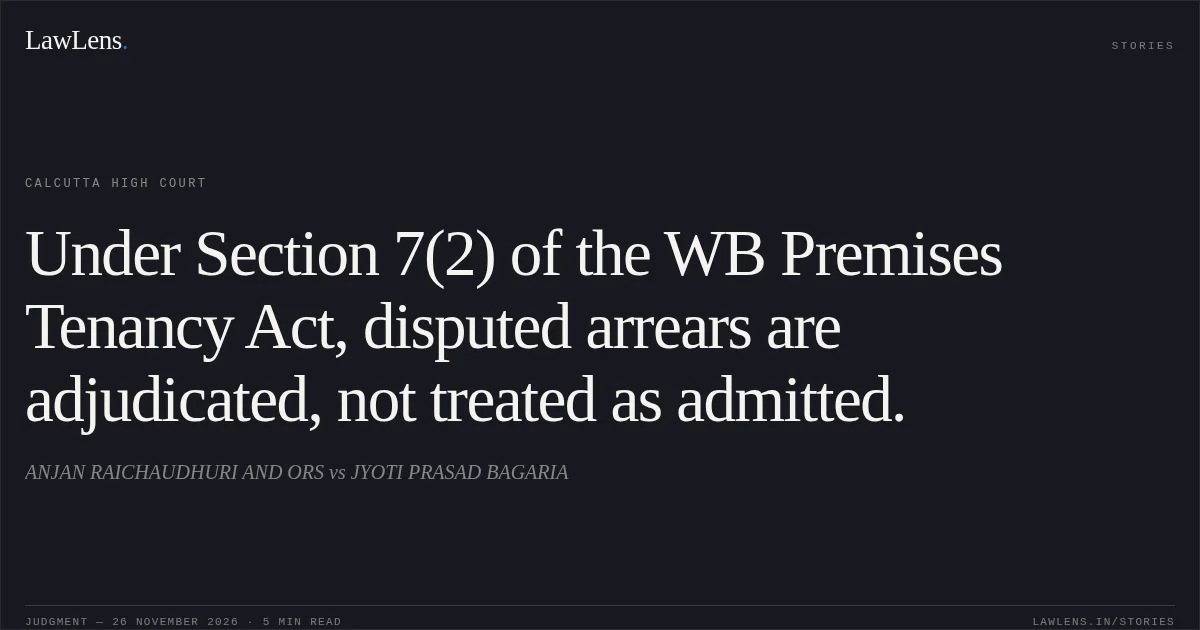
¶ 23–24, 28The landlords' contention that the 2015–2019 arrears were "admitted" failed because the tenant had expressly disputed them, asserting prior deposit in T.S. No. 101 of 2024. The word "him" in Section 7(2) refers to the tenant, and the tenant had not admitted those arrears. The precondition of an admitted amount under Section 7(2) was therefore satisfied, and the Section 7(1)(a) route did not arise for that period.
¶ 22, 29–32Since the dispute was genuine, the trial court was obliged to adjudicate it on evidence. The onus of proving prior deposit lay on the tenant, who produced challans. The trial court considered them and found default for the disputed period.
¶ 33–34, 39, 43A finding that the tenant's assertion was "disproved" or "not proved" does not convert the dispute into an admitted fact. The trial court's order is therefore a valid exercise of its Section 7(2) power and not an excess of jurisdiction.
¶ 40, 44, 52In Sk. Mongla, the admitted arrears were not deposited with the Section 7(2) application, and condonation was sought under Section 151 CPC. In Jay Prakash Gupta, the same failure occurred at filing. In Sumit Singh, relief was refused on the petitioner's unconvincing explanation for delay under Section 7(3). In Nilima Paul, delay was not condoned because Section 5 of the Limitation Act does not apply. Khaitan Consultants, which concerns occupation charges above the last-paid rate, was not raised at any stage here and was therefore inapplicable.
¶ 45–51The challenge to the Rs. 1,200 rate finding was unsupported by material showing perversity.
¶ 3805Holding
The 2015–2019 rent was not an amount admitted by the tenant, so Section 7(2) was properly invoked.
¶ 31–32The Section 7(1) and 7(2) applications were filed within the statutory period.
¶ 24, 28The trial court was obliged to adjudicate the dispute and, on evidence, validly held the tenant in default for January 2015 to January 2019 and specified the arrears.
¶ 29, 40, 43–44The trial court's order fixing the rate at Rs. 1,200 and directing deposit within the specified time was upheld. The impugned order does not warrant interference under Article 227 of the Constitution. C.O. 2075 of 2025 is dismissed without costs.
¶ 52–53Original Court PDF
ANJAN RAICHAUDHURI AND ORSvsJYOTI PRASAD BAGARIA
Click to open original judgment
Original judgment, available to read, download and summarize on LawLens.in