01Facts
The plaintiff, a thika tenant, sued the appellants (defendants) for recovery of possession, treating them as trespassers under the Transfer of Property Act, 1882
p. 10The defendants filed an application under Order VII Rule 11 CPC, contending that the suit was barred under Sections 8(3) and 21 of the West Bengal Thika Tenancy (Acquisition and Regulation) Act, 2001 ("2001 Act") because the suit premises were thika land and the defendants were bharatiyas
p. 3The plaintiff contested the application, asserting that the defendants were trespassers and that the 2001 Act had no application
p. 10The Trial Court allowed the application and rejected the plaint
p. 3The First Appellate Court reversed, set aside the trial court's order, rejected the Order VII Rule 11 petition, and remitted the suit for fresh proceedings
p. 3The defendants filed the present second appeal. The Division Bench admitted the appeal on 28 November 2024 and framed three substantial questions of law, with a fourth added on 16 February 2026
pp. 4–5The Court noted that the maintainability of a second appeal against a remand order was contested in conflicting judgments, but declined to revisit the point because the Division Bench had already admitted the appeal and no party had challenged that order
p. 502Issues
i.1. Whether a suit for eviction of a bharatiya at the instance of a thika tenant is maintainable before the Civil Court in light of Section 8(1) of the 2001 Act
p. 4ii.2. Whether such a suit must be filed before the Thika Controller even though the tenancy is governed by the West Bengal Premises Tenancy Act, 1997 ("1997 Act")
p. 4iii.3. Whether the forum provided under the 2001 Act, brought into the 1997 Act by reference, is diluted by a specific provision of the 1997 Act
p. 4iv.4. Whether the Civil Court has jurisdiction to decide a suit against a defendant alleged to be a trespasser on thika land
p. 503Law Applied
Section 8(1) of the 2001 Act, which makes the 1997 Act applicable to thika land, and Section 8(3) of the 2001 Act, which vests the Controller with disputes over rent payment and "any case of eviction of Bharatiya"
p. 11 · p. 13Section 21 of the 2001 Act, which bars civil court jurisdiction over matters the Controller is empowered to decide
p. 6Section 2(g) (definition of "tenant") and Section 3(e)–(f) (exclusions) of the 1997 Act
pp. 6–7 · p. 11T. Arivandandam v. T.V. Satyapal (AIR 1977 SC 2421), which requires a meaningful, not formal, reading of the plaint to determine whether it discloses a clear right to sue
pp. 5–6Imtiazul Haque v. Reyaz Ahmed @ Wasim (FAT 257 of 2023), a Division Bench decision holding that on the plaint's own admissions, bharatiya status may be decided under Order VII Rule 11(d) without trial, since only plaint averments are considered
pp. 7–8Krishna Shaw v. Netai Pandit, 2016 (3) CHN (Cal) 1, which held that a thika tenant's eviction suit against a bharatiya lies before the Controller, and that a later Act assented to by the Governor prevails over an earlier one
pp. 8–9Md. Jamil Akhter v. Abdul Majid, 2011 (1) CLJ 308, which held that a suit by a licensor against a licensee is not barred under Section 8(3) or Section 21
pp. 11–12Sri Gauranga Talukder v. Sri Tarak Nath Mondal (C.O. 4228 of 2025), which held that a successor ceases to be a bharatiya after five years from the predecessor's death and becomes a trespasser
p. 12Sri Manik Das v. Pramila Das (C.O. 1605 of 2022), which held that a suit against a trespasser is not barred by the 2001 Act
pp. 12–1304Reasoning
The Order VII Rule 11 inquiry is confined to the plaint's averments. On a plain reading, the plaintiff characterised the defendants as trespassers under the general law, and not as bharatiyas
p. 13Section 8(3) covers only rent disputes and evictions of bharatiyas, and contains no provision for Controller adjudication of trespass suits
p. 13The plaintiff had explained, by reference to Section 2(g) of the 1997 Act, why the defendants were trespassers, and the defendants had not shown how that averment was false or that they continued as bharatiyas
p. 14Because the plaint did not on its face show a bar, the suit was not barred at the threshold. The defendants' bharatiya claim is a defence to be pleaded in the written statement and proved at trial; only if they succeed will the suit become non-maintainable before the Civil Court
p. 14The reasoning distinguishes Imtiazul Haque, where the plaint itself admitted bharatiya status
p. 8The judgment does not expressly reconcile Krishna Shaw, which concerned eviction of a bharatiya by a thika tenant, with the trespass characterisation accepted here
On the procedural point, the Court deferred to the Division Bench's admission of the second appeal rather than deciding maintainability
p. 505Holding
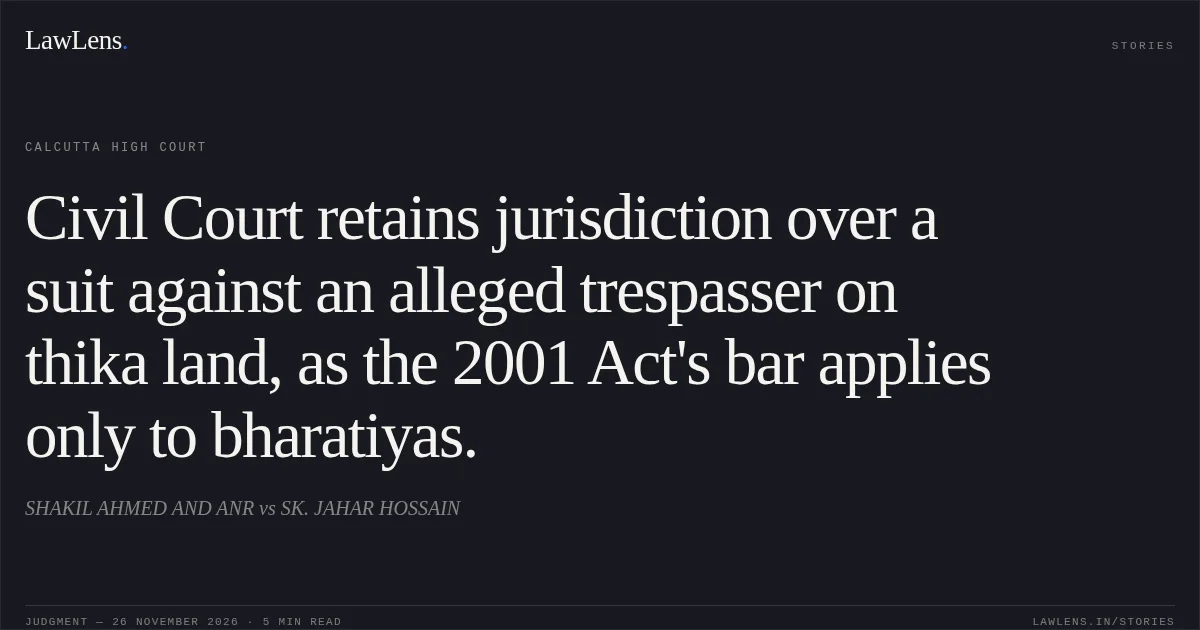
A suit characterising the defendants as trespassers is not barred on the face of the plaint under Section 8(3) or Section 21 of the 2001 Act, and the Order VII Rule 11 application was rightly rejected
p. 14The judgment records that the first and second questions were "answered in favour of the appellant" and the third "against the appellant"
p. 14The fourth question (civil court jurisdiction over trespass suits on thika land) is answered implicitly in the plaintiff's favour on the Order VII Rule 11 standard
p. 14The appeal is dismissed, and the Judgment of the First Appellate Court in Title Appeal No. 53/2023 dated 14 May 2024 is affirmed. The matter is remitted to the Civil Judge (Junior Division), Additional Court, Sealdah, in Title Suit No. 500/2022. The defendants may file a written statement within six weeks, extendable by two weeks in exceptional circumstances
pp. 14–15The Court clarified that its decision concerns only the Order VII Rule 11 application and not the merits of the suit
p. 15Original Court PDF
SHAKIL AHMED AND ANRvsSK. JAHAR HOSSAIN
Click to open original judgment
Original judgment, available to read, download and summarize on LawLens.in