01Facts
The petitioner, as landlord, instituted OC 23 of 2018 in the Court of the Civil Judge (Junior Division), Karseong, seeking eviction of the opposite party, the tenant.
¶ 2The tenant appeared and, on an application under Section 7(1) of the West Bengal Premises Tenancy Act, 1997, was permitted to deposit current rent by the 15th of each succeeding month.
¶ 2The tenant deposited rent accordingly, but the deposits for March 2020 and April 2020 were made on June 10, 2020.
¶ 3The deposits for December 2020, October 2021, December 2021, December 2022 and December 2023 were made on December 8, 2020, October 29, 2021, December 4, 2021, December 5, 2022 and December 18, 2023, respectively.
¶ 3The petitioner applied under Section 7(3) contending that these deposits were illegal under Section 7(1)(c), and sought that the defence be struck out.
¶ 4The trial court rejected the application by the impugned order dated June 29, 2026.
¶ 1, 5The petitioner challenged that order in revision, arguing that the Supreme Court's COVID-19 limitation extension orders cover only judicial filings and not administrative acts such as rent deposits, relying on Arun Brothers v. Sakti Prasanna Chatterjee.
¶ 6–8The tenant argued that the lockdown made timely deposit impossible and that the other deposits were timely.
¶ 902Issues
i.1. Whether the tenant's deposits for March 2020 and April 2020, made on June 10, 2020, breached the mandatory time limit in Section 7(1)(c) so as to attract the penal consequence of Section 7(3), given the COVID-19 lockdown and the Supreme Court's suo motu limitation-extension order.
¶ 6–16ii.2. Whether deposits of rent made within the same month for December 2020, October 2021, December 2021, December 2022 and December 2023 are illegal under Section 7(1)(c).
¶ 1903Law Applied
Section 7(1)(a)–(c) of the West Bengal Premises Tenancy Act, 1997 provides that the tenant's deposit obligation arises on institution of the eviction suit, must be discharged within one month of service of summons or appearance, and requires monthly deposits by the 15th of each succeeding month.
¶ 14Such time limits are mandatory, and breach attracts Section 7(3), as held in Bijay Kumar Singh v. Amit Kumar Chamariya, (2019) 10 SCC 660; Debasish Paul v. Amal Boral, (2024) 2 SCC 169; and Seventh Day Adventist Senior Secondary School v. Ismat Ahmed, 2025 SCC OnLine SC 1696.
¶ 11The Supreme Court's suo motu order of March 23, 2020 in In Re: Cognizance for Extension of Limitation, SMW(C) No. 3/2020, extended limitation periods from March 15, 2020 under Articles 141 and 142 of the Constitution.
¶ 7, 13, 16The maxim lex non cogit ad impossibilia holds that the law does not compel impossible performance, as held in Raj Kumar Dey v. Tarapada Dey, (1987) 4 SCC 398.
¶ 18Section 7(3) is aimed at wilful or negligent defaulters, not at bona fide tenants rendered incapable of compliance.
¶ 21Under Article 227 of the Constitution, the High Court will not interfere with a view that is plausible and possible.
¶ 22Arun Brothers v. Sakti Prasanna Chatterjee, AIR 1983 Cal 129 (Special Bench), holds that the Rent Controller acts administratively in accepting rent deposits.
¶ 20Provisions in the judgment · 1 · Linked ones open on LawLens
West Bengal Premises Tenancy Act, 1997 Section 7
04Reasoning
The Section 7(1)(c) deposits are made in relation to the eviction suit, and their filing requires a challan and an open court registry.
¶ 15–16Although the petitioner's reading of the Supreme Court order appeared plausible at first blush, the court read the order in its entirety and held that it extends the time limits for deposits under Section 7(1)(c).
¶ 13, 17Independently, the due dates for March and April 2020 fell within the strictest phase of the nationwide lockdown, when courts and challan deposits were practically unavailable, so compliance was impossible and the tenant could not be faulted.
¶ 12, 18As to the December 2020 to December 2023 deposits, the court construed "15th of each succeeding month" as a ceiling, not a minimum, so deposits made within the relevant month are not illegal.
¶ 19Arun Brothers was held inapplicable because it concerned the administrative nature of the Rent Controller's acceptance of deposits, not the tenant's timeliness or the COVID-19 context.
¶ 20Because no default occurred, and any delay was not wilful or negligent, Section 7(3) was not attracted.
¶ 21, 22The trial court's view was therefore plausible and possible, warranting no interference under Article 227.
¶ 2205Holding
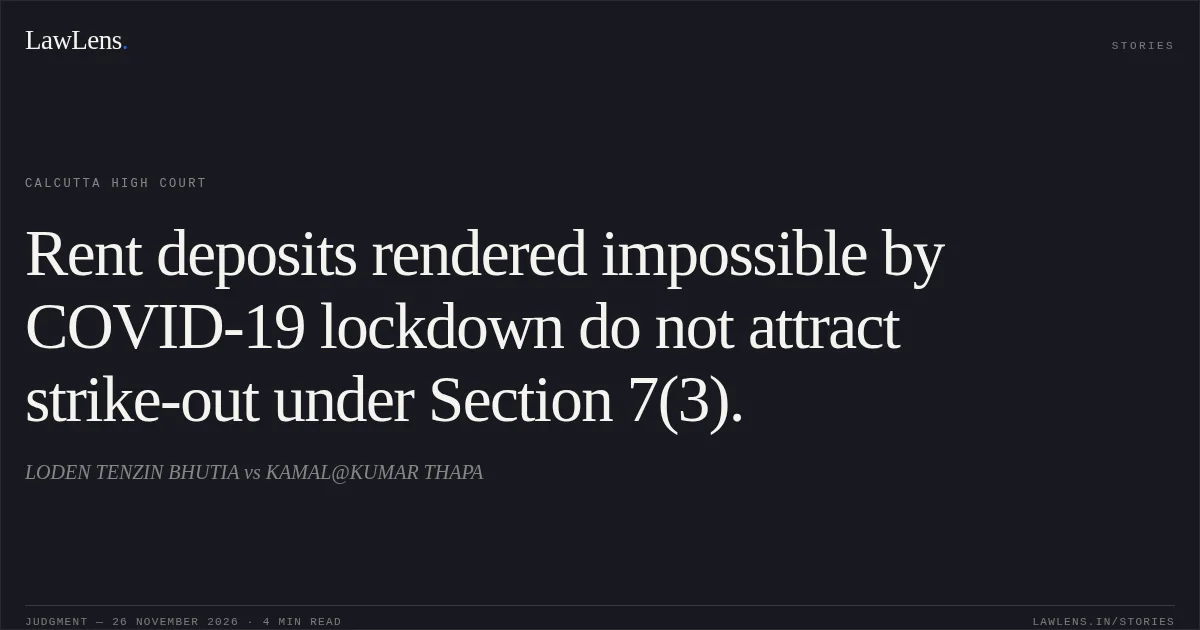
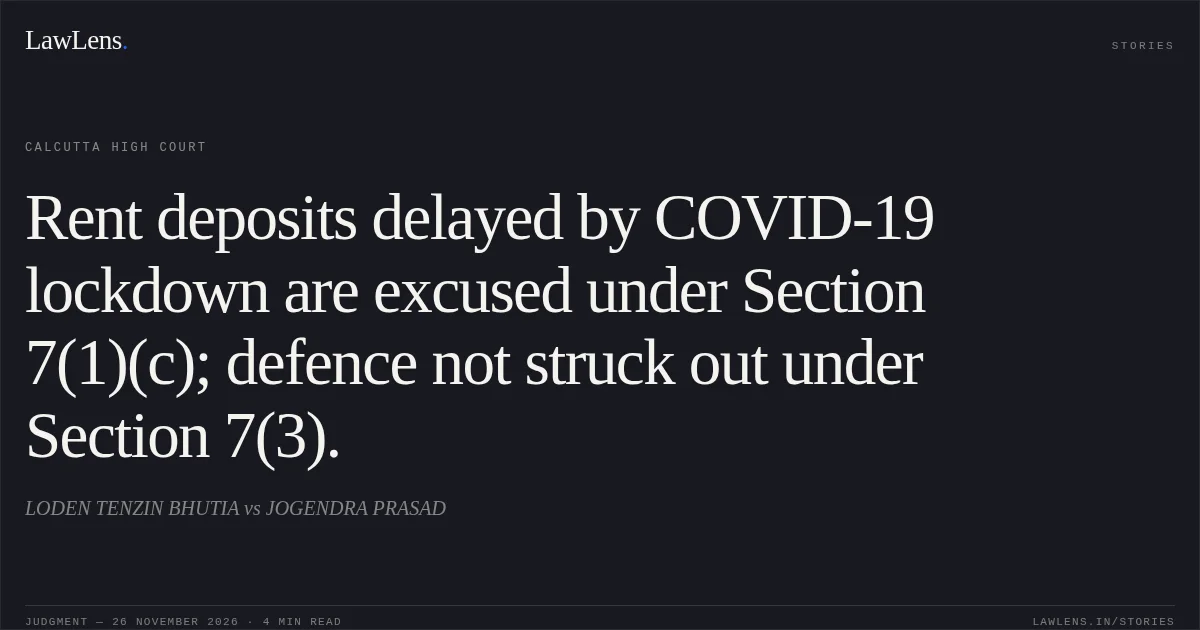
The March and April 2020 deposits, though made on June 10, 2020, do not constitute a breach of Section 7(1)(c) that attracts Section 7(3), because the COVID-19 lockdown made timely deposit impossible and the Supreme Court's extension order covers the period.
¶ 12, 16–18The December 2020, October 2021, December 2021, December 2022 and December 2023 deposits, made within the relevant months, are not illegal. The rigours of Section 7(3) are not attracted, and the trial court's rejection of the petitioner's application is a plausible view.
¶ 19, 21–22C.O. 126 of 2026 is dismissed without costs. The impugned order dated June 29, 2026 stands upheld, and certified copies are to be supplied on application.
¶ 23–24Original Court PDF
LODEN TENZIN BHUTIAvsPOONAM PARVEZ
Click to open original judgment
Original judgment, available to read, download and summarize on LawLens.in