01Facts
The plaintiff-appellant claimed ownership of the suit land under a registered sale deed (No. 2382 of 1995) and alleged that he constructed a two-storied building on the north-west portion, keeping the rest vacant.
p. 2The defendant, his elder brother-in-law, supervised construction while the plaintiff was posted outside Bengal with the BSF.
p. 2After the defendant's house was destroyed in the 2000 flood, the plaintiff allegedly granted him a licence to reside in the suit building on the understanding that he would vacate on the plaintiff's retirement.
p. 2The plaintiff revoked the licence on 11.08.2006 and sought eviction.
p. 3The defendant denied the licence and relied on a photocopy of an unregistered "Bainanama Patra" (agreement for sale) dated 11.06.2001, marked Exhibit M, to claim protection under Section 53A of the Transfer of Property Act, 1882.
p. 5 · p. 15The Trial Court decreed the suit for eviction and held Exhibit M to be a manufactured document, noting that the Gram Panchayat signature on it was dated 29.02.2012, eleven years after the purported execution.
pp. 3–4 · p. 17The First Appellate Court reversed, relying on the photocopy of Exhibit M.
p. 4 · p. 15The plaintiff appealed to the High Court.
p. 402Issues
i.1. Whether the First Appellate Court was justified in allowing the appeal and dismissing the eviction suit by accepting the defendant's Section 53A defence based on Exhibit M, without reversing the Trial Court's finding that the agreement was a manufactured document.
p. 5 · pp. 15–17ii.2. Whether the defendant is entitled to protection under Section 60(b) of the Indian Easements Act, 1882.
pp. 5–6 · pp. 17–2503Law Applied
The Court relied on Section 65 of the Evidence Act, 1872, as construed in H. Siddiqui v. A. Ramalingam (2011), under which secondary evidence of a document is inadmissible unless non-production of the original is explained and the copy is authenticated by foundational evidence.
pp. 6–7The Court applied Section 54 of the TP Act and Narandas Karsondas v. S.A. Kamtan, as cited in Swaraj Lamp and Industries Pvt. Ltd. v. State of Haryana (2012), holding that a contract of sale does not itself create an interest in immovable property.
pp. 8–9The Court applied Section 60(b) of the Indian Easements Act, 1882, which makes a licence irrevocable where the licensee, acting upon it, has executed a work of a permanent character and incurred expenses.
p. 17 · p. 21The Court relied on Panchu Gopal Barua v. Umesh Chandra Goswami (1997) 4 SCC 713, holding that Section 60(b) cannot operate where the Act is not in force, that equitable relief requires clean hands, and that a licence cannot be irrevocable where it prohibited permanent construction.
pp. 10–13 · pp. 21–22The Court applied the "justice, equity and good conscience" principle as the basis for equitable relief.
pp. 22–23The Court relied on Nagubai Ammal v. B. Shama Rao, AIR 1956 SC 593, on the scope of pleadings and issues where parties have gone to trial on an issue.
pp. 23–24Section 23 of the West Bengal Panchayat Act, 1973, which requires prior written Gram Panchayat permission for construction, was also considered.
pp. 17–18Provisions in the judgment · 8 · Linked ones open on LawLens
Transfer of Property Act, 1882 Section 5Section 40Section 54
Indian Easements Act, 1882 Section 60
Specific Relief Act, 1963 Section 3
Indian Trust Act, 1882 Section 91
Registration Act, 1908 Section 49
West Bengal Panchayat Act, 1973 Section 23
04Reasoning
On Issue 1, the Court held that the First Appellate Court erred. It accepted a photocopy of Exhibit M without recording reasons for admitting secondary evidence and without reversing the Trial Court's finding that the document was manufactured.
pp. 15–16That finding, supported by the 2012 Panchayat signature date, stood unrebutted, so the Section 53A defence could not succeed.
pp. 16–17On Issue 2, the Court noted that the plaintiff's own evidence on the absence of Gram Panchayat permission was contradicted by Section 23 of the 1973 Act.
pp. 17–18The Court accepted the defendant's evidence (DW-1, DW-2, DW-3, DW-6 and Exhibit K) that he obtained Panchayat permission and built the structure, with the plaintiff's knowledge, between 2003 and 2006.
pp. 18–20The Court then held that Section 60(b) of the Easements Act does not apply in West Bengal, so the normal answer is negative.
p. 22The Court nonetheless applied equity, finding that both parties lacked clean hands: the plaintiff had not proved the licence terms after construction, and the defendant's residence of about twenty years, with his investment, made eviction harsh and inequitable.
pp. 22–23Relying on Nagubai Ammal, the Court held that the defendant's plea of equitable protection could be entertained despite the absence of a pleaded licence.
pp. 23–24Partial eviction was rejected as impractical and would prolong litigation, so the Court allowed retention of the whole property on payment of compensation.
pp. 24–2505Holding
Issue 1: The First Appellate Court was not justified in accepting the Section 53A defence based on the photocopy of Exhibit M, which the Trial Court had found to be manufactured, and that finding was not reversed. The question is decided in favour of the appellant.
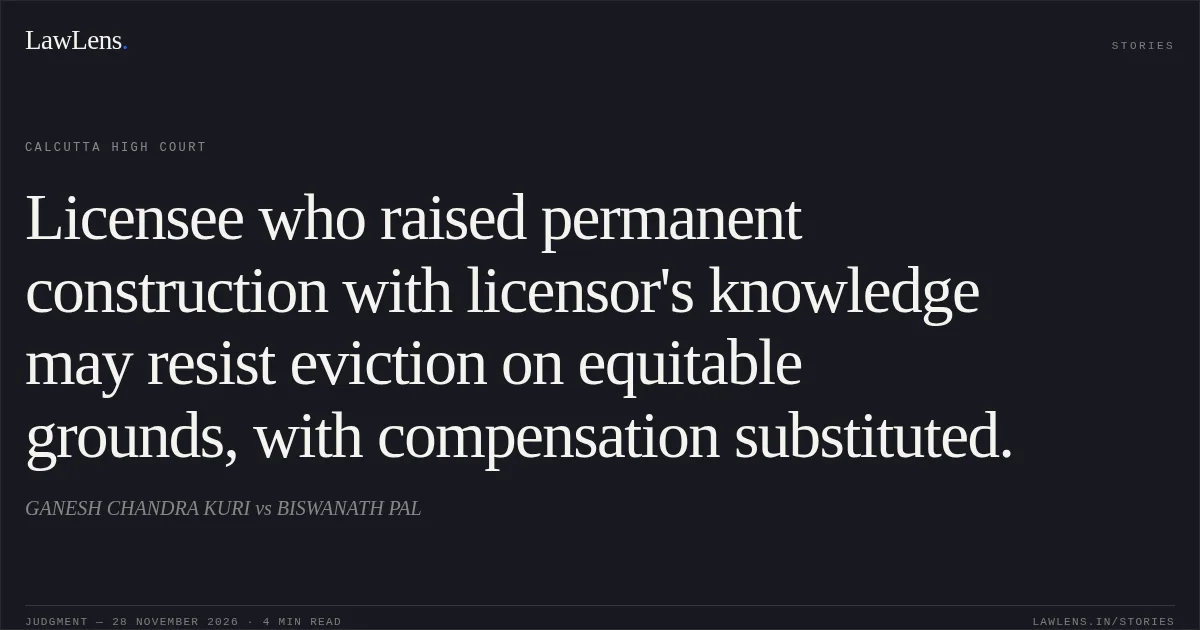
p. 16Issue 2: Section 60(b) of the Indian Easements Act does not apply in West Bengal. Protection is granted only on the principles of justice, equity and good conscience, given the mutual lack of clean hands and the defendant's long occupation and investment. The defendant is not evicted from the entire property.
pp. 22–24Final Order: The appeal (S.A.T. 101 of 2016) is allowed in part. The judgment and decree dated 17.08.2015 are modified. The defendant may retain the suit property on paying the plaintiff Rs. 3,00,000 within two months, failing which the plaintiff may execute the order.
pp. 25–26Original Court PDF
GANESH CHANDRA KURIvsBISWANATH PAL
Click to open original judgment
Original judgment, available to read, download and summarize on LawLens.in