Facts
Indrabhan Singh, a Class IV employee in the Pratapgarh Collectorate, had been untraceable since 8 May 2022.
Source reference: p.1His wife and son challenged the Collector’s order dated 31 December 2024 dismissing him for unauthorised absence, alleging that the disciplinary proceedings were ex parte and that a required newspaper publication had not been made.
Source reference: p.1–2They also sought consideration of claims for salary and service benefits, family pension, and compassionate appointment.
Source reference: p.1–2The State submitted that Singh had a history of unauthorised absence and was an accused in a criminal case in which charges had been framed; it further stated that disciplinary proceedings were conducted, a show-cause notice was published in a newspaper, and no reply was received.
Source reference: p.2–3The Court accepted that the inquiry had proceeded ex parte after the employee failed to participate and that the dismissal order followed.
Source reference: p.3Issues
1. Whether the dismissal of the missing employee for unauthorised absence was liable to be quashed on the ground that the disciplinary proceedings were conducted ex parte.
Source reference: p.2–32. Whether the employee’s legal heirs were entitled to pensionary or other service benefits under the Government Order dated 13 April 2017 despite his dismissal.
Source reference: p.2–43. Whether the authorities should be directed to decide the petitioners’ representations concerning service benefits and compassionate appointment.
Source reference: p.1Law Applied
The petitioners relied on Chapter III, Rule 18 of the Financial Handbook, Volume II (Parts II–IV), the U.P. Punishment and Appeal Rules, 1999, and the Government Order dated 13 April 2017 concerning benefits for a missing employee.
Source reference: p.1–2The judgment does not set out or interpret the text of those provisions, cite any precedent, or formulate a general rule governing missing employees’ benefits.
Source reference: p.3–4Its decision rests on the case-specific conclusion that Singh had been dismissed for unauthorised absence following disciplinary proceedings in which the authorities had taken steps to secure his participation, including newspaper publication of the show-cause notice.
Source reference: p.3–4Reasoning
The Court noted that Singh was untraceable and was also an accused in a criminal case in which a charge sheet had been filed and charges framed.
Source reference: p.3It found that disciplinary proceedings for absence from duty had been initiated, that an inquiry was completed ex parte after Singh failed to cooperate, and that the show-cause notice was published in a newspaper without any reply being submitted.
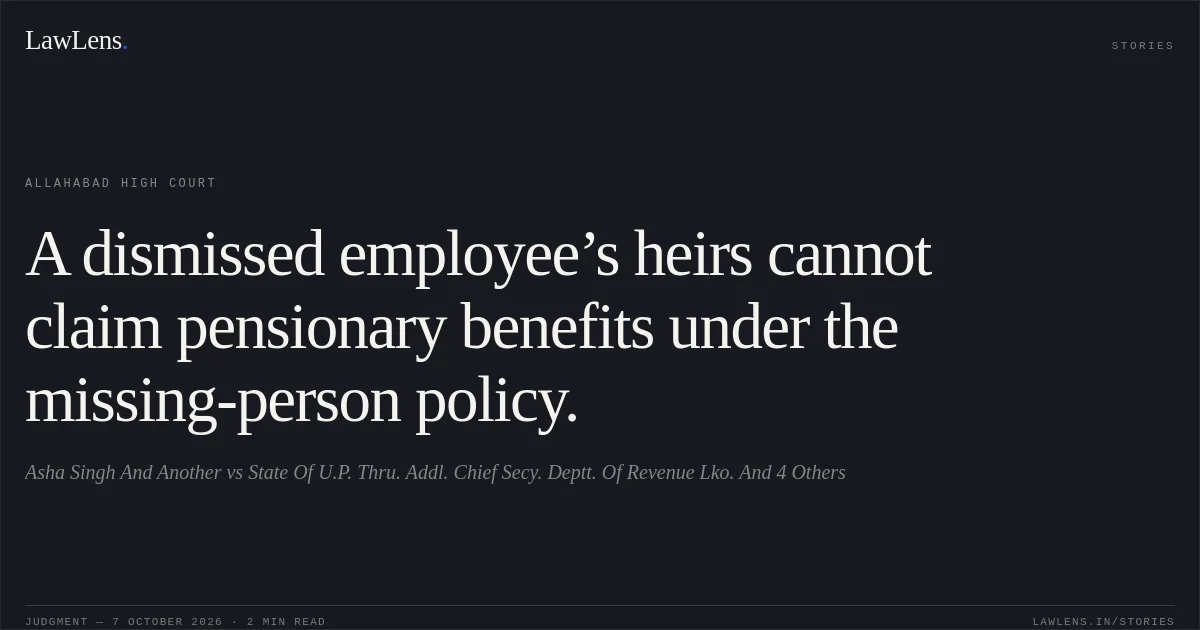
Source reference: p.3In those circumstances, the Court rejected the challenge to the dismissal and held that the petitioners could not obtain pensionary benefits under the cited Government Order because Singh had already been dismissed for unauthorised absence.
Source reference: p.4The judgment did not separately analyse the requested representations or compassionate appointment.
Source reference: p.4Holding
The Court dismissed the petition as misconceived.
It declined to quash the dismissal order or grant the requested service and pensionary relief to the petitioners, the legal heirs of the dismissed employee.
Source reference: p.4Acts & Sections Cited
9 provisions across 3 statutes referred to in this judgment. Each provision opens on LawLens.
Indian Penal Code, 18604
Scheduled Castes and the Scheduled Tribes (Prevention of Atrocities) Act, 19893
Original Court PDF
Asha Singh And AnothervsState Of U.P. Thru. Addl. Chief Secy. Deptt. Of Revenue Lko. And 4 Others
Click to open original judgment
Original judgment, available to read, download and summarize on LawLens.in