Facts
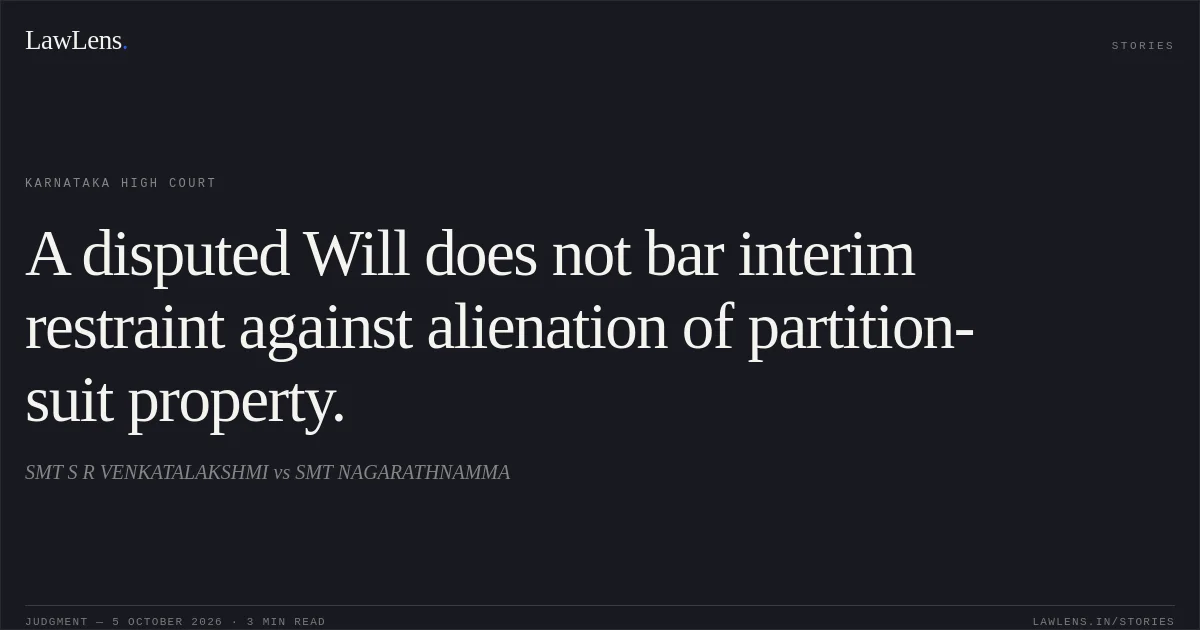
The petitioners, daughters of late S.R. Ramaswamy, filed a partition suit against their mother and brother, claiming that the suit properties were their father’s self-acquired properties and seeking partition and separate possession.
Source reference: para. 3–4They sought a temporary injunction restraining alienation of the properties; the Trial Court granted it, but the Appellate Court allowed the defendants’ miscellaneous appeal and set aside the injunction, principally because the plaintiffs had not disclosed an alleged 1995 Will in the plaint.
Source reference: para. 3–4The plaintiffs challenged that order under Articles 226 and 227 of the Constitution.
Source reference: para. 3–4An interim injunction granted by the High Court on 8 April 2019 had remained in force during the proceedings.
Source reference: para. 11Issues
1. Whether the Appellate Court was justified in setting aside the Trial Court’s discretionary order granting an injunction against alienation of the suit properties.
Source reference: para. 4–5, 8–102. Whether the plaintiffs’ alleged failure to disclose the Will in the plaint, by itself, justified denying interim protection.
Source reference: para. 4, 9Law Applied
Under Order XXXIX Rules 1 and 2 of the Code of Civil Procedure, 1908, temporary injunctive relief may be granted to preserve the subject matter of a suit pending adjudication.
Source reference: para. 3An appellate court exercising jurisdiction under Order XLIII Rule 1(r) CPC may interfere with a discretionary injunction order where the discretion was exercised arbitrarily, capriciously, perversely, or contrary to settled principles; it may not substitute its discretion merely because another view is possible.
Source reference: para. 10In a dispute concerning a Will, its validity, genuineness, and due execution are matters for adjudication at trial, and the propounder must establish the Will in accordance with law.
Source reference: para. 6The High Court may intervene under Articles 226 and 227 where the impugned order discloses material irregularity or perversity.
Source reference: para. 12The Appellate Court’s reliance on Prakash and others v. Pulavathi, AIR 2016 SC 769, was held not to justify mechanically denying interim protection without examining the relevant circumstances.
Source reference: para. 4, 9Reasoning
The defendants relied on the alleged Will to resist the partition claim, but its validity and effect had not been adjudicated and were matters for trial.
Source reference: para. 6–7The injunction application sought only to prevent alienation and preserve the properties; permitting alienation could create third-party rights and complicate enforcement of any eventual decree, whereas maintaining the injunction would not prevent the defendants from proving the Will.
Source reference: para. 6–7The alleged omission of the Will from the plaint did not, in the circumstances, determine whether the properties should be preserved pending suit and did not warrant denying interim protection.
Source reference: para. 9The Trial Court’s order reflected a proper exercise of discretion, and the Appellate Court had identified no legally sufficient ground for interfering with it.
Source reference: para. 8–10The continuing interim protection and the pending status of the suit further weighed against unsettling the existing arrangement.
Source reference: para. 11Holding
The High Court answered the issues in favour of the petitioners.
It allowed the writ petition, quashed the Appellate Court’s order dated 6 February 2019, and restored the Trial Court’s order restraining the defendants from alienating the suit properties.
Source reference: para. 13(i)–(iii)The Court clarified that its observations were confined to the interlocutory application, left all contentions open, and directed the parties to cooperate in the expeditious disposal of the suit.
Source reference: para. 13(iv)–(v)Original Court PDF
SMT S R VENKATALAKSHMIvsSMT NAGARATHNAMMA
Click to open original judgment
Original judgment, available to read, download and summarize on LawLens.in