Facts
The appellant developer and the respondent allottee executed an Allotment Letter-cum-Agreement on 28 May 2014 for a studio apartment. It contained an arbitration clause providing for arbitration in New Delhi by a sole arbitrator appointed by the appellant.
Source reference: pp. 2–3, para. 5On the same date, the parties executed a separate Monthly Investment Return Assurance Agreement, which provided that its terms would supersede the Allotment Letter where applicable or in conflict and conferred exclusive jurisdiction on Delhi courts, without expressly providing for arbitration.
Source reference: pp. 3–4, paras. 6–7After the appellant stopped paying assured returns, the respondent sued for recovery of amounts paid towards the apartment and unpaid returns.
Source reference: pp. 4–6, paras. 9–13The appellant applied under Section 8 of the Arbitration and Conciliation Act, 1996, for referral to arbitration; the Trial Court dismissed the application, finding that the later agreement superseded the arbitration clause.
Source reference: pp. 4–6, paras. 9–13Issues
1. Whether the dispute in the suit was prima facie covered by the arbitration clause in the Allotment Letter, warranting referral under Section 8 of the Arbitration and Conciliation Act, 1996.
Source reference: p. 10, paras. 20–222. Whether the Trial Court could determine conclusively, at the Section 8 stage, that the later Assurance Agreement superseded the arbitration clause.
Source reference: pp. 10–11, paras. 21–22Law Applied
Section 8 of the Arbitration and Conciliation Act, 1996, requires a judicial authority to refer parties to arbitration where the action concerns a matter covered by an arbitration agreement, unless it finds prima facie that no valid arbitration agreement exists; Section 5 limits judicial intervention in matters governed by Part I to intervention permitted by the Act.
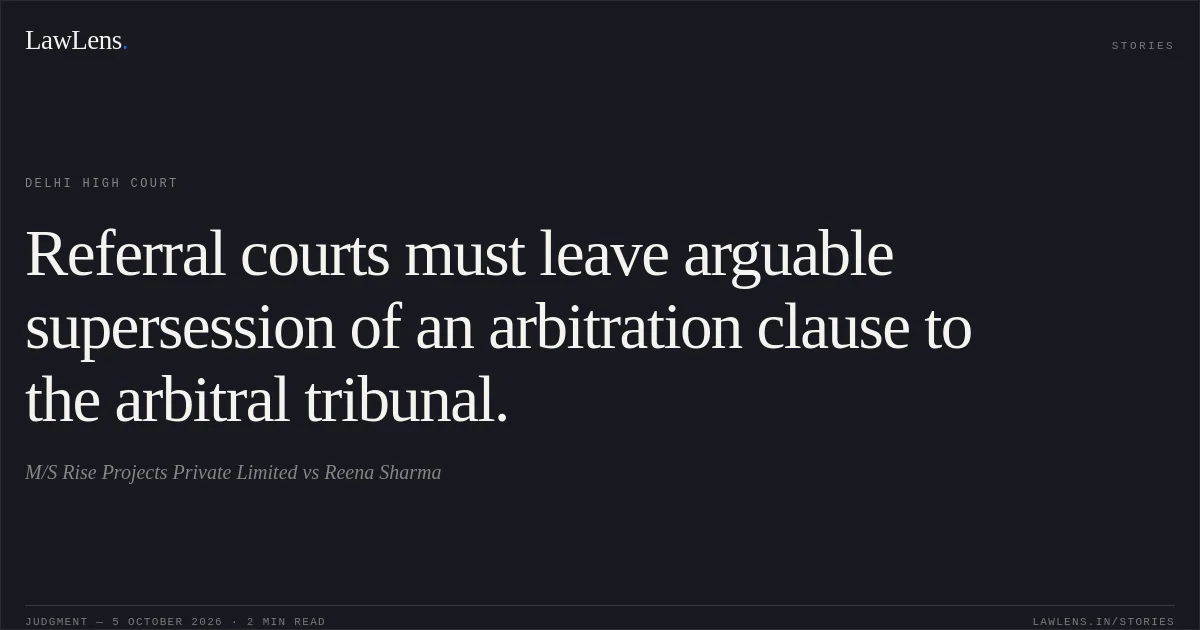
Source reference: p. 7, para. 16Under Vidya Drolia v. Durga Trading Corporation, referral courts should avoid a mini-trial or elaborate review and ordinarily refer the matter where objections to arbitrability are arguable—“when in doubt, do refer”.
Source reference: pp. 7–8, para. 17In Re: Interplay between Arbitration Agreements under the Arbitration and Conciliation Act, 1996 and the Indian Stamp Act, 1899 and SBI General Insurance Co. Ltd. v. Krish Spinning affirm the limited scope of referral-stage review and the arbitral tribunal’s competence to rule on its own jurisdiction under Section 16.
Source reference: pp. 8–10, paras. 18–19Reasoning
The respondent’s principal claim sought cancellation of the allotment and refund of the amount paid for the apartment, bringing the core dispute prima facie within the Allotment Letter’s express arbitration clause; the claim for unpaid assured returns was treated as consequential damages.
Source reference: p. 10, para. 20The Trial Court nevertheless resolved the contractual interplay between the two agreements and concluded that the arbitration clause had no legal effect. The High Court held that this conclusive inquiry exceeded the limited review appropriate under Section 8: the court was required only to assess whether the dispute was prima facie covered by an arbitration agreement, leaving substantive questions for the arbitral tribunal.
Source reference: pp. 10–11, paras. 21–22Holding
The High Court allowed the appeal, set aside the Trial Court’s order, and allowed the appellant’s Section 8 application, referring the parties to arbitration.
It directed that the arbitrator be appointed in accordance with the Arbitration and Conciliation Act, 1996, and left all substantive contentions open for determination by the tribunal, uninfluenced by the judgment’s observations.
Source reference: p. 11, paras. 25–26Acts & Sections Cited
6 provisions across 1 statute referred to in this judgment. Each provision opens on LawLens.
Arbitration and Conciliation Act, 19966
Original Court PDF
M/S Rise Projects Private LimitedvsReena Sharma
Click to open original judgment
Original judgment, available to read, download and summarize on LawLens.in