Facts
The petitioner challenged preventive-detention proceedings initiated against him under the Bihar Control of Crimes Act, 2024. On 5 December 2025, the Sub-Divisional Police Officer, Barh-1 recommended action against the petitioner; the recommendation was endorsed by superior police authorities and forwarded to the District Magistrate, Patna.
Source reference: para. 10On 10 December 2025, the District Magistrate passed a detention order in B.C.C.A. Case No. 1-09/2025 under Section 12(2), issued through Memo No. 7987 dated 11 December 2025, and the petitioner was detained in Bhagalpur Central Jail.
Source reference: para. 11The State Government subsequently considered the Advisory Board’s opinion, confirmed the detention for the period from 11 December 2025 to 10 June 2026, and rejected the petitioner’s representation.
Source reference: para. 12During the pendency of the writ petition, the Senior Superintendent of Police, Patna submitted a fresh proposal dated 4 June 2026. On its basis, the District Magistrate passed an order dated 6 June 2026 directing the petitioner’s detention for a further period of six months with effect from 11 June 2026.
Source reference: para. 13Issues
1. Whether the initial preventive-detention order suffered from jurisdictional infirmity, procedural illegality, non-application of mind, or failure to satisfy the statutory requirements under the Bihar Control of Crimes Act, 2024?
Source reference: para. 19(i)2. Whether the petitioner qualified as an “anti-social element” under Section 2(b) of the Act on the basis of the criminal cases, charge-sheets, pending investigations, Sanha entries, and other material relied upon by the detaining authority?
Source reference: para. 59(i)3. Whether the material relied upon disclosed activities prejudicial to the maintenance of “public order,” as distinct from ordinary “law and order,” so as to justify preventive detention?
Source reference: paras. 19(ii), 59(iii), 104–1134. Whether the petitioner’s constitutional and statutory safeguards, including consideration of his representation and reference to the Advisory Board, were duly complied with?
Source reference: paras. 19(ii), 59(iv), 132(e)5. Whether, after expiry of the initial period of detention confirmed by the State Government, the District Magistrate had authority to pass the subsequent detention order dated 6 June 2026?
Source reference: paras. 19(iii), 59(v)6. Whether the Government notification dated 24 March 2026 issued under Section 12(2) authorised the District Magistrate to pass the subsequent detention order?
Source reference: paras. 19(iv), 128–131Law Applied
The Court applied Sections 2(b), 2(f) and 12 of the Bihar Control of Crimes Act, 2024. Section 2(b) defines an “anti-social element,” while Section 2(f) requires that, during the preceding twenty-four months, at least two cases involving specified offences must have resulted in police reports being filed before a court. Section 12 permits the State Government to order preventive detention and authorises a District Magistrate to exercise that power when empowered by the State Government under Section 12(2), subject to statutory approval and safeguards.
Source reference: para. 21Preventive detention is distinct from punitive prosecution, and its validity depends on the detaining authority’s independent subjective satisfaction based on relevant material, as recognised in Haradhan Saha v. State of West Bengal, (1975) 3 SCC 198.
Source reference: paras. 85–86The Court also applied the principles from Ahamed Nassar v. State of Tamil Nadu, (1999) 8 SCC 473, and K.S. Nagamuthu v. State of Tamil Nadu, (2006) 4 SCC 792, requiring consideration of all relevant material and prohibiting mechanical decision-making.
Source reference: paras. 37–38, 90The distinction between law and order and public order was applied in accordance with Rekha v. State of Tamil Nadu, (2011) 5 SCC 244, Sayed Abdul Ala v. Union of India, (2007) 15 SCC 208, and Kuso Sah v. State of Bihar, while Vijay Narain Singh v. State of Bihar, (1984) 3 SCC 14, was relied upon for the principle that habitual conduct involves repeated or persistent acts showing continuity.
Source reference: paras. 39–41, 83, 106–110Reasoning
The Court held that the statutory definition under Section 2(b) did not require prior conviction. The petitioner’s criminal antecedents, charge-sheets, pending investigations, police dossier, and other contemporaneous material were capable of cumulatively supporting the District Magistrate’s satisfaction that he was an anti-social element; charge-sheets were relevant even though they did not establish guilt, and pending cases or Sanha entries could be considered as corroborative material rather than as sole proof.
Source reference: paras. 94–103The Court further found that the detention order was not based on isolated incidents but on an alleged continuing pattern of criminal activity that generated fear and insecurity among local residents and affected the normal tempo of community life. Accordingly, the activities were held capable of extending beyond private disputes and entering the field of public order.
Source reference: paras. 104–113The allegation that the District Magistrate merely adopted the police proposal was rejected because the order referred to the criminal antecedents, nature and status of the cases, surrounding circumstances, and their perceived impact on public order, indicating independent consideration.
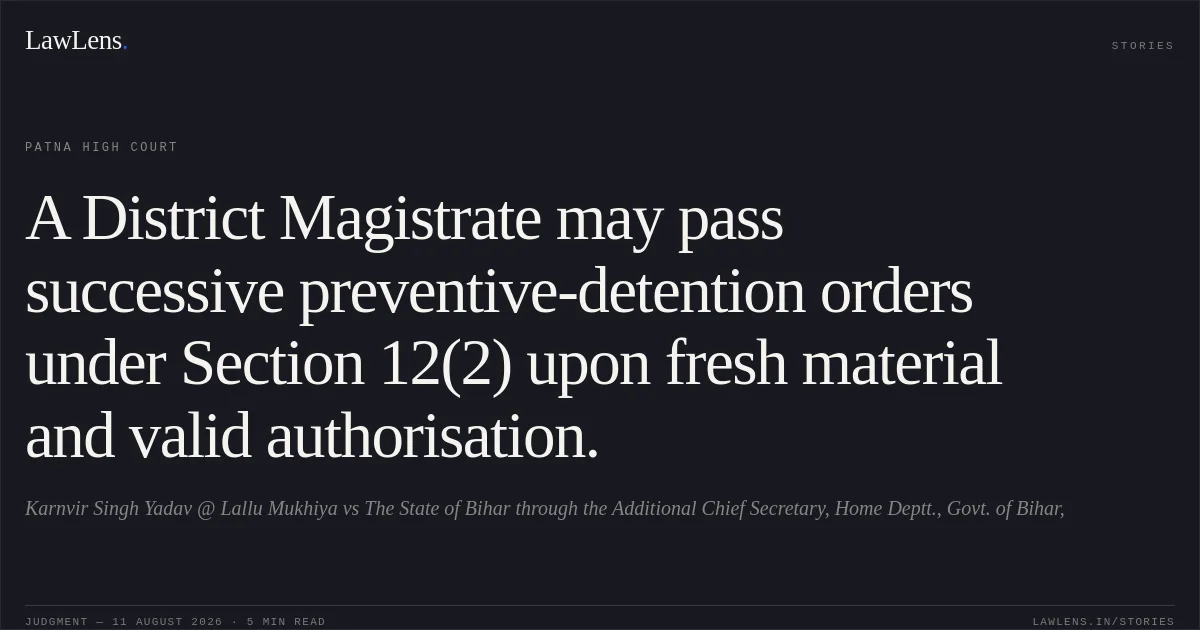
Source reference: paras. 114–121Regarding the subsequent order, the Court treated it as a fresh detention order based on fresh material rather than as a mere continuation of the earlier detention. It held that Section 12 did not prohibit successive orders and that the notification dated 24 March 2026 validly empowered District Magistrates to exercise the detention power within their jurisdiction. Since no jurisdictional defect or procedural violation was demonstrated, the subsequent order was upheld.
Source reference: paras. 122–131Holding
The Patna High Court dismissed the writ petition. It held that the petitioner was validly treated as an “anti-social element” under Section 2(b), that the material before the District Magistrate was sufficient to support subjective satisfaction concerning disturbance of public order, and that the detention order was not vitiated by non-application of mind.
The Court further held that the petitioner’s representations and the Advisory Board procedure complied with the constitutional and statutory safeguards.
Source reference: para. 132(e)It upheld the District Magistrate’s authority to pass the subsequent detention order dated 6 June 2026 pursuant to Section 12(2) and the notification dated 24 March 2026.
Source reference: paras. 126–131Consequently, both the initial and subsequent detention orders were sustained, the writ petition was dismissed, and there was no order as to costs.
Source reference: paras. 133–135Acts & Sections Cited
7 provisions across 2 statutes referred to in this judgment. Linked provisions open on LawLens.
Bihar Control of Crimes Act, 20244
Bihar Control of Crimes Act, 19813
Original Court PDF
Karnvir Singh Yadav @ Lallu MukhiyavsThe State of Bihar through the Additional Chief Secretary, Home Deptt., Govt. of Bihar,
Click to open original judgment
Original judgment, available to read, download and summarize on LawLens.in