Facts
The petitioner challenged a Family Court, Erode order directing him to pay maintenance of ₹5,000 per month to each respondent and ₹10,000 towards litigation expenses.
Source reference: p. 1–3He contended that his wife was employed, had deserted him, and could maintain herself; that his own income and agricultural resources were limited; and that the son had attained majority.
Source reference: p. 1–3The judgment records that the marriage took place on 11 June 2003, the son was born on 20 July 2004, and the impugned order was made in M.C. No. 31 of 2022.
Source reference: p. 1–3The petitioner sought to have that order set aside.
Source reference: p. 1–3The judgment’s prayer section describes the challenged order as dated 24 February 2016.
Source reference: p. 1Issues
Whether the Family Court’s maintenance order suffered from illegality, material irregularity, or perversity warranting interference in revision
Source reference: p. 3Whether the wife’s alleged income, the petitioner’s claimed limited means, and the delay in bringing the maintenance claim justified setting aside or reducing the award
Source reference: p. 5–6Whether the son’s attainment of majority affected his entitlement to maintenance under the applicable statutory conditions
Source reference: p. 6Law Applied
The revision was brought under Sections 438 and 442 of the Bharatiya Nagarik Suraksha Sanhita, 2023.
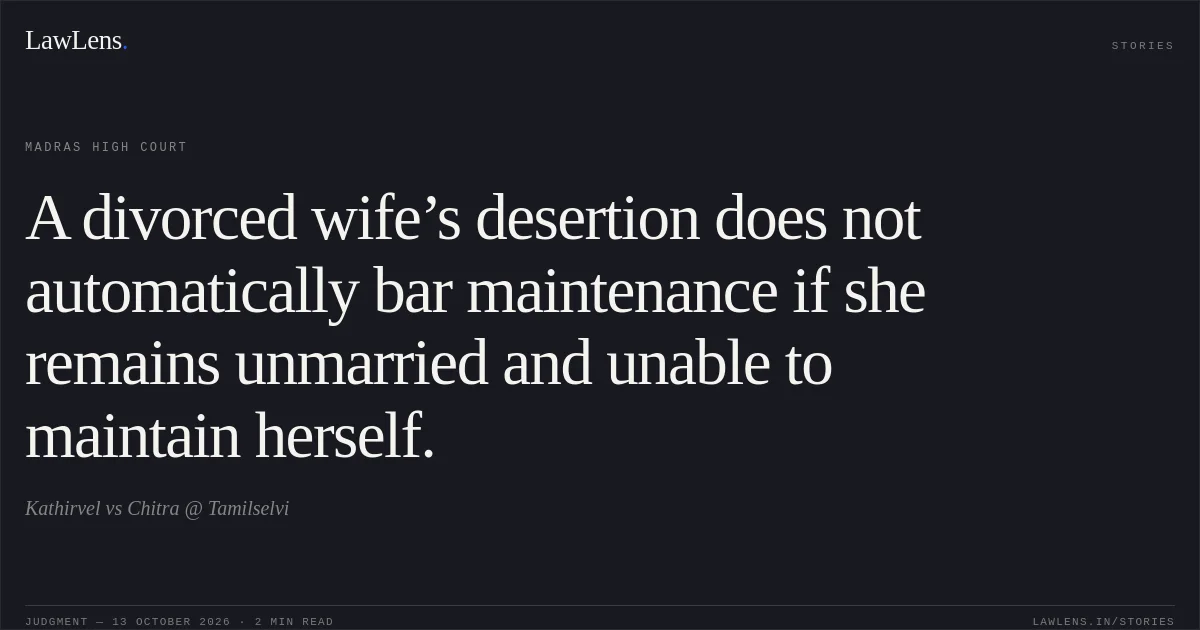
Source reference: p. 2The Court referred to the maintenance principles in Section 125 CrPC, including Explanation (b) to Section 125(1) and the disqualifications in Section 125(4): a divorced wife who has not remarried and is unable to maintain herself may claim maintenance, and desertion leading to divorce does not, by itself, bar that claim.
Source reference: p. 3–5The Court relied on Rohtash Singh v. Ramendri (Smt.) and Others, (2000) 3 SCC 180.
Source reference: p. 3–5It also stated that a major son’s entitlement is subject to statutory conditions, including physical or mental abnormality or injury that renders him unable to maintain himself, where applicable.
Source reference: p. 6Revisional interference is not a rehearing on merits; it is warranted where the order suffers from illegality, material irregularity, perversity, or failure to consider relevant material.
Source reference: p. 6–7Reasoning
The Court held that the wife’s alleged separation from the petitioner and the assertion that she earned ₹15,000 per month did not, without assessment of her actual financial circumstances, establish that she was disentitled to maintenance.
Source reference: p. 3–5It considered the petitioner’s asserted ownership of approximately 1½ acres and cattle-rearing livelihood insufficient, on the grounds presented, to show that the award was excessive or unreasonable; actual income, assets, liabilities, and the claimants’ needs were relevant.
Source reference: p. 5Delay in filing did not automatically extinguish a sustainable maintenance claim.
Source reference: p. 6Although the son’s majority required consideration of the statutory conditions for continued entitlement, the Court concluded that this fact did not establish that the entire order should be set aside.
Source reference: p. 6It found no sufficient revisional ground to disturb the Family Court’s order.
Source reference: p. 6–7Holding
The Court dismissed the criminal revision and confirmed the Family Court’s order directing payment of ₹5,000 per month to each respondent and ₹10,000 towards litigation expenses.
There was no order as to costs.
Source reference: p. 7Acts & Sections Cited
3 provisions across 2 statutes referred to in this judgment. Each provision opens on LawLens.
Bharatiya Nagarik Suraksha Sanhita, 20232
Code of Criminal Procedure, 19731
Original Court PDF
KathirvelvsChitra @ Tamilselvi
Click to open original judgment
Original judgment, available to read, download and summarize on LawLens.in