Facts
The complainant alleged that the applicant repeatedly subjected her to forcible sexual assault and rape while she was working in or visiting agricultural fields. After developing abdominal pain, she was medically examined and found to be pregnant. She thereafter disclosed the alleged incidents to her family, leading to registration of FIR I-C.R. No. 11197057250978 of 2025 at Vaghodiya Police Station under Section 64(2)(m) of the Bharatiya Nyaya Sanhita, 2023 (“BNS”).
Source reference: paras. 5.1–5.2; pp. 2–3Following investigation, a chargesheet was filed and Sessions Case No. 37 of 2025 was instituted before the Additional Sessions Court, Savli.
Source reference: para. 5.2; p. 4The applicant filed an application for discharge under Section 250 of the Bharatiya Nagarik Suraksha Sanhita, 2023 (“BNSS”), contending principally that the DNA report excluded him as the biological father of the foetus, that the FIR was delayed by approximately five months, and that the complainant’s statements contained material contradictions.
Source reference: para. 6; pp. 4–6The Trial Court rejected the discharge application. The applicant consequently invoked the revisional jurisdiction of the High Court under Sections 438 and 442 of the BNSS, also seeking quashing of the charge framed in the Sessions Case.
Source reference: paras. 3 and 6.1; pp. 1, 6Issues
1. Whether the Trial Court erred in rejecting the applicant’s discharge application despite the DNA report allegedly excluding him as the biological father of the foetus, the delay in lodging the FIR, and the alleged inconsistencies in the complainant’s statements?
Source reference: paras. 6, 8–12; pp. 4–6, 8–132. Whether the materials collected during investigation disclosed a prima facie case or raised a strong suspicion sufficient to proceed against the applicant for the alleged offence under Section 64(2)(m) of the BNS?
Source reference: paras. 8, 10–12; pp. 8, 11–133. Whether the High Court should exercise revisional jurisdiction to interfere with the order rejecting discharge and the subsequent framing of charge?
Source reference: paras. 9–12; pp. 9–13Law Applied
The Court applied Sections 438 and 442 of the BNSS governing criminal revision, and Section 250 of the BNSS concerning discharge in a Sessions case.
Source reference: paras. 3, 6; pp. 1, 4The alleged substantive offence was under Section 64(2)(m) of the BNS.
Source reference: para. 5.1; p. 2At the discharge or charge-framing stage, the Court is not required to conduct a mini-trial or assess the reliability and evidentiary value of the prosecution material in detail; it must only determine whether the material discloses a prima facie case or raises a strong suspicion against the accused.
Source reference: para. 8; p. 8Relying on Amit Kapoor v. Ramesh Chander, (2012) 9 SCC 460, Sajjan Kumar v. Central Bureau of Investigation, (2010) 9 SCC 368, and K. Ravi v. State of Tamil Nadu, AIR 2024 SC 4074, the Court held that revisional interference is limited and warranted only in cases of patent illegality, perversity, non-compliance with law, absence of evidence, or arbitrary exercise of judicial discretion.
Source reference: paras. 9–9.2; pp. 9–11Reasoning
The High Court found that the complainant had specifically named the applicant and alleged that he had committed rape upon her on several occasions.
Source reference: para. 10; p. 11Her allegations were supported, at the prima facie stage, by statements of family members to whom she had disclosed the incident, the statement of the applicant’s brother regarding the applicant’s sexual relationship with the complainant, and the medical material relating to both parties.
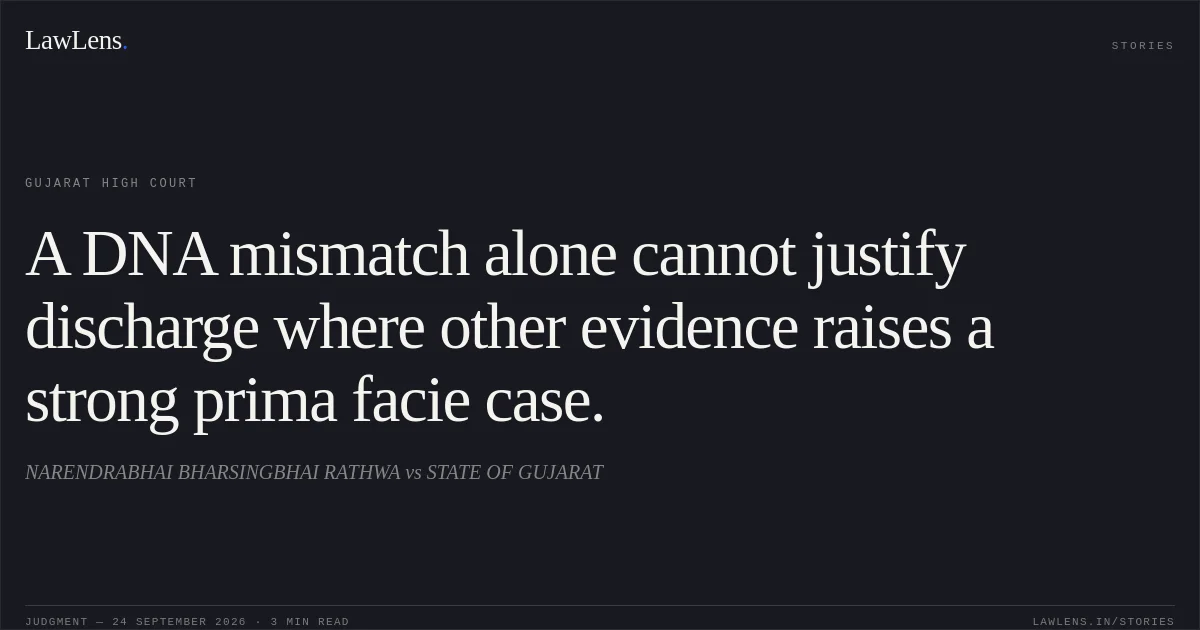
Source reference: para. 10; pp. 11–12Although the DNA report did not match the applicant with the foetus, the Court held that the prosecution case involved allegations of repeated sexual assaults and could not be rejected solely on the basis of the DNA result at the preliminary stage.
Source reference: para. 10; p. 12The applicant’s arguments concerning delay, contradictions, and the reliability of the scientific evidence involved appreciation of evidence and possible defences, which were matters for trial rather than discharge.
Source reference: paras. 8, 10–12; pp. 8, 12–13Since the Trial Court had considered the relevant material and recorded cogent reasons, its order did not suffer from jurisdictional error, perversity, illegality, or material irregularity warranting revisional interference.
Source reference: paras. 11–12; pp. 12–13Holding
The Court held that the chargesheet disclosed sufficient prima facie material and raised more than a mere suspicion regarding the applicant’s involvement in the alleged offence.
It therefore declined to interfere with the Trial Court’s rejection of the discharge application or with the proceedings in the Sessions Case.
Source reference: paras. 11–12; pp. 12–13The Criminal Revision Application was dismissed, the order of the 9th Additional Sessions Judge, Vadodara at Savli, below Exhibit 7 was confirmed, and the Rule was discharged.
Source reference: para. 13; p. 14The Court clarified that its observations were confined to the revision proceedings and would not influence the Trial Court during the trial on merits.
Source reference: para. 14; p. 14Acts & Sections Cited
9 provisions across 3 statutes referred to in this judgment. Each provision opens on LawLens.
Bharatiya Nagarik Suraksha Sanhita, 20233
Bharatiya Nyaya Sanhita, 20231
Code of Criminal Procedure, 19735
Original Court PDF
NARENDRABHAI BHARSINGBHAI RATHWAvsSTATE OF GUJARAT
Click to open original judgment
Original judgment, available to read, download and summarize on LawLens.in