Facts
The prosecution alleged that the appellant, who was married to the deceased for about three years, had subjected her to physical and mental harassment, including demanding money and pledging her gold ornaments.
Source reference: p. 3–5It alleged that on 20 January 2016 he poured petrol on her and set her on fire after she refused to hand over her mangalya chain; she died of her injuries on 24 January 2016.
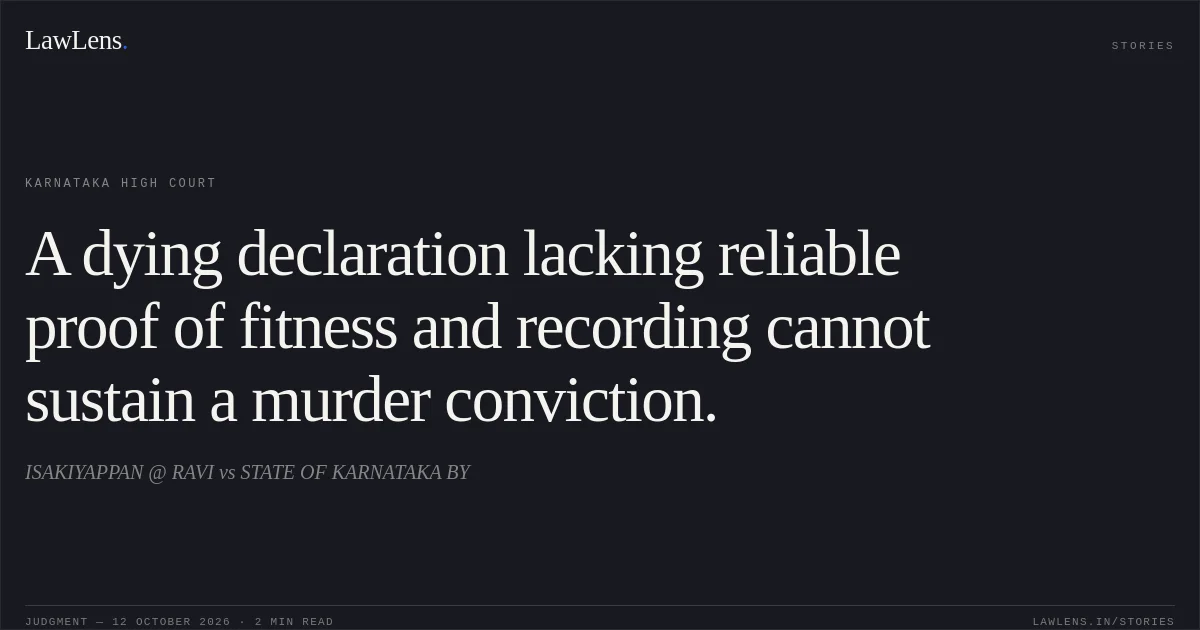
Source reference: p. 3–5The trial court convicted him under Sections 498-A and 302 of the Indian Penal Code (IPC), relying principally on the deceased’s statement recorded in hospital, marked Exhibit P6.
Source reference: p. 5–6The appellant challenged the conviction and sentence on appeal.
Source reference: p. 2Issues
Whether Exhibit P6 was a reliable dying declaration sufficient to establish beyond reasonable doubt that the appellant caused the deceased’s death.
Source reference: p. 10–13Whether the evidence established the offence of cruelty under Section 498-A IPC.
Source reference: p. 13Law Applied
The Court considered Section 302 IPC, concerning murder, and Section 498-A IPC, concerning a husband’s cruelty to his wife.
Source reference: p. 2–3, 13In assessing Exhibit P6, it examined whether the deceased was conscious and fit to make the statement and whether the circumstances of its recording supported its reliability.
Source reference: p. 10–13The judgment cited no precedent; its determination rested on the evidence and circumstances concerning the declaration and the other testimony on record.
Source reference: p. 10–13Reasoning
The Court found that the deceased had reportedly been considered unfit to give a statement on the day of the incident, but the prosecution produced no medical records showing her subsequent condition or treatment.
Source reference: p. 10–13The doctor who certified her fitness when Exhibit P6 was recorded and the police officer who wrote the statement in Kannada from the deceased’s Tamil account were not examined.
Source reference: p. 10–13The Court also noted that the deceased died the following day and that other witnesses’ evidence raised the possibility of suicide. These circumstances meant Exhibit P6 did not inspire confidence and could not sustain the Section 302 conviction.
Source reference: p. 10–13By contrast, the house owner’s evidence that the appellant quarrelled with and physically assaulted the deceased when she would not give him money for alcohol was not challenged in cross-examination; the Court held this evidence established the ingredients of Section 498-A.
Source reference: p. 13Holding
The appeal was allowed in part.
The Court set aside the appellant’s conviction and sentence under Section 302 IPC, but confirmed his conviction and sentence under Section 498-A IPC.
Source reference: p. 13–14It also granted set-off for the period of imprisonment already undergone.
Source reference: p. 13–14Acts & Sections Cited
3 provisions across 2 statutes referred to in this judgment. Each provision opens on LawLens.
Code of Criminal Procedure, 19731
Indian Penal Code, 18602
Original Court PDF
ISAKIYAPPAN @ RAVIvsSTATE OF KARNATAKA BY
Click to open original judgment
Original judgment, available to read, download and summarize on LawLens.in