Facts
Hari Shankar was employed as a conductor with the Delhi Transport Corporation (DTC) from 21 May 1985. During a vigilance inspection on 29 March 1994, he was allegedly found to have re-issued old and used tickets to passengers after collecting fare and was also found carrying several punched tickets. A charge-sheet was issued alleging dishonesty, financial loss to DTC, breach of rules, and conduct prejudicial to DTC’s prestige.
Source reference: p.2–3, paras 2–3Following a departmental enquiry, in which he was found guilty, he was dismissed from service with effect from 10 October 1995.
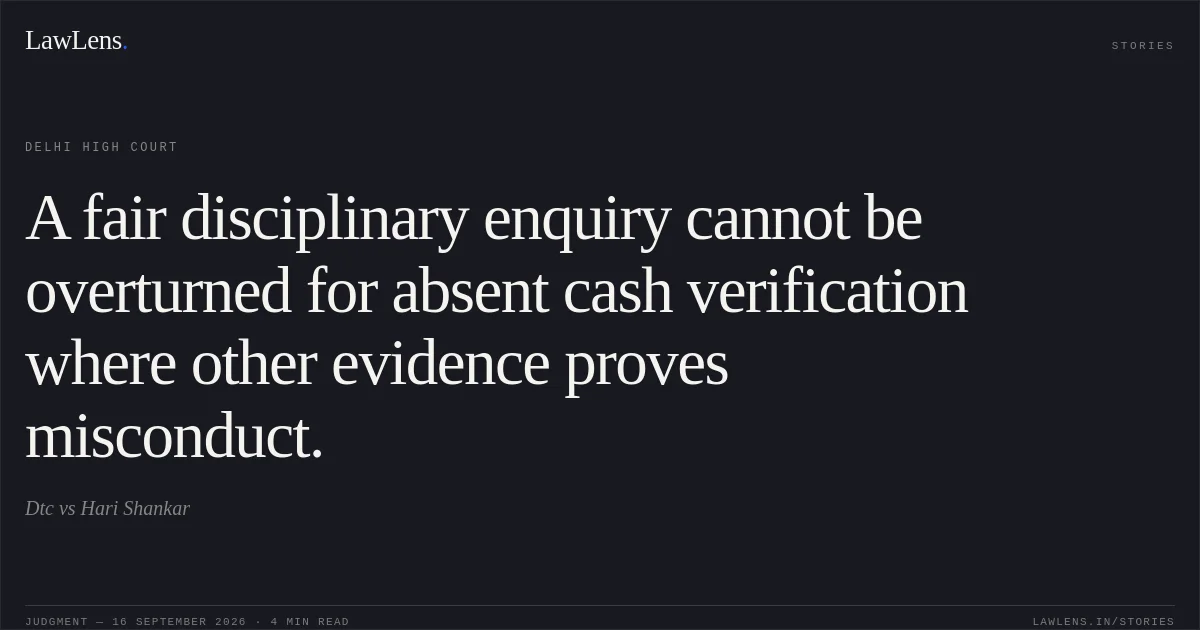
Source reference: p.3, para 3The Labour Court held that the enquiry was fair and consistent with natural justice but set aside the enquiry findings on the ground that the cash had not been checked and that there was ambiguity regarding whether certain tickets were stale. It consequently directed reinstatement with lump-sum compensation of ₹80,000.
Source reference: p.3, para 4DTC challenged the award under Article 226 of the Constitution. During the proceedings, Hari Shankar was granted benefits under Section 17B of the Industrial Disputes Act, 1947.
Source reference: p.3, para 6Issues
1. Whether the Labour Court was justified in interfering with the findings of a fair and valid domestic enquiry on the grounds that cash was not verified and that there was ambiguity regarding the validity of certain tickets.
Source reference: p.5–6, paras 14–162. Whether DTC was entitled to an opportunity to lead additional evidence before the Labour Court to establish the misconduct.
Source reference: p.5–8, paras 14–153. Whether the Labour Court exceeded the permissible limits of judicial review by reappreciating evidence and substituting its own conclusions for those of the Enquiry Officer.
Source reference: p.15–16, paras 24–26Law Applied
The Court held that judicial review under Article 226 is supervisory and does not permit the High Court to act as an appellate court or reappreciate evidence unless the Labour Court’s conclusion is arbitrary, perverse, or unsupported by evidence.
Source reference: p.5, para 12Domestic enquiries are not governed by strict rules of evidence; misconduct must be established on a preponderance of probabilities, provided there is some material supporting the finding.
Source reference: p.5, para 13Once an enquiry is found fair and compliant with natural justice, interference with its findings is permissible only where the findings are based on no evidence or are manifestly perverse.
Source reference: p.8–9, para 16Relying on Karnataka State Road Transport Corporation v. Lakshmidevamma, (2001) 5 SCC 433, and Shambhu Nath Goyal v. Bank of Baroda, (1983) 4 SCC 491, the Court held that an employer seeking to adduce additional evidence must make a timely request, ordinarily in its written statement; such a right is not automatic or statutory.
Source reference: p.6–8, para 15The Court further relied on UPSRTC v. Suresh Chand Sharma and related authorities to hold that non-verification of cash does not ipso facto vitiate a domestic enquiry, although it may be relevant where the remaining evidence is substantially deficient.
Source reference: p.9–12, para 17Reasoning
The Court found that the Labour Court had impermissibly reassessed the evidence despite upholding the fairness of the enquiry. The contemporaneous checking report recorded the ticket numbers, the passengers’ statements, the recovery of used or punched tickets, and Hari Shankar’s admission; his signatures on the checking report and passenger statements were undisputed.
Source reference: p.12–14, paras 19–21His explanation that the tickets related to passengers whose fares had allegedly been refunded, and his allegation that vigilance officials falsely implicated him for refusing a bribe, were unsupported by independent or contemporaneous evidence.
Source reference: p.13–15, paras 21 and 23The absence of cash verification was therefore not decisive because the other incriminating material sufficiently established the misconduct on a preponderance of probabilities.
Source reference: p.14–15, paras 22–24The Labour Court’s insistence on further proof regarding the validity of each ticket and cash reconciliation applied an unduly strict standard of proof and effectively substituted its own assessment for that of the Enquiry Officer.
Source reference: p.14–16, paras 22 and 25–26DTC was also not entitled to lead additional evidence because it had not sought such permission at the appropriate stage.
Source reference: p.6–8, para 15Holding
The Court held that the Labour Court was not justified in setting aside the findings of the domestic enquiry. The enquiry findings were supported by relevant material, including the checking report, recovery of used tickets, passenger statements, Hari Shankar’s undisputed signatures, and his recorded admission.
The writ petition was accordingly allowed, and the Labour Court’s award dated 4 December 2009 was set aside.
Source reference: p.15–16, paras 26–29DTC was directed to receive the deposited sum of ₹80,000 with accrued interest, if any, within four weeks.
Source reference: p.16, para 27Amounts already paid to Hari Shankar under Section 17B of the Industrial Disputes Act were held non-recoverable, as they constituted subsistence allowance during the pendency of the proceedings.
Source reference: p.16, para 28Acts & Sections Cited
3 provisions across 1 statute referred to in this judgment. Linked provisions open on LawLens.
Industrial Disputes Act, 19473
Original Court PDF
DtcvsHari Shankar
Click to open original judgment
Original judgment, available to read, download and summarize on LawLens.in