01Facts
Ranjit Singh died in a motor vehicle accident on 26 November 2011 when Bolero vehicle No. UK-06-L-2144 allegedly struck him while he was returning from his agricultural field.
¶ 2–3His legal representatives instituted a claim petition, which was allowed by the Motor Accident Claims Tribunal/Additional District Judge, Khatima, District Udham Singh Nagar, by judgment and award dated 29 March 2013 in M.A.C.P. No. 452 of 2011.
¶ 2–3The Insurance Company challenged the award, principally contending that the vehicle driver did not possess a valid driving licence.
¶ 4The Tribunal had assessed the deceased’s monthly income at ₹3,000, deducted 50% towards personal expenses, and applied a multiplier of 13 based on the age of the parents/claimants.
¶ 7, 902Issues
i.1. Whether the Insurance Company established that the vehicle was being driven without a valid and effective driving licence, thereby avoiding liability under the award.
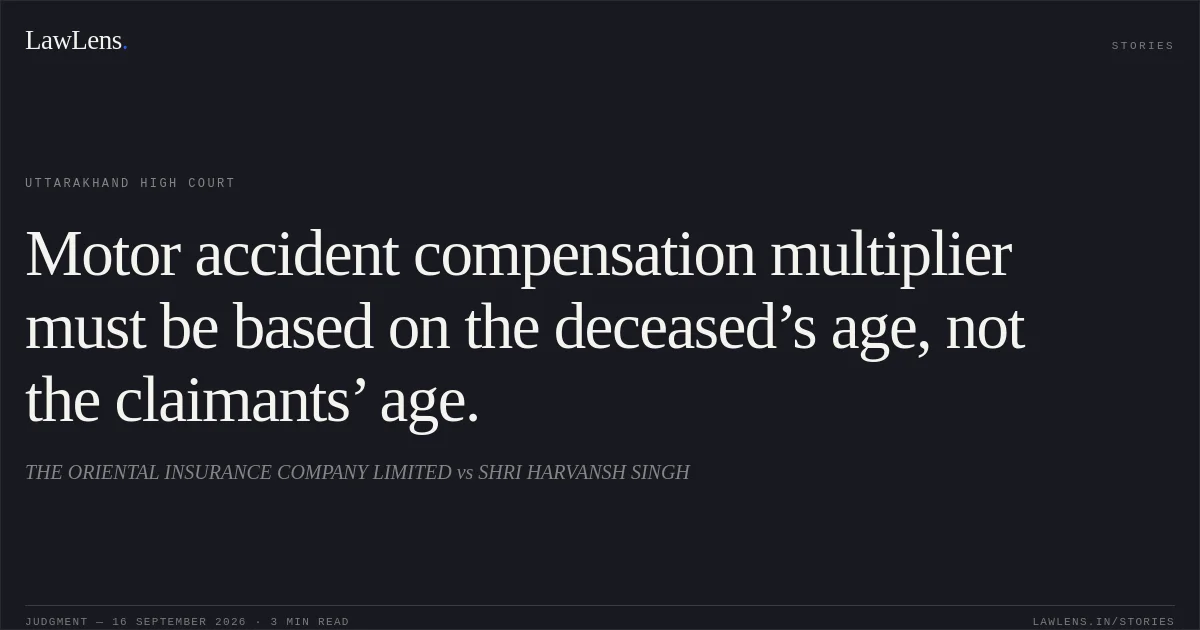
¶ 4–6ii.2. Whether the Tribunal erred by applying a multiplier of 13 with reference to the age of the parents/claimants instead of the age of the deceased.
¶ 7–8iii.3. Whether the compensation required recalculation in accordance with the applicable multiplier and settled principles governing motor accident compensation.
¶ 8–1003Law Applied
The Court applied the principles governing assessment of “just compensation” under the Motor Vehicles Act, including the settled rule that the multiplier is to be selected with reference to the age of the deceased rather than the age of the claimants.
¶ 8It relied on National Insurance Company Limited v. Pranay Sethi, (2017) 16 SCC 680, concerning the determination of fair, reasonable and just compensation and the appropriate multiplier method.
¶ 8In the case of an unmarried deceased, 50% of the income is deducted towards personal and living expenses.
¶ 9The insurer bears liability where the driver possessed a valid and effective driving licence; a properly verified licence does not constitute a breach absolving the insurer from liability.
¶ 5–604Reasoning
The Court examined the original report of the R.T.O., Bareilly, and found that Driving Licence No. 2/7/7 dated 8 December 1997 had in fact been issued by that authority.
¶ 5–6The licence had subsequently been renewed after the formation of Uttarakhand, and the renewal records were verified by the R.T.O., Haldwani.
¶ 5–6Accordingly, the Insurance Company failed to establish that the driver lacked a valid and effective licence.
¶ 5–6On computation, the Court held that the Tribunal had incorrectly used the claimants’ age for selecting the multiplier.
¶ 7–10Applying the deceased’s age, the appropriate multiplier was 18.
¶ 7–10From the annual income of ₹36,000, 50% was deducted for the deceased’s personal expenses, leaving an annual contribution of ₹18,000.
¶ 7–10Applying the multiplier of 18 resulted in a loss of dependency of ₹3,24,000; adding ₹4,500 under conventional heads produced total compensation of ₹3,28,500.
¶ 7–1005Holding
The Court rejected the Insurance Company’s challenge based on the alleged invalidity of the driving licence and affirmed its liability to satisfy the award.
¶ 6, 11The appeal was partly allowed only to the extent of modifying the computation: the multiplier of 13 was substituted with 18, and the total compensation was recalculated at ₹3,28,500 with interest at 6% per annum.
¶ 10, 12The Insurance Company was directed to satisfy the modified award within six weeks, after adjustment of any amount already deposited.
¶ 11, 13The statutory amount deposited in appeal was directed to be remitted to the Tribunal for adjustment, with any balance payable to the claimants in accordance with the Tribunal’s directions.
¶ 11, 13Original Court PDF
THE ORIENTAL INSURANCE COMPANY LIMITEDvsSHRI HARVANSH SINGH
Click to open original judgment
Original judgment, available to read, download and summarize on LawLens.in