Facts
The NCLT, Mumbai approved Ashdan Properties Private Limited’s resolution plan concerning Rolta India Limited on 15 December 2025.
Source reference: no citationThe Regional Provident Fund Commissioner-II sought to challenge that order before the NCLAT under Section 61(1) of the Insolvency and Bankruptcy Code, 2016 (IBC).
Source reference: no citationThe appellant’s counsel attempted to e-file the appeal on 28 January 2026, within the 45-day outer period under Section 61(2), but could not do so because of technical defects and OTP-delivery failures in the NCLAT’s e-filing system.
Source reference: paras. 5–6, 14–15Further attempts on 29 January 2026 were unsuccessful owing to a backend technical defect reported by the Registry.
Source reference: paras. 5–6, 14–15The appeal was ultimately e-filed on 30 January 2026, one day beyond the maximum condonable period.
Source reference: paras. 5–6, 14–15The NCLAT rejected the application for condonation of delay and dismissed the appeal as time-barred, holding that limitation commenced from the date of pronouncement of the NCLT’s order and that it lacked power to condone delay beyond the 30-day period plus the additional 15-day period permitted under Section 61(2) of the IBC.
Source reference: para. 7Issues
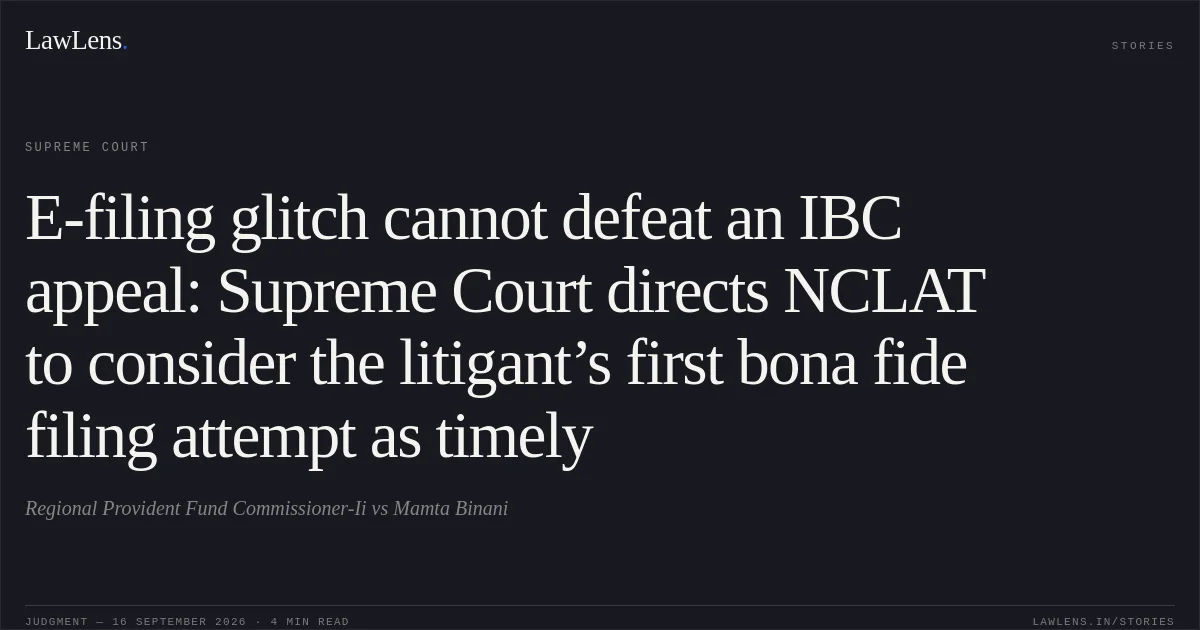
Whether the NCLAT was correct in rejecting the appeal as time-barred when the delay beyond the statutory 45-day period resulted from technical failures in the NCLAT’s own e-filing system, despite the appellant’s bona fide attempts to file within time?
Source reference: paras. 13–19Whether, in such circumstances, the NCLAT could invoke the principle of actus curiae neminem gravabit and treat the date of the appellant’s first bona fide e-filing attempt as the date of presentation, notwithstanding the absence of power to condone delay beyond the period prescribed by Section 61(2) of the IBC?
Source reference: paras. 17–22Law Applied
Section 61(2) of the IBC prescribes a 30-day limitation period for appeals to the NCLAT, with a further statutory discretion to condone delay up to 15 days, but not beyond that outer limit.
Source reference: paras. 7, 14, 18The Court reaffirmed the limitation principles stated in V. Nagarajan v. SKS Ispat & Power Ltd., (2022) 2 SCC 244, and Sanjay Pandurang Kalate v. Vistra ITCL (India) Ltd., (2024) 3 SCC 27, that limitation ordinarily begins from the date of pronouncement of the order.
Source reference: paras. 7, 9–10It also accepted the rule in National Spot Exchange Ltd. v. Anil Kohli, (2022) 11 SCC 761, and Tata Steel Ltd. v. Raj Kumar Banerjee, (2025) 9 SCC 483, that hardship, negligence, or an erroneous understanding of limitation cannot justify extension beyond the statutory maximum.
Source reference: paras. 7, 9–10However, the Court applied the doctrine actus curiae neminem gravabit—an act of the court shall prejudice no person—holding that a litigant should not suffer where a bona fide filing is prevented by the court or tribunal’s own non-functional filing system.
Source reference: paras. 19–22Principles analogous to Order VII Rule 6 of the Code of Civil Procedure, 1908 may also be invoked where necessary to exempt the period attributable to such system failure.
Source reference: para. 20The Court further relied on Regional Manager v. Pawan Kumar Dubey, (1976) 3 SCC 334, for the proposition that the ratio of a decision depends on the rule deduced from its facts and that materially different facts may require a different result.
Source reference: para. 11Reasoning
The Supreme Court agreed that the NCLAT correctly understood the ordinary computation of limitation under Section 61(2) and correctly held that it lacked power to condone delay beyond 45 days.
Source reference: paras. 9, 18However, the present case was materially different from cases involving ignorance of law, hardship, negligence, or an incorrect computation of limitation.
Source reference: no citationThe appellant had begun the filing process within the condonable period and had made repeated bona fide attempts to file the appeal, but the filing was prevented by OTP and backend failures in the NCLAT’s own e-filing system, as confirmed by the Registry’s report.
Source reference: paras. 14–15Consequently, the matter was not properly characterised as an application for condonation of delay beyond the statutory limit.
Source reference: no citationThe appropriate course was to exclude the period during which the tribunal’s filing system was incapable of receiving the appeal and, where justified, treat the first bona fide attempt as the date of presentation.
Source reference: paras. 19–22Refusing to do so would make the appellant suffer for the act of the tribunal, contrary to the principle actus curiae neminem gravabit.
Source reference: paras. 19–22Holding
The Supreme Court allowed the appeal and set aside the NCLAT’s order dated 21 May 2026.
It restored the appeal, Comp. App. (AT) (Ins) No. 503 of 2026, and the application for condonation of delay, I.A. No. 1951 of 2026, to the NCLAT for reconsideration.
Source reference: para. 24The NCLAT was directed to determine whether sufficient cause existed for the delay beyond the initial 30-day limitation period, taking into account the appellant’s bona fide filing attempts and the technical failure of the NCLAT’s e-filing system.
Source reference: paras. 24–25If satisfied, the NCLAT was to register and decide the appeal in accordance with law.
Source reference: paras. 24–25The parties were directed to bear their own costs.
Source reference: paras. 24–25Acts & Sections Cited
1 provisions across 1 statute referred to in this judgment. Each provision opens on LawLens.
Insolvency and Bankruptcy Code, 2016.1
Original Court PDF
Regional Provident Fund Commissioner-IivsMamta Binani
Click to open original judgment
Original judgment, available to read, download and summarize on LawLens.in