Facts
The appellant no. 1 was a member and promoter of Pranabananda Cooperative Bank Ltd., which originated as a cooperative credit society and was included among primary cooperative banks in 1996.
Source reference: para. 2(a)The Bank applied to the Reserve Bank of India (RBI) for a banking licence under Section 22 of the Banking Regulation Act, 1949.
Source reference: no citationIn 1999, the elected Board of Directors was superseded and a Board of Administrators was appointed; that supersession was subsequently quashed by the High Court.
Source reference: para. 2(a)Following an inspection, the RBI rejected the Bank’s licence application on 25 January 2001 on the ground of serious financial and operational irregularities and requested the Registrar of Cooperative Societies (RCS) to wind up the Bank.
Source reference: para. 2(c)–(d); paras. 9–10The RCS thereafter passed an order dated 6 August 2002 under Section 99(1) of the West Bengal Cooperative Societies Act, 1983 (“1983 Act”) directing winding up and appointed a liquidator.
Source reference: para. 2(e)The Cooperative Tribunal initially set aside the order, but its decision was remanded for fresh consideration by the High Court and Division Bench. On remand, the Tribunal affirmed the winding-up order on 4 October 2016, and the learned Single Judge dismissed the appellants’ writ petition on 4 June 2018.
Source reference: para. 2(g)–(m)In the appeal, the State relied upon an inspection allegedly conducted under Section 92 in 1999, but could not establish that the inspection report had been served on the appellants or that they had been heard before the winding-up order.
Source reference: paras. 7–8, 21–23Issues
Whether the RCS could order winding up under Section 99(1) of the 1983 Act without communicating the Section 92 inspection report to the cooperative society and without affording the affected members a reasonable opportunity of hearing.
Source reference: paras. 14–19, 21–31Whether the RBI’s request for winding up under Section 145 of the 1983 Act was binding on the RCS and permitted the RCS to dispense with the statutory requirements under Sections 92 and 99.
Source reference: paras. 10–13, 41–46Whether the appellants could challenge the winding-up order and pursue the proceedings despite the appointment of a liquidator.
Source reference: paras. 41–45Law Applied
Section 99(1) of the 1983 Act permits winding up only after an audit under Section 90, inspection under Section 92, inquiry under Section 93, or an application by three-fourths of the members; Section 92(3) requires the inspection report or its summary to be communicated to the cooperative society within one month, and this requirement is mandatory where the report may form the basis of winding up.
Source reference: paras. 12, 14–19Section 145 gives an insured cooperative bank additional protection by requiring prior RBI sanction and compliance with the Deposit Insurance Corporation Act, but does not authorise the RBI to bypass the RCS’s statutory procedure under Section 99.
Source reference: paras. 12–13, 42Natural justice, particularly audi alteram partem, must be read into statutory powers involving serious civil consequences even where the statute is silent, as recognised in A.K. Kraipak v. Union of India, Maneka Gandhi v. Union of India, Swadeshi Cotton Mills v. Union of India, M.S. Nally Bharat Engineering Co. Ltd. v. State of Bihar, Mangilal v. State of M.P., and Rajesh Kumar v. CIT.
Source reference: paras. 32–39An order exercising statutory power must also contain reasons and comply with Article 14.
Source reference: para. 48Section 136 read with the Third Schedule expressly permits any member of a cooperative society to appeal against an order of winding up under Section 99.
Source reference: paras. 43–44Reasoning
The Court held that the RBI’s communication was only a requisition to the RCS to act under Sections 99, 100 and 145 of the 1983 Act; it did not itself constitute a winding-up order and did not authorise the RCS to ignore the statutory safeguards.
Source reference: paras. 9–13, 42Although the State asserted that a Section 92 inspection had occurred in 1999, it failed to produce the inspection report or prove that it had been communicated to the appellants. The Court therefore drew an adverse inference that the report had not been served.
Source reference: paras. 21–23, 29–30The inspection was conducted after the elected Board had been superseded, and any opportunity given to the Board of Administrators could not substitute a hearing to the actual members and elected directors, particularly because the supersession had later been declared illegal.
Source reference: paras. 24–29Since winding up had grave civil and economic consequences, the RCS was required to disclose the material relied upon, hear the affected persons, and record an independent and reasoned opinion.
Source reference: paras. 27–31, 45–48Instead, the RCS acted substantially on the RBI’s direction and passed an unreasoned order. The RBI’s unchallenged orders did not cure the RCS’s independent statutory violations.
Source reference: paras. 27–31, 45–48The appellants were competent to challenge the winding-up order because Section 136 and the Third Schedule specifically conferred that right on any member; requiring them to proceed through the liquidator would be impermissible and practically equivalent to requiring the liquidator to challenge his own appointment.
Source reference: paras. 43–45Holding
The appeal was allowed.
The Court quashed the RCS’s winding-up order dated 6 August 2002, set aside the Tribunal’s order dated 4 October 2016 and the learned Single Judge’s order dated 4 June 2018, and set aside the appointment of the liquidator.
Source reference: para. 50The society was directed to revive and function as a cooperative credit society, but was prohibited from carrying on banking business as a cooperative bank.
Source reference: paras. 50–52The RCS was left at liberty to proceed afresh in accordance with law.
Source reference: paras. 50–52The liquidator was directed to hand over the society’s assets to its members under the supervision of the RCS, without prejudice to proceedings initiated by any other authority.
Source reference: paras. 50–52Acts & Sections Cited
13 provisions across 3 statutes referred to in this judgment. Each provision opens on LawLens.
Banking Regulation Act, 19494
West Bengal Co-operative Societies Act, 19838
Deposit Insurance and Credit Guarantee Corporation Act, 19611
Original Court PDF
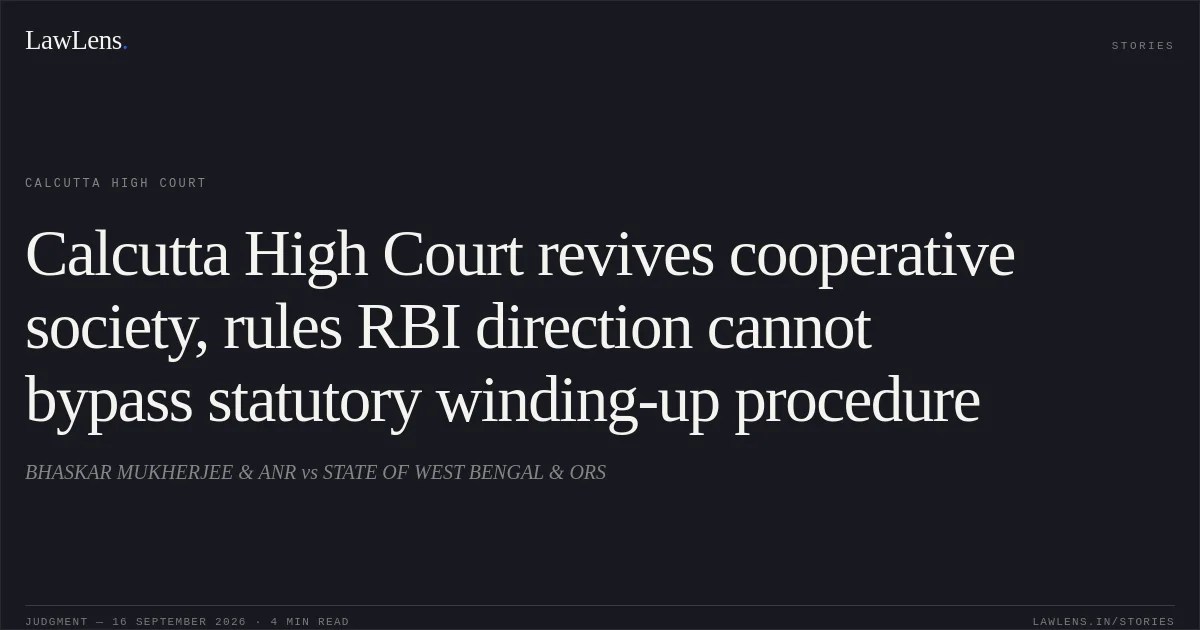
BHASKAR MUKHERJEE & ANRvsSTATE OF WEST BENGAL & ORS
Click to open original judgment
Original judgment, available to read, download and summarize on LawLens.in