Facts
The respondents were initially engaged as Lower Division Clerks on consolidated remuneration of ₹12,000 per month.
Source reference: paras. 1–3; pp. 3–4By order dated 21 May 2013, they were appointed against regular posts and granted regular pay scales.
Source reference: paras. 1–3; pp. 3–4During an audit conducted on 2 February 2018, the appointments were found to be irregular.
Source reference: paras. 1–3; pp. 3–4Relying on the audit objection, the appellant-Society withdrew the regular pay scales and directed the respondents to continue on consolidated remuneration of ₹12,000 per month by order dated 5 February 2018.
Source reference: paras. 1–3; pp. 3–4No notice or opportunity of hearing was afforded before the reduction.
Source reference: paras. 1–3; pp. 3–4The respondents filed writ petitions, which were allowed by the learned Single Judge on the ground that reduction of pay scale involved civil consequences and violated natural justice.
Source reference: paras. 1–3; pp. 3–4The Society challenged that order through the present connected special appeals.
Source reference: paras. 1–3; pp. 3–4Issues
Whether the appellant-Society could reduce the respondents’ regular pay scales and restore them to consolidated remuneration without issuing notice or granting an opportunity of hearing.
Source reference: paras. 3, 8–9; pp. 4–7Whether the alleged irregularity or fraud in the respondents’ appointments, as detected during audit, dispensed with the requirement of complying with the principles of natural justice.
Source reference: para. 5; p. 4Law Applied
Any reduction or re-fixation of an employee’s pay that causes recurring financial loss constitutes a civil consequence and cannot ordinarily be effected without prior notice and an opportunity of hearing.
Source reference: para. 8; pp. 5–6The Court relied principally on Mukund K. Pai & Ors. v. Punjab National Bank & Ors., 2025 SCC OnLine SC 2345, which held that re-fixation of pay resulting in reduction of salary requires observance of natural justice.
Source reference: para. 8; pp. 5–6It also applied the principle in Bhagwan Shukla v. Union of India & Ors., (1994) 6 SCC 154, that reduction of an employee’s basic pay without notice or hearing is a flagrant violation of natural justice, notwithstanding the financial or administrative justification asserted by the employer.
Source reference: para. 8; pp. 5–6Reasoning
The Division Bench held that the decisive fact was not whether the appointments were irregular, but that the respondents’ pay had been reduced without affording them an opportunity to contest the audit findings or the proposed action.
Source reference: paras. 8–9; pp. 5–7Reduction from the regular pay scale to fixed remuneration caused direct and recurring financial prejudice and therefore attracted the audi alteram partem rule.
Source reference: paras. 8–9; pp. 5–7The Society’s contention that it was merely restoring the pre-existing position, or that the appointments resulted from the former Manager’s alleged fraud, did not eliminate the respondents’ right to be heard before an adverse pay-reduction order was passed.
Source reference: paras. 5, 9; pp. 4, 7Since the order dated 5 February 2018 was made behind the respondents’ backs, the learned Single Judge was justified in quashing it.
Source reference: no citationHolding
The Court answered the issues against the appellant-Society.
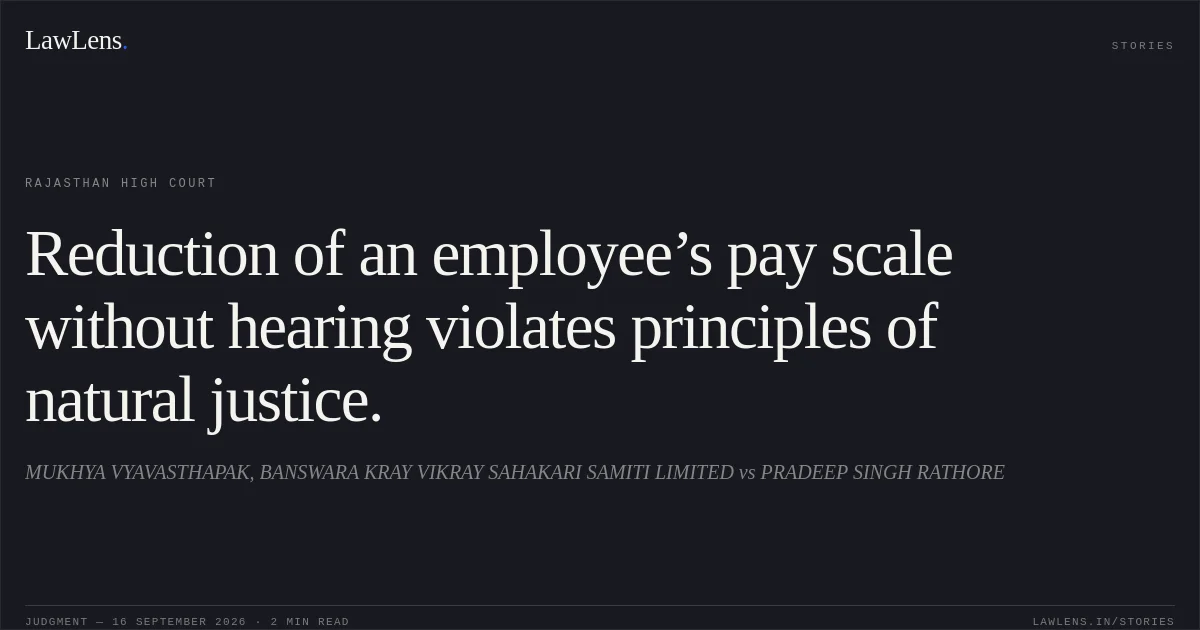
It held that reduction of the respondents’ pay scales without prior notice and hearing violated the principles of natural justice, even where the reduction was based on alleged irregular appointments and audit objections.
Source reference: para. 9; p. 7Finding no merit in the connected special appeals, the Court dismissed all of them and disposed of any pending interlocutory applications.
Source reference: paras. 10–11; p. 7Original Court PDF
MUKHYA VYAVASTHAPAK, BANSWARA KRAY VIKRAY SAHAKARI SAMITI LIMITEDvsPRADEEP SINGH RATHORE
Click to open original judgment
Original judgment, available to read, download and summarize on LawLens.in