01Facts
On 12 October 2011, respondent No. 4/claimant suffered injuries when an auto-rickshaw bearing registration No. MP-07-R-0858, allegedly driven rashly and negligently by respondent No. 3, Tillu Khan, collided with his motorcycle.
¶ 1–2The Motor Accident Claims Tribunal awarded Rs.67,000/- with interest at 7% per annum, payable jointly and severally by the respondents.
¶ 1The Insurance Company challenged the award under Section 173(1) of the Motor Vehicles Act, 1988, contending that the driver’s licence was fake and that the vehicle was being driven in breach of the insurance policy.
¶ 5, 7During the appeal, the Insurance Company sought to produce an RTO report and covering letter dated 3 November 2014 as additional evidence under Order XLI Rule 27 CPC.
¶ 8–9, 1302Issues
i.Whether the RTO report and accompanying documents should be admitted as additional evidence under Order XLI Rule 27 CPC to determine the genuineness of the driver’s licence.
¶ 13–15ii.Whether the alleged falsity of the driver’s licence, by itself, absolved the Insurance Company from its statutory liability to satisfy the award.
¶ 16–18iii.Whether the Insurance Company proved that the insured owner had knowledge of the fake licence, or had otherwise committed a wilful breach of the insurance policy by permitting the driver to operate the vehicle.
¶ 16–1803Law Applied
The Court applied Section 173(1) of the Motor Vehicles Act, 1988, governing appeals against awards of the Claims Tribunal, and Order XLI Rule 27 CPC, under which additional evidence may be admitted where the appellate court requires it to pronounce judgment satisfactorily or where another substantial cause exists.
¶ 14Relying on North Eastern Railway Admn. v. Bhagwan Das, (2008) 8 SCC 511, and the principles in Parsotim Thakur v. Lal Mohar Thakur and K. Venkataramiah v. A. Seetharama Reddy, the Court held that additional evidence may be admitted to cure an evidentiary lacuna relevant to a satisfactory adjudication, but not merely to enable a party to repair its weak case.
¶ 14Under Section 149(2)(a)(ii) of the Motor Vehicles Act and the applicable policy conditions, an insurer may rely on the defence that the driver was not duly licensed; however, under National Insurance Co. Ltd. v. Swaran Singh, (2004) 3 SCC 297, United India Insurance Co. Ltd. v. Lehru, (2003) 3 SCC 338, Ram Chandra Singh v. Rajaram, (2018) 8 SCC 799, and IFFCO Tokio General Insurance Co. Ltd. v. Gita Devi, 2024 (13) SCC 755, the mere fact that a driving licence was fake does not, by itself, absolve the insurer.
¶ 16–18The insurer must prove that the owner knew, or ought reasonably to have known, that the licence was fake and nevertheless wilfully permitted the driver to operate the vehicle.
¶ 16–18Provisions in the judgment · 5 · Linked ones open on LawLens
Code of Civil Procedure, 1908 Section 151Section 107Section 41
Motor Vehicles Act, 1988 Section 173Section 149
04Reasoning
The Court allowed the Insurance Company’s application under Order XLI Rule 27 CPC because the RTO report was relevant to the central controversy concerning the genuineness of the driver’s licence and was stated to have been unavailable despite due diligence during the Tribunal proceedings.
¶ 15Nevertheless, even assuming that the licence was fake, the Insurance Company neither pleaded nor established that the insured owner had knowledge of its falsity or had failed to exercise reasonable care in employing the driver.
¶ 16, 18Consistent with IFFCO Tokio and the earlier Supreme Court authorities, production of a seemingly valid licence does not ordinarily impose an obligation on the owner to obtain independent verification from the RTO, unless circumstances create a genuine doubt regarding its validity.
¶ 17Since the insurer failed to prove a wilful breach of the policy conditions, the statutory liability to satisfy the compensation award remained unaffected.
¶ 16–18The Coordinate Bench’s remand order in another appeal arising from the same accident did not govern the present case because that remand was based on a different procedural and evidentiary context.
¶ 1905Holding
The Court held that the additional RTO documents were admissible, but their admission did not establish a legally sufficient defence for the Insurance Company.
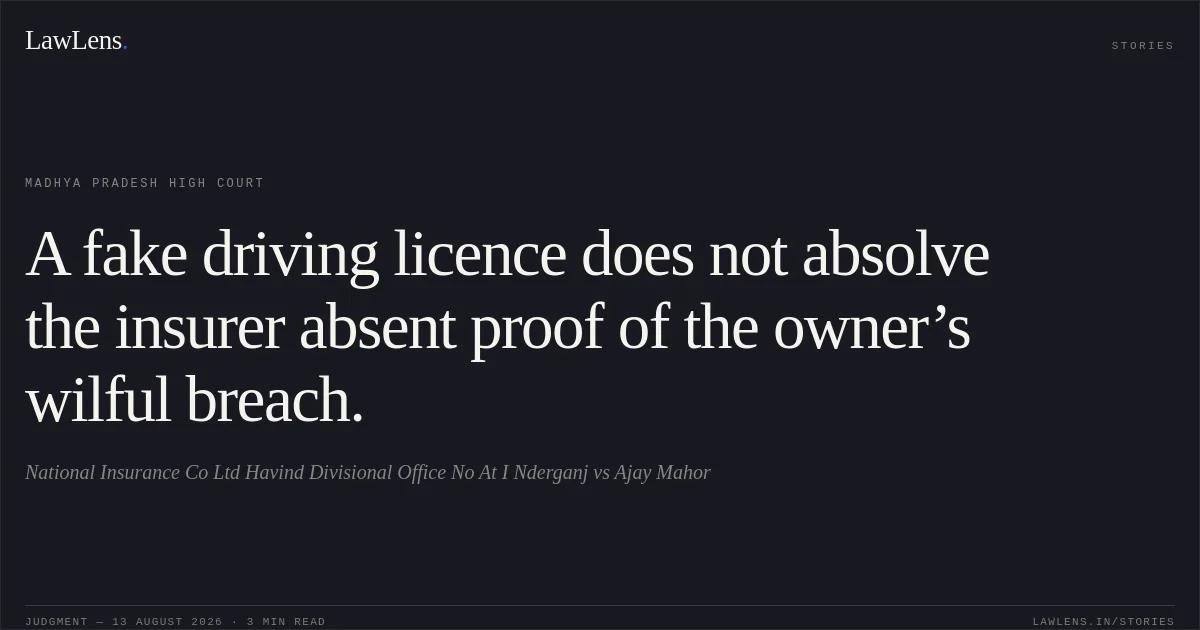
¶ 15The mere falsity of the driver’s licence was insufficient to absolve the insurer absent proof of the owner’s knowledge, lack of reasonable care, or wilful breach of the policy.
¶ 18The award of Rs.67,000/- with interest at 7% per annum was therefore upheld, and Miscellaneous Appeal No. 989 of 2014 was dismissed.
¶ 20–21There was no order as to costs, and all pending interlocutory applications were disposed of.
¶ 20–21Original Court PDF
National Insurance Co Ltd Havind Divisional Office No At I NderganjvsAjay Mahor
Click to open original judgment
Original judgment, available to read, download and summarize on LawLens.in