Facts
The appellants’ case was that Deependra had purchased a ticket from Mainpuri to Anand Vihar and was travelling on Train No. 14151 when he was found dead near Maripat Railway Station on 26 August 2018.
Source reference: pp. 1–2The Railway Claims Tribunal dismissed the claim, holding that the deceased was not proved to be a bona fide passenger and that his death did not result from an untoward incident.
Source reference: pp. 1–2The appellants challenged that decision, relying on the father’s testimony and contemporaneous railway records; the Railways relied on the non-recovery of a ticket and a DRM report suggesting that the deceased had attempted to get off the moving train.
Source reference: pp. 2–3Issues
1. Whether the deceased was a bona fide passenger despite no ticket being recovered from him.
Source reference: pp. 3–4, paras. 6–82. Whether the deceased’s death resulted from an accidental fall constituting an “untoward incident,” or from conduct attracting an exception to the Railways’ liability.
Source reference: pp. 4–5, paras. 9–11Law Applied
Section 123(c)(2) of the Railways Act, 1989 includes the accidental falling of a passenger from a train within the definition of an “untoward incident”; exclusion from the Railways’ statutory liability must be supported by material establishing a recognised exception under Section 124-A.
Source reference: p. 4, para. 9Under Union of India v. Rina Devi, (2019) 3 SCC 572, non-recovery of a ticket does not, by itself, negate bona fide passenger status; the claimant may discharge the initial burden through relevant facts and circumstances, after which the burden shifts to the Railways.
Source reference: p. 3, para. 6The Court also relied on Lata v. Union of India, 2026 INSC 715, and Sukhabhai Nanjibhai Makwana & Anr. v. Union of India, 2026 INSC 1056, for the principles that claims are assessed on a preponderance of probabilities and that ticket non-recovery alone does not defeat a claim where the claimant’s evidence is not rebutted.
Source reference: p. 3, para. 6Reasoning
The father’s testimony that he had purchased a ticket for the deceased was not nullified by his inability to identify the train number or confirm that he saw the deceased board; it had to be assessed with the surrounding circumstances and the contemporaneous record linking the deceased to Train No. 14151.
Source reference: p. 3, para. 7The Railways produced no cogent evidence that the deceased was travelling without a ticket, and non-recovery of the ticket was not determinative.
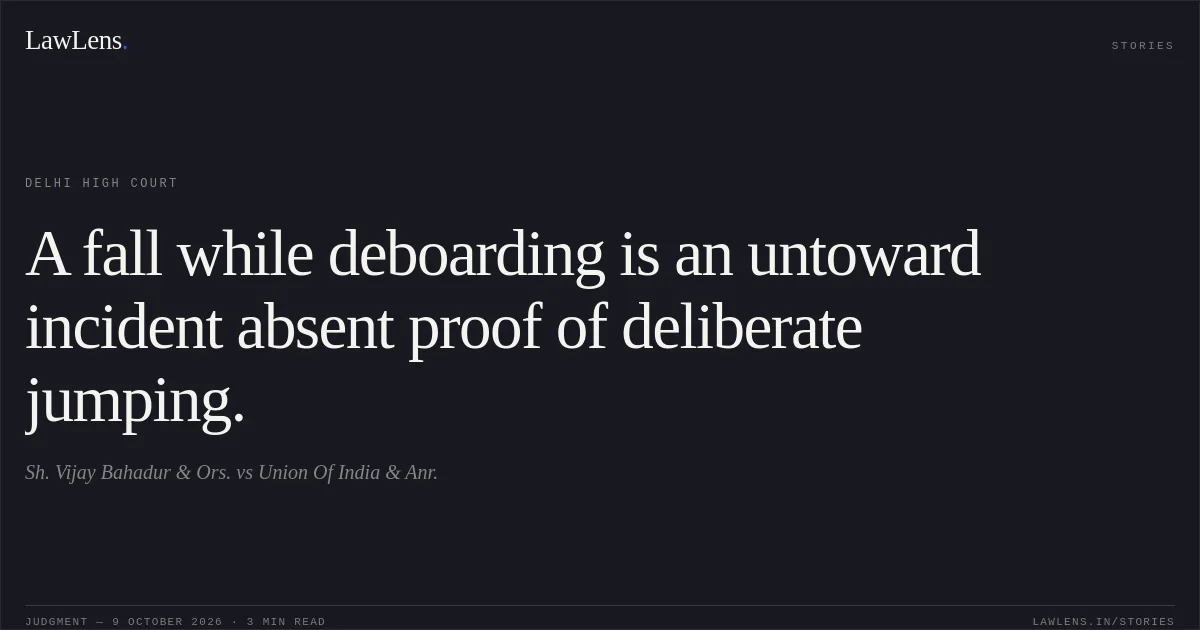
Source reference: p. 4, para. 8As to the manner of death, the constable’s statement that the deceased had “fallen down while deboarding” did not establish a deliberate jump, and the absence of a scheduled stop at Maripat did not, by itself, prove such conduct.
Source reference: p. 4, para. 10The contemporaneous panchanama and initial information recorded a fall from the train; the later DRM report was insufficient to displace that record or establish an exception to liability.
Source reference: p. 5, para. 11Holding
The Court held that the deceased was a bona fide passenger and that the evidence established an accidental fall constituting an untoward incident, not a deliberate jump attracting an exception under Section 124-A.
It set aside the Tribunal’s judgment, allowed the appeal, and remanded the matter to the Tribunal to assess compensation and direct its disbursement within two months of receiving the order; the matter was directed to be listed before the Tribunal on 30 November 2026.
Source reference: p. 5, paras. 12–13Acts & Sections Cited
2 provisions across 2 statutes referred to in this judgment. Each provision opens on LawLens.
Railway Claims Tribunal Act, 19871
Railways Act, 19891
Original Court PDF
Sh. Vijay Bahadur & Ors.vsUnion Of India & Anr.
Click to open original judgment
Original judgment, available to read, download and summarize on LawLens.in