Facts
The appellant was convicted under Section 302 IPC by the Additional District & Sessions Judge/Special Judge, Auraiya, for causing the death of Smt. Ramdevi by striking her with an axe after she allegedly refused his demand for money.
Source reference: paras. 1–5, 11–17The incident occurred on 21 December 2010 at approximately 8:30 a.m. while the deceased was winnowing millet near a shed.
Source reference: paras. 1–5, 11–17The prosecution relied principally on the testimonies of PW-1 Rakesh Babu and PW-2 Omveer, who claimed to have witnessed the assault, and on the post-mortem evidence of PW-5, which attributed death to shock and haemorrhage caused by ante-mortem injuries.
Source reference: paras. 1–5, 11–17The trial court convicted the appellant under Section 302 IPC and sentenced him to life imprisonment with a fine of ₹2,000, with an additional one year’s imprisonment in default of payment.
Source reference: para. 1Issues
Whether the appellant’s conviction for murder under Section 302 IPC should be altered to culpable homicide not amounting to murder under Section 304 Part I IPC by applying Exception 4 to Section 300 IPC?
Source reference: paras. 18–20Whether the period of imprisonment already undergone by the appellant was sufficient to meet the ends of justice after alteration of the conviction?
Source reference: para. 29Law Applied
The Court applied Sections 299, 300 and 304 IPC.
Source reference: paras. 20, 25It held that where the accused causes death with the requisite intention or knowledge but the case falls within Exception 4 to Section 300 IPC, the offence is culpable homicide not amounting to murder punishable under Section 304 Part I IPC.
Source reference: paras. 20, 25Exception 4 requires cumulatively that the act be committed without premeditation, in a sudden fight or quarrel, in the heat of passion, and without the offender taking undue advantage or acting cruelly or unusually.
Source reference: para. 20Relying on Surinder Kumar v. Union Territory, Chandigarh, (1989) 2 SCC 217, the Court held that the cause of the quarrel, the identity of the initial aggressor, and the number of injuries are not by themselves decisive, provided the occurrence was sudden and unpremeditated and the accused did not act cruelly.
Source reference: para. 22The Court also relied on Budhi Singh v. State of Himachal Pradesh, (2012) 13 SCC 663, regarding the sequential assessment of causation, culpable homicide, murder, and statutory exceptions.
Source reference: para. 25The Court also relied on Jhaptu Ram v. State of Himachal Pradesh, (2014) 12 SCC 410 and Sankath Prasad v. State of U.P., (2020) 12 SCC 564, which support conversion from Section 302 to Section 304 Part I where the fatal assault occurs during a sudden altercation without prior intention to kill.
Source reference: paras. 26–27Reasoning
The Court accepted the prosecution evidence establishing that the appellant caused the deceased’s death with an axe, but examined whether the circumstances brought the case within Exception 4 to Section 300 IPC.
Source reference: paras. 18–20It found no evidence of a calculated ambush or prior plan to kill.
Source reference: paras. 21, 23–24, 28The occurrence took place in broad daylight at an open farm shed, followed an immediate dispute over the deceased’s refusal to give money, and lasted only briefly.
Source reference: paras. 21, 23–24, 28The axe was treated as an agricultural implement available at the spot, rather than proof of prior preparation.
Source reference: paras. 21, 23–24, 28The appellant fled when the witnesses approached, which the Court considered inconsistent with an intention to inflict prolonged or unusually cruel violence.
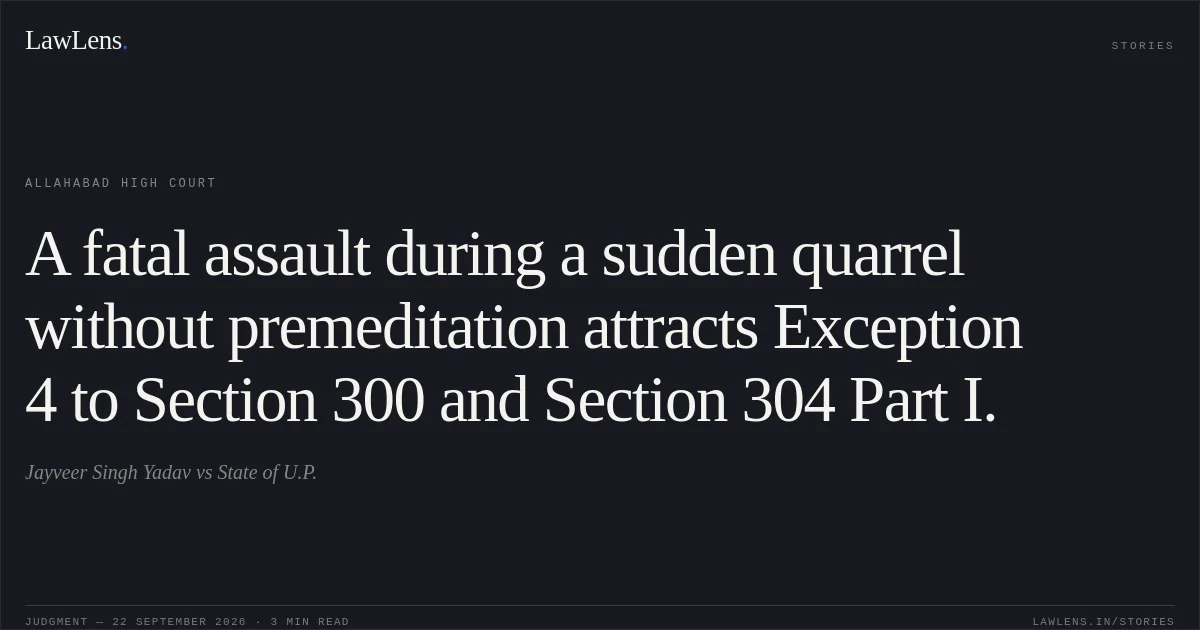
Source reference: paras. 21, 23–24, 28Although the appellant knew that striking the deceased on the head and neck with an axe was likely to cause death, the absence of premeditation and the sudden nature of the altercation brought the case within Exception 4.
Source reference: para. 28The Court therefore held that the trial court had erred in treating the incident as premeditated murder under Section 302 IPC.
Source reference: para. 28Considering the period already spent in custody, the Court further held that the sentence undergone was sufficient for the offence under Section 304 Part I IPC.
Source reference: para. 29Holding
The appeal was partly allowed.
The conviction and sentence under Section 302 IPC were set aside and substituted with a conviction under Section 304 Part I IPC.
Source reference: para. 30The appellant’s sentence was reduced to the period already undergone, while the fine was maintained.
Source reference: paras. 29–30As the appellant was in custody, the Court directed his release forthwith unless he was required in any other case.
Source reference: para. 31A certified copy of the judgment and the trial court record were directed to be transmitted to the trial court and the concerned jail superintendent for compliance.
Source reference: para. 32Acts & Sections Cited
8 provisions across 2 statutes referred to in this judgment. Each provision opens on LawLens.
Indian Penal Code, 18606
Code of Criminal Procedure, 19732
Original Court PDF
Jayveer Singh YadavvsState of U.P.
Click to open original judgment
Original judgment, available to read, download and summarize on LawLens.in