Facts
Rameshwar Dutt was appointed as a Junior Assistant by the Deputy Commissioner, Kathua, in 1993 along with Naresh Kumar and Anil Kumar, for defence-related requisition/acquisition work.
Source reference: para. 4His engagement was described as ad hoc/temporary and was extended from time to time.
Source reference: para. 4Naresh Kumar and Anil Kumar, who had been engaged with him and performed similar duties, were subsequently accommodated in Tehsil offices and granted the benefits of regular service, including preparation of service books; Naresh Kumar later retired with pensionary benefits.
Source reference: paras. 10–13Dutt continued to work for more than three decades, except for a short break from 4 October 2012 to 21 October 2012, and repeatedly sought treatment equivalent to that given to his two colleagues.
Source reference: paras. 5–6In 2021, after the Defence Estate Officer stated that his services were no longer required, Dutt was disengaged with effect from 31 March 2021.
Source reference: para. 6His claim for regularisation was rejected by order dated 8 February 2022.
Source reference: para. 6The Central Administrative Tribunal quashed the rejection order and directed regularisation of Dutt as Junior Assistant from the date Naresh Kumar and Anil Kumar received the corresponding benefit.
Source reference: paras. 1–2, 14The Union Territory challenged that decision before the High Court.
Source reference: paras. 1–2, 14Issues
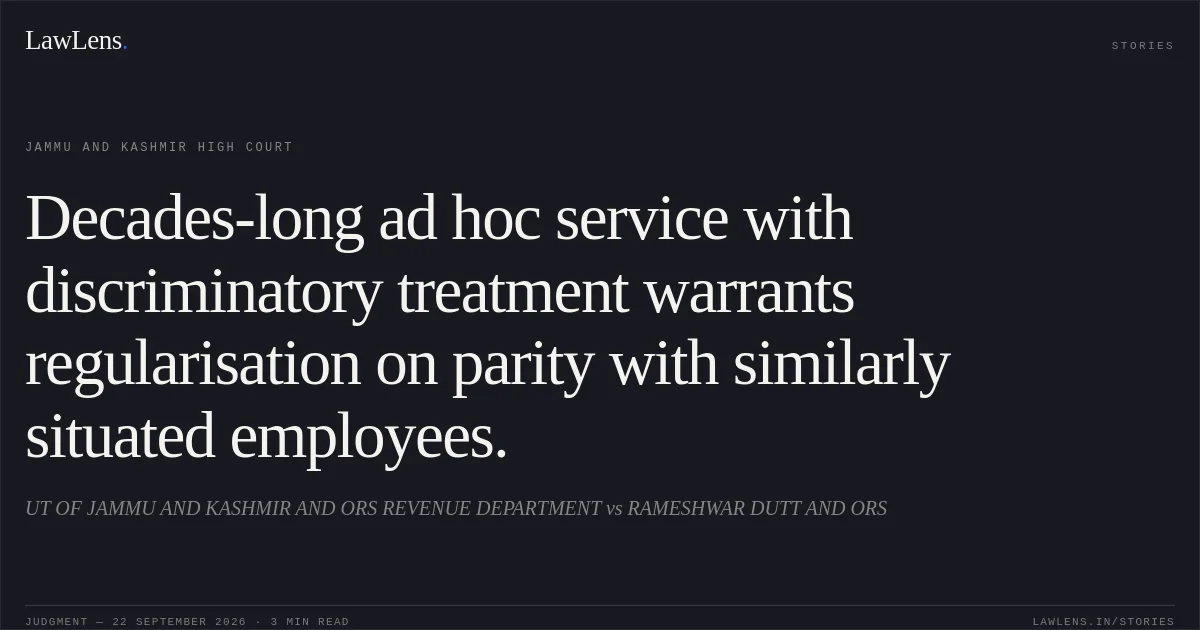
Whether an employee engaged on an ad hoc/temporary basis could claim regularisation merely because he had continued in service for more than three decades.
Source reference: paras. 7, 11Whether the respondent was entitled to treatment equivalent to that given to Naresh Kumar and Anil Kumar, who were engaged with him, performed similar duties, and were granted the benefits of regular service.
Source reference: paras. 10–13Whether the Tribunal erred in directing the petitioners to regularise the respondent as Junior Assistant from the date on which the corresponding benefit was extended to the other similarly situated employees.
Source reference: para. 14Law Applied
The Court applied the settled principle that mere long continuation on an ad hoc or temporary basis does not, by itself, confer a right to regularisation, and that regularisation ordinarily cannot be directed contrary to the applicable recruitment or service rules.
Source reference: para. 11However, the Court also applied the constitutional principle of equality and non-discrimination, holding that similarly situated employees performing similar duties cannot be treated differently without a rational basis.
Source reference: paras. 10–13Administrative authorities cannot continuously utilise an employee’s services for decades, deny him the benefits accorded to similarly placed employees, and then disengage him by relying solely on the temporary character of his initial appointment.
Source reference: paras. 10–13The Court further held that the absence of a formal regularisation order for the comparator employees could not defeat the respondent’s claim where the authorities had prepared their service books and extended to them the benefits of regular service.
Source reference: para. 13Reasoning
The Court distinguished the respondent’s case from an ordinary claim based solely on prolonged ad hoc service.
Source reference: no citationDutt had been appointed alongside Naresh Kumar and Anil Kumar, had performed similar duties, and had continued to be utilised by the authorities for more than three decades.
Source reference: paras. 9–12Unlike Dutt, the two comparators were accommodated in regular departmental work and received the practical benefits of regular service.
Source reference: paras. 9–12The authorities repeatedly deferred consideration of Dutt’s representations, continued to take work from him, and ultimately disengaged him after the Defence Estate Officer stated that his services were no longer required.
Source reference: paras. 9–12In the Court’s view, this conduct amounted to hostile discrimination and could not be justified merely by describing Dutt’s original appointment as temporary.
Source reference: paras. 9–12The petitioners’ argument that the comparator employees had not been formally regularised was rejected because their service books had been prepared and they had been treated as regular employees in substance.
Source reference: para. 13Given the peculiar facts, the Tribunal’s direction was held to correct discriminatory treatment rather than impermissibly perpetuate an illegality.
Source reference: paras. 13–14Holding
The High Court dismissed the writ petition and upheld the Tribunal’s judgment dated 20 March 2025.
It held that Rameshwar Dutt was entitled to be treated on par with Naresh Kumar and Anil Kumar.
Source reference: paras. 14–16The Court directed the petitioners to comply with the Tribunal’s order regularising him as Junior Assistant in the Revenue Department from the date on which the corresponding benefit was granted to those employees.
Source reference: paras. 14–16Original Court PDF
UT OF JAMMU AND KASHMIR AND ORS REVENUE DEPARTMENTvsRAMESHWAR DUTT AND ORS
Click to open original judgment
Original judgment, available to read, download and summarize on LawLens.in