Facts
The UPSC issued a 2013 notification for recruitment to 85 posts of Public Prosecutor in the CBI.
Source reference: p. 3, paras 6–7The respondent participated in the selection and was placed at Serial No. 17 in the reserve list, which contained 44 candidates, after 84 candidates were recommended for appointment.
Source reference: p. 3, paras 6–7Under the UPSC guidelines, the reserve list ordinarily remained operative for 18 months from finalisation of the Interview Board Report, with possible extension up to two years in exceptional cases.
Source reference: p. 4, paras 8–9The parties accepted that the panel remained valid until 16 January 2017.
Source reference: p. 4, paras 10, 13The DOPT informed the UPSC on 5 February 2016 that 14 selected candidates had expressed unwillingness to join and requested 14 replacement dossiers from the reserve panel.
Source reference: p. 6, paras 19–20Six of those candidates belonged to the OBC category, including A. Mohammad Ali.
Source reference: pp. 6–7, paras 19–20The UPSC acknowledged the communication but ultimately forwarded dossiers against only five OBC vacancies.
Source reference: pp. 8, 11, paras 21, 25Although A. Mohammad Ali’s name was omitted from a later DOPT communication dated 13 January 2017, the original unwillingness documents concerning him were forwarded on 2 June 2017, after expiry of the panel.
Source reference: pp. 9–13, paras 23–26The Tribunal directed that the respondent’s candidature be considered.
Source reference: p. 3, para. 7The UPSC challenged that direction before the High Court.
Source reference: p. 15, para. 34Issues
Whether the UPSC was required to operate the reserve panel in respect of vacancies arising before 16 January 2017, notwithstanding that the panel subsequently expired.
Source reference: p. 4, paras 10, 13–14Whether the DOPT’s communication dated 5 February 2016 constituted a requisition in respect of six OBC vacancies, including the vacancy arising from A. Mohammad Ali’s failure to join, thereby requiring the UPSC to forward six replacement dossiers.
Source reference: pp. 6–8, paras 19–22Whether the respondent was entitled to consideration for appointment as the sixth OBC candidate in the reserve list.
Source reference: p. 15, paras 32–34Law Applied
The Court applied the UPSC’s reserve-list guidelines, under which the reserve list ordinarily operates for 18 months from finalisation of the Interview Board Report and may, in exceptional cases, be extended up to two years.
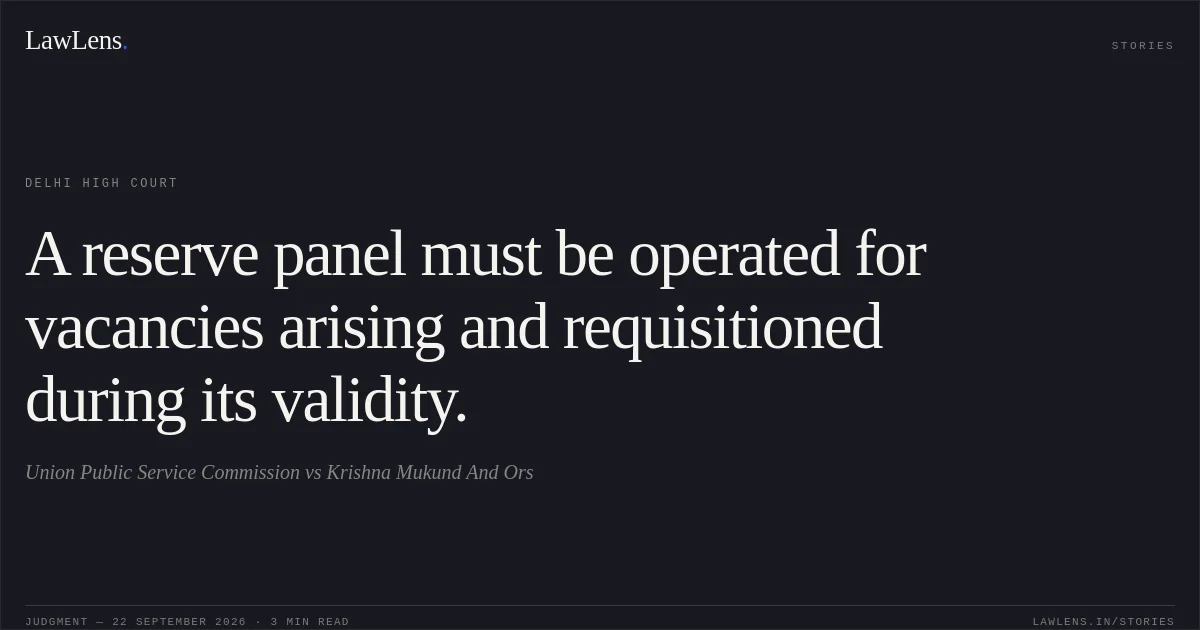
Source reference: p. 4, para. 8The governing principle is that a court ordinarily cannot direct a selecting or appointing authority to operate a panel after its expiry; however, vacancies arising during the life of the panel must be filled from the available panel, and the expiry of the panel cannot justify non-selection where the requisite vacancies and requisitions arose before expiry.
Source reference: p. 2, paras 1–2No statutory provision or judicial precedent was specifically cited in the judgment.
Source reference: no citationReasoning
The Court held that the relevant date was when the vacancy arose and when the requisition was communicated, not when the DOPT later transmitted the original unwillingness documents.
Source reference: no citationA. Mohammad Ali was expressly identified in the DOPT’s 5 February 2016 communication as a selected candidate who had not joined, and the communication sought a replacement dossier against his vacancy.
Source reference: pp. 6–7, paras 19–20The UPSC’s own reply dated 30 March 2016 also included his name among the candidates for whom reserve-list replacements were required.
Source reference: p. 8, paras 21–22His omission from the 13 January 2017 communication was attributable only to the delayed transmission of the original documents and did not erase the earlier requisition or alter the fact that the vacancy had arisen during the panel’s validity.
Source reference: pp. 13–14, paras 24, 29–31Consequently, the UPSC wrongly treated the matter as involving only five OBC vacancies and forwarded only five dossiers.
Source reference: no citationHad it forwarded the sixth dossier, the respondent would have been the next OBC candidate considered from the reserve list.
Source reference: pp. 5, 11, 14–15, paras 17, 25, 32–33Holding
The High Court dismissed the UPSC’s challenge to the extent of the respondent and upheld the Tribunal’s direction that his candidature be considered for appointment as Public Prosecutor pursuant to the selection.
The Court held that the vacancy arising from A. Mohammad Ali’s failure to join had arisen, and had been requisitioned, before expiry of the panel; therefore, the UPSC’s failure to forward the sixth dossier was legally unsustainable.
Source reference: p. 14, para. 31However, the Court set aside the Tribunal’s broader directions concerning other candidates, holding that only one additional vacancy had been missed.
Source reference: p. 15, para. 35Consequential orders concerning the respondent were directed to be passed within eight weeks.
Source reference: p. 16, paras 37–38Original Court PDF
Union Public Service CommissionvsKrishna Mukund And Ors
Click to open original judgment
Original judgment, available to read, download and summarize on LawLens.in