Facts
The petitioner, Sandipan Biswas, was the husband of the de facto complainant/opposite party no. 2.
Source reference: paras. 1–5; p. 1–2The parties allegedly married in August 2022 according to Hindu rites.
Source reference: paras. 1–5; p. 1–2The complainant alleged that, after the marriage, the petitioner and his in-laws subjected her to physical and mental cruelty and that the petitioner had deceived her regarding his character.
Source reference: paras. 1–5; p. 1–2On the basis of the complaint, Kotwali Police Station Case No. 933 of 2023 was registered on 28 September 2023 under Sections 498A, 420, 406 and 34 of the Indian Penal Code, 1860 (“IPC”).
Source reference: paras. 1–5; p. 1–2The police subsequently filed a charge-sheet under Sections 498A, 406 and 34 IPC.
Source reference: para. 4; p. 2No alleged stridhan articles were recovered or seized despite a search.
Source reference: para. 8; p. 3The petitioner invoked the revisional jurisdiction of the High Court seeking quashing of the criminal proceeding.
Source reference: no citationThe Court also noted that the existence of a valid marriage between the parties was doubtful and that the allegations in the case diary were general in nature.
Source reference: paras. 6–8, 11; pp. 2–3, 8Issues
Whether the allegations and materials in the case diary disclosed the essential ingredients of offences under Sections 498A, 406 and 34 IPC against the petitioner.
Source reference: paras. 6, 8–11; pp. 2–3, 8Whether continuation of the criminal proceeding against the petitioner would amount to an abuse of the process of law warranting exercise of the High Court’s quashing jurisdiction.
Source reference: paras. 10–13; pp. 3–8Whether the general and omnibus allegations of matrimonial cruelty, in the absence of specific particulars and supporting material, were sufficient to sustain the prosecution.
Source reference: para. 10; pp. 3–8Law Applied
The Court applied Section 498A IPC, which criminalises cruelty by a husband or his relative and defines cruelty as either wilful conduct likely to drive a woman to suicide or cause grave injury or danger to her physical or mental health, or harassment intended to coerce an unlawful demand for property or valuable security.
Source reference: para. 9; pp. 3–4The Court also considered Sections 406 and 34 IPC concerning criminal breach of trust and acts done by several persons in furtherance of a common intention, respectively.
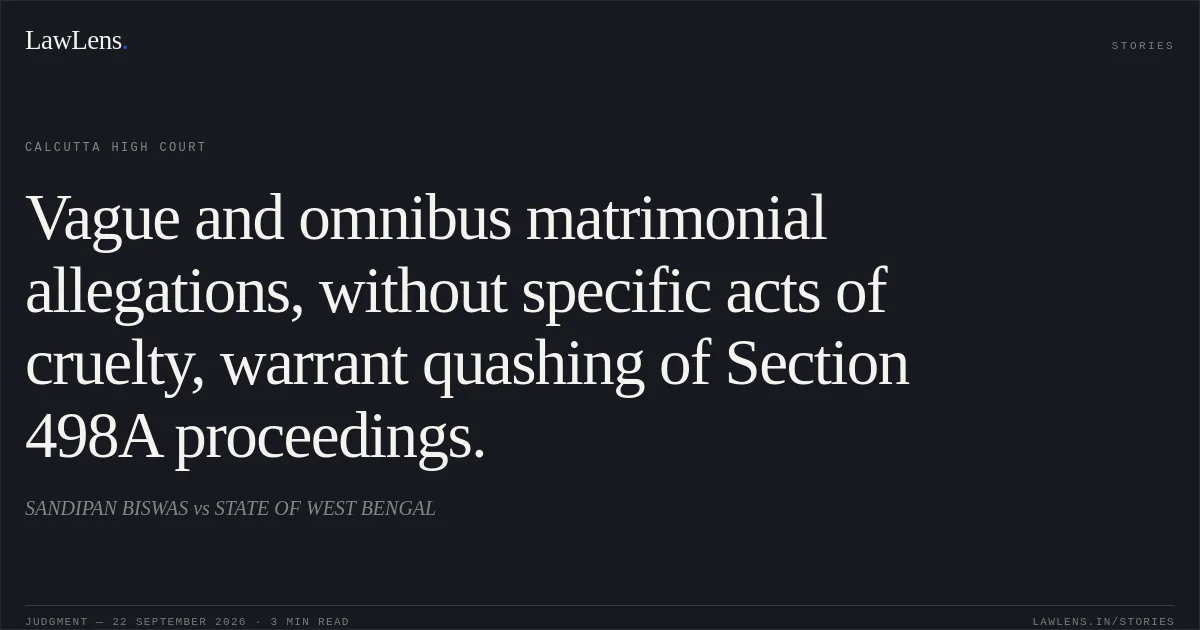
Source reference: paras. 1, 4, 13; pp. 1–2, 8Relying on Dara Lakshmi Narayana v. State of Telangana, the Court reiterated that vague, omnibus and non-particularised allegations in matrimonial disputes, without details of the time, place, manner or specific involvement of the accused, cannot ordinarily sustain criminal prosecution under Section 498A IPC.
Source reference: para. 10; pp. 4–8The Court further relied on G.V. Rao v. L.H.V. Prasad, Preeti Gupta v. State of Jharkhand and the principles in State of Haryana v. Bhajan Lal, particularly the category concerning proceedings instituted with ulterior motives or amounting to an abuse of process.
Source reference: para. 10; pp. 6–8The High Court’s inherent/quashing jurisdiction is to be exercised where continuation of the prosecution would constitute an abuse of the process of the court.
Source reference: no citationReasoning
The Court found that the allegations against the petitioner were general and lacked the specific particulars necessary to establish statutory cruelty under Section 498A IPC, including any concrete act of wilful conduct, dowry-related harassment, unlawful demand, or conduct endangering the complainant’s life, limb or physical or mental health.
Source reference: paras. 9–11; pp. 3–4, 8The materials also did not sufficiently establish the ingredients of criminal breach of trust under Section 406 IPC; no alleged stridhan articles were recovered or seized despite a search.
Source reference: para. 8; p. 3The Court additionally noted that the existence of a valid marriage itself was doubtful, which weakened the foundation of the Section 498A prosecution.
Source reference: para. 7; p. 2Applying the Supreme Court’s caution against prosecuting persons on the basis of vague matrimonial allegations, the Court concluded that permitting the proceeding to continue, despite the absence of the essential ingredients of the alleged offences, would amount to an abuse of the process of law.
Source reference: paras. 10–11; pp. 4–8Holding
The High Court allowed the revision and quashed G.R. Case No. 3509 of 2023, arising out of Kotwali Police Station Case No. 933 of 2023 dated 28 September 2023, under Sections 498A, 420, 406 and 34 IPC, insofar as the petitioner Sandipan Biswas was concerned.
The connected applications were disposed of, any interim order was vacated, and the judgment was directed to be communicated to the Trial Court for necessary compliance.
Source reference: paras. 14–17; pp. 8–9Acts & Sections Cited
6 provisions across 3 statutes referred to in this judgment. Each provision opens on LawLens.
Indian Penal Code, 18603
Code of Criminal Procedure, 19731
Original Court PDF
SANDIPAN BISWASvsSTATE OF WEST BENGAL
Click to open original judgment
Original judgment, available to read, download and summarize on LawLens.in