Facts
The petitioner, an 11-year-old minor, was residing with her family in Baramulla after migrating from Reasi.
Source reference: para. 2She developed fever, vomiting, cough and abdominal pain and was medically examined at a Sub-District Hospital, where an ultrasound revealed that she was pregnant.
Source reference: para. 2On being questioned, she disclosed that she had been forcibly subjected to sexual intercourse by an unidentified person.
Source reference: para. 3The matter was reported to the police, and she was placed in protective custody and lodged in a shelter home; the alleged offender had not yet been identified or arrested.
Source reference: para. 3The petitioner sought termination of the pregnancy, directions for apprehension of the accused, and compensation under the applicable Victim Compensation Scheme.
Source reference: para. 1The High Court constituted a Medical Board and directed that the minor be produced before it under appropriate protection.
Source reference: paras. 10–11Upon multidisciplinary examination, the Board opined that she was physically and mentally fit to undergo medical termination of pregnancy and that termination was medically feasible, subject to specialist supervision and necessary precautions.
Source reference: para. 12The pregnancy was assessed at approximately 22 weeks and 5 days as on 11 September 2026.
Source reference: para. 12By the date of judgment, 22 September 2026, the gestational age had advanced to approximately 24 weeks and 2 days.
Source reference: para. 16Issues
Whether the High Court, in exercise of its constitutional jurisdiction under Article 226, could permit medical termination of the minor’s pregnancy after the gestational period prescribed under Rule 3-B of the Medical Termination of Pregnancy Rules, 2003 had technically elapsed due to the time taken for medical and judicial consideration?
Source reference: paras. 16–20Whether, having regard to the minor’s age, the alleged sexual assault, and the Medical Board’s opinion, continuation of the pregnancy would violate her rights to life, bodily integrity, dignity, and physical and mental health?
Source reference: paras. 5–6, 20–22What consequential directions were necessary regarding the procedure, medical care, preservation of forensic material, confidentiality, and investigation?
Source reference: paras. 22–27Law Applied
The Court applied the Medical Termination of Pregnancy Act, 1971, read with Rule 3-B of the Medical Termination of Pregnancy Rules, 2003, under which minors and survivors of sexual assault, rape or incest are eligible for termination of pregnancy up to twenty-four weeks.
Source reference: paras. 14–15It further applied Article 226 of the Constitution, holding that the absence of a statutory remedy or the expiry of the statutory period does not exclude the constitutional remedy where enforcement of fundamental rights requires judicial intervention.
Source reference: para. 18Relying on S v. Union of India, SLP No. 14454/2026, decided on 24 April 2026, the Court held that constitutional courts must assess the circumstances from the perspective of the pregnant woman and her constitutional rights, rather than mechanically compel continuation of an unwanted pregnancy merely because the statutory period has elapsed.
Source reference: para. 19The Court also relied on the principles of bodily integrity, dignity, personal liberty, and protection of physical and mental health under Article 21.
Source reference: paras. 5–6Reasoning
The Court accepted that the pregnancy fell within Rule 3-B when the Medical Board examined the minor on 11 September 2026, at which time it was approximately 22 weeks and 5 days.
Source reference: paras. 12, 15–16Although the pregnancy had crossed twenty-four weeks by the date of judgment, the delay was attributable to the process of obtaining the Medical Board’s opinion and judicial consideration, and not to deliberate inaction by the petitioner.
Source reference: para. 17The Court treated the statutory framework as requiring harmonious application with its constitutional jurisdiction under Article 226.
Source reference: para. 18Given the petitioner’s extremely young age, the alleged rape, her vulnerability, the risks associated with continuing the pregnancy, and the Medical Board’s considered opinion that termination remained medically feasible, the Court held that compelling her to carry the pregnancy to term would undermine her constitutional rights and welfare.
Source reference: paras. 20–22The Court therefore permitted termination, while requiring specialist supervision, psychological support, medical safeguards, and preservation of legally permissible foetal material for forensic purposes.
Source reference: paras. 23–27Holding
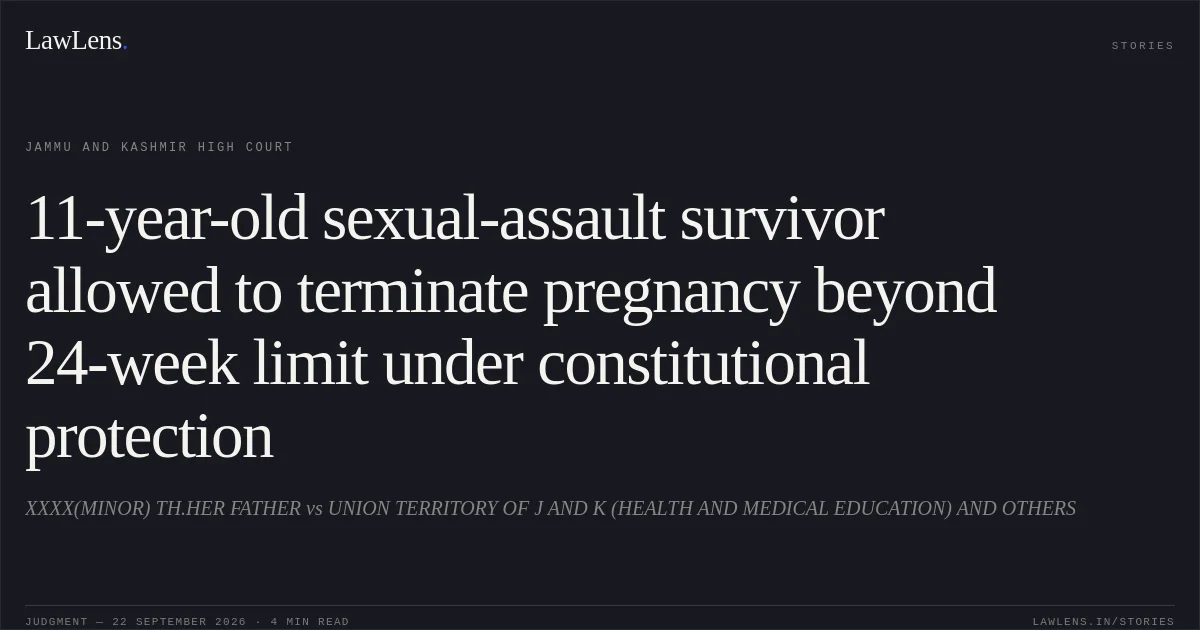
The petition was allowed.
The respondents were directed to take immediate and consequential steps for termination of the minor’s pregnancy, ordinarily at the Associated Hospital, Government Medical College, Baramulla, subject to the treating specialists’ assessment of available infrastructure and medical safety.
Source reference: paras. 22, 26–27The minor was permitted to have her mother or lawful guardian present, subject to medical protocol, and was to receive psychological counselling before and after the procedure.
Source reference: para. 23The authorities were directed to preserve and forward foetal tissue or other relevant material for DNA profiling and forensic examination in accordance with law.
Source reference: para. 24The petitioner’s identity, medical records and other identifying particulars were to remain confidential.
Source reference: para. 25All expenses relating to the procedure and associated care were to be borne by the respondents, with immediate referral to a better-equipped facility if medically required.
Source reference: para. 26The petition was disposed of in these terms.
Source reference: para. 28Acts & Sections Cited
1 provisions across 1 statute referred to in this judgment. Each provision opens on LawLens.
Medical Termination of Pregnancy Act, 19711
Original Court PDF
XXXX(MINOR) TH.HER FATHERvsUNION TERRITORY OF J AND K (HEALTH AND MEDICAL EDUCATION) AND OTHERS
Click to open original judgment
Original judgment, available to read, download and summarize on LawLens.in