Facts
The appellant, Gaurav Aneja, claimed appointment as Lambardar of Village Akbarpur alias Murad Majra following the death of his father, Ram Singh, who had held that office.
Source reference: para. 1After the prescribed process, the appellant and Harvinder Singh, respondent no. 2, remained the two candidates. The Collector, Patiala appointed the appellant as Lambardar on 26 August 2014, principally considering his educational qualification and hereditary claim.
Source reference: para. 2; p. 4On appeal, the Commissioner, Patiala Division set aside the appointment and accepted respondent no. 2’s claim on 12 November 2014.
Source reference: para. 3The Financial Commissioner (Appeals), Punjab dismissed the appellant’s further appeal on 25 February 2020.
Source reference: para. 4The appellant’s writ petition was dismissed by the learned Single Judge on 24 April 2026, who found the revenue authorities’ orders reasoned and held respondent no. 2 to be suitable for appointment.
Source reference: para. 5Issues
Whether the appellant’s hereditary claim, arising from his father’s previous appointment as Lambardar, created a right or sufficiently decisive ground for his appointment as Lambardar?
Source reference: paras. 6–12Whether the revenue authorities and the learned Single Judge properly assessed the candidates’ suitability, including educational qualifications, personal availability in the village, and other factors under the applicable rules?
Source reference: paras. 10–13Whether the learned Single Judge’s refusal to interfere with the orders of the Commissioner and Financial Commissioner disclosed any illegality warranting appellate interference?
Source reference: paras. 5, 14Law Applied
The Court applied Section 28(1) of the Punjab Land Revenue Act, 1887, which authorises the State Government to frame rules regulating the appointment of village officers.
Source reference: para. 9; p. 3It relied on Rule 15 of the Punjab Land Revenue Rules, 1909, which requires consideration of factors including hereditary claim, property in the estate, services rendered by the candidate or family, personal influence, character, ability, freedom from indebtedness, community strength, and national service.
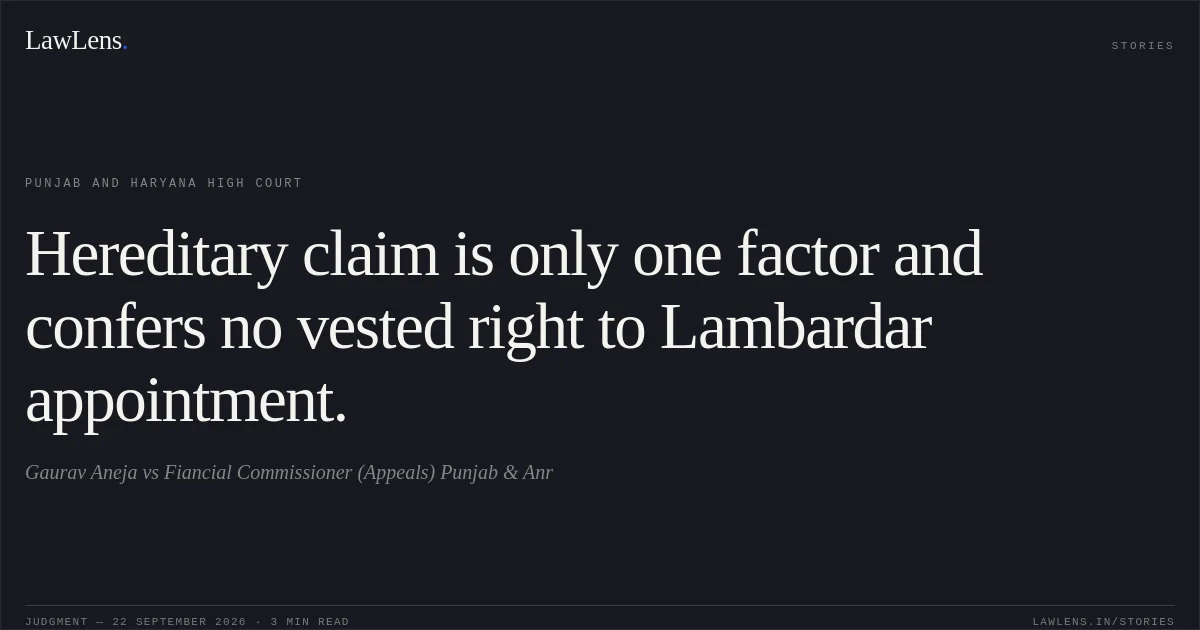
Source reference: para. 10; pp. 3–4The governing principle is that hereditary claim is merely one relevant consideration and is neither the sole nor decisive factor; appointment to the office of Lambardar cannot be claimed as a matter of hereditary right.
Source reference: para. 11; p. 4The Court also relied on Neeraj Kumar v. State of Haryana and Others, 2013 (4) RCR (Civil) 207, for the principle that the candidate’s availability in the village is a vital factor in determining suitability for appointment as Lambardar.
Source reference: para. 13; p. 5Reasoning
The Court held that the appellant’s hereditary connection to the office could not, by itself, outweigh the other considerations prescribed under Rule 15.
Source reference: paras. 10–12The Collector had treated the appellant’s alleged educational superiority as significant, but the record showed that the appellant had studied only up to 10+2, contrary to the basis apparently relied upon for his appointment.
Source reference: para. 12; p. 4The authorities also found that the appellant resided in Patiala city and was not readily available to villagers for their day-to-day requirements, whereas local availability was of paramount importance for a village headman.
Source reference: para. 12; p. 5Applying the principle in Neeraj Kumar, the Court concluded that respondent no. 2’s suitability was properly accepted by the revenue authorities.
Source reference: para. 13; p. 5Since the Commissioner and Financial Commissioner had passed reasoned orders and the learned Single Judge found no legal infirmity in them, no ground for appellate interference was established.
Source reference: paras. 5, 12–14Holding
The Court answered the issues against the appellant. It held that hereditary claim did not confer an indefeasible or vested right to appointment as Lambardar and that the appellant’s lack of regular availability in the village was a material factor supporting respondent no. 2’s selection.
Finding no illegality in the judgment of the learned Single Judge dated 24 April 2026 or in the orders of the revenue authorities, the Division Bench dismissed the appeal.
Source reference: para. 14All pending civil miscellaneous applications, if any, were also disposed of.
Source reference: para. 15Acts & Sections Cited
1 provisions across 1 statute referred to in this judgment. Each provision opens on LawLens.
Punjab Land-Revenue Act, 18871
Original Court PDF
Gaurav AnejavsFiancial Commissioner (Appeals) Punjab & Anr
Click to open original judgment
Original judgment, available to read, download and summarize on LawLens.in