Facts
The petitioner was employed as Corporate Manager with Manmachine India Pvt. Ltd. and was responsible for recovering amounts payable by customers to the company. A sum of ₹1,43,120 was due from Yogesh M. Parmar, Director of Fermatech Conferate Solutions. The petitioner allegedly induced Parmar to issue the payment cheque in favour of Arvind Clean Line, an unrelated entity, instead of Manmachine India Pvt. Ltd. When Parmar contacted the company, the alleged deception came to light and payment of the cheque was stopped. The petitioner allegedly confessed to the wrongdoing and stated that he had also given away four machines. An FIR was registered for offences under Sections 420, 408 and 511 of the IPC, and a chargesheet was subsequently filed in C.C. No. 232/PW/2010.
Source reference: pp. 2–4, paras. 4.1–4.4The petitioner’s application for discharge under Section 239 CrPC was rejected by the Metropolitan Magistrate on 7 December 2016. His revision application was thereafter dismissed by the Additional Sessions Judge on 7 July 2017. The petitioner challenged both orders before the High Court under Article 227 of the Constitution and Section 482 CrPC.
Source reference: pp. 4–6, paras. 5, 9–10Issues
Whether the materials in the FIR, chargesheet and accompanying documents disclosed a prima facie case or a ground for presuming that the petitioner had committed the alleged offences under Sections 420, 408 and 511 of the IPC?
Source reference: pp. 5–6, 12–13, paras. 8–10, 17–19Whether the petitioner was entitled to discharge under Section 239 CrPC on the ground that the charges were “groundless”?
Source reference: pp. 8–13, paras. 12–19Whether the High Court, in exercise of jurisdiction under Article 227 of the Constitution and Section 482 CrPC, should interfere with the concurrent orders refusing discharge?
Source reference: pp. 1, 4–6, 9–14, paras. 1, 5, 10, 20–21Law Applied
The Court applied Section 239 CrPC, under which an accused in a warrant case instituted on a police report may be discharged only where the Magistrate considers the charge to be “groundless”; this means that there is no material giving rise to a presumption that the accused committed the offence.
Source reference: pp. 8–13, paras. 12, 15, 17–19Sections 227 and 245 CrPC were considered by reference to the Supreme Court’s explanation that, at the discharge or charge-framing stage, the court examines the record for a prima facie case or strong suspicion and does not conduct a meticulous assessment of evidentiary reliability.
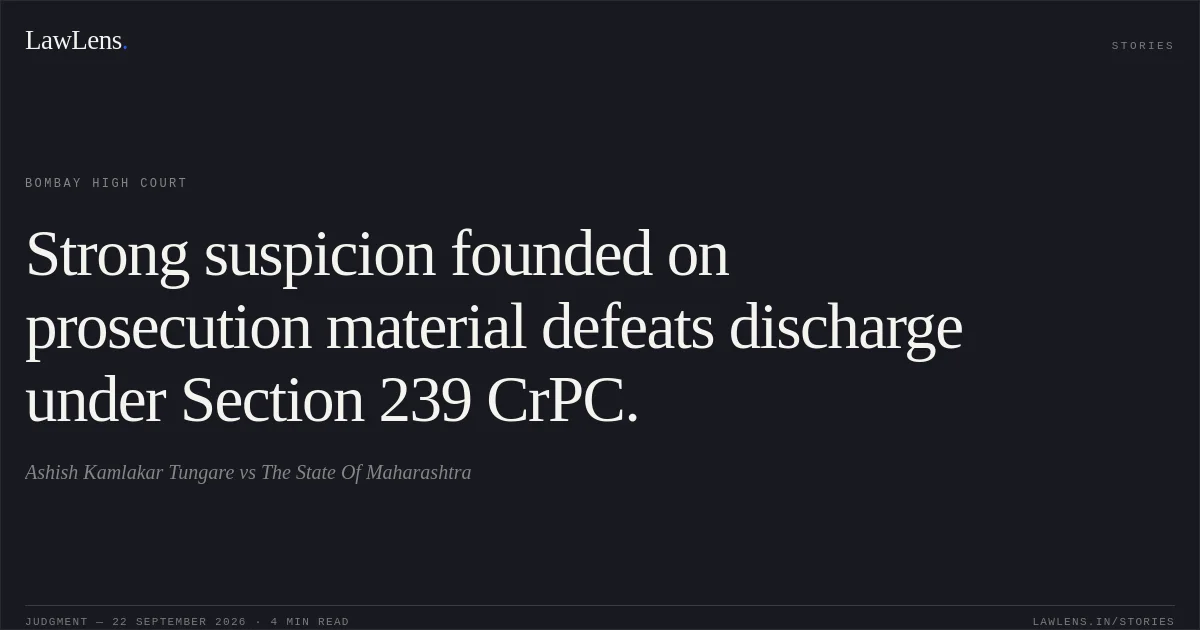
Source reference: p. 8, para. 12Relying on Union of India v. Prafulla Kumar Samal, AIR 1979 SC 366, R.S. Nayak v. A.R. Antulay, AIR 1986 SC 2045, State of Maharashtra v. Som Nath Thapa, (1996) 4 SCC 659, and Palvinder Singh v. Balwinder Singh, (2008) 14 SCC 504, the Court held that strong suspicion founded on the prosecution material is sufficient to proceed to trial.
Source reference: pp. 7–10, paras. 11–14It further relied on State of T.N. v. R. Soundirarasu, (2023) 6 SCC 768, which held that “groundless” means that the materials disclose no ground for presuming commission of the offence, and on K. Ramakrishna v. State of Bihar, (2000) 8 SCC 547, for the principle that the court should not weigh the reliability or sufficiency of evidence at the discharge stage.
Source reference: pp. 10–12, para. 15The alleged substantive offences were Sections 420, 408 and 511 IPC.
Source reference: pp. 3–4, para. 4.4Reasoning
The Court found that the petitioner’s duty was to collect money payable to Manmachine India Pvt. Ltd., yet he allegedly represented to the debtor that the cheque should be issued in favour of Arvind Clean Line, an unrelated entity.
Source reference: p. 6, para. 8This conduct, together with the allegations in the FIR and the material collected during investigation, prima facie indicated deception and dishonest inducement, thereby creating a strong suspicion sufficient to proceed under the principles governing Section 239 CrPC.
Source reference: pp. 6, 12–13, paras. 8, 17–19The fact that the cheque was stopped before payment and that no property or money was ultimately recovered from the petitioner did not render the charge groundless at the preliminary stage. The petitioner’s arguments concerning the absence of recovery, alleged interested witnesses, lack of wrongful loss or gain, and the evidentiary weaknesses in the prosecution case involved matters for trial and could not be conclusively adjudicated in discharge proceedings.
Source reference: pp. 4–5, 11–12, paras. 6.1–6.4, 15, 17Since both the Magistrate and the Revisional Court had found prima facie material and their orders contained reasons, the High Court found no basis to exercise its supervisory or inherent jurisdiction to interfere.
Source reference: pp. 6, 13–14, paras. 10, 17–20Holding
The High Court held that the prosecution material disclosed a prima facie case and a strong suspicion against the petitioner; consequently, the charges could not be regarded as “groundless” under Section 239 CrPC.
The petition was therefore dismissed, and the orders dated 7 December 2016 and 7 July 2017 refusing discharge were left undisturbed.
Source reference: p. 14, paras. 20–21The Registry was directed to communicate a copy of the order to Respondent No. 2.
Source reference: p. 14, para. 22Acts & Sections Cited
9 provisions across 2 statutes referred to in this judgment. Each provision opens on LawLens.
Code of Criminal Procedure, 19736
Indian Penal Code, 18603
Original Court PDF
Ashish Kamlakar TungarevsThe State Of Maharashtra
Click to open original judgment
Original judgment, available to read, download and summarize on LawLens.in