Facts
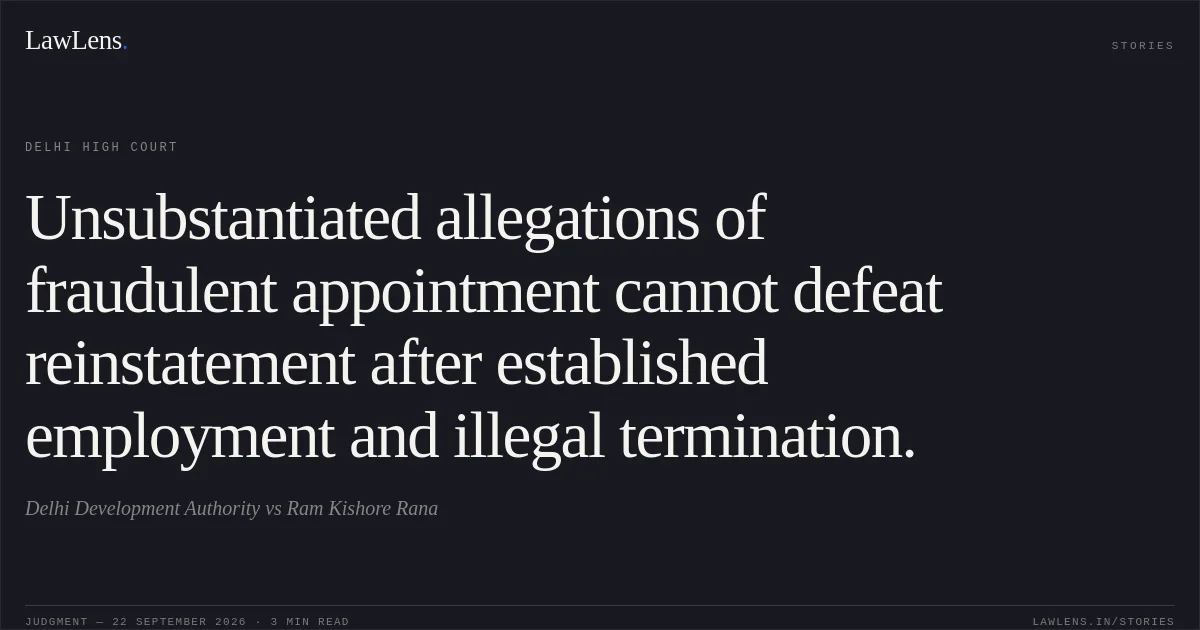
Ram Kishore Rana claimed that he was appointed and confirmed as a Beldar with the Delhi Development Authority (DDA) from 3 January 1985 and worked until 6 July 1992, after which he was denied duties without notice, enquiry, or compliance with Section 25-F of the Industrial Disputes Act, 1947. He raised an industrial dispute alleging illegal termination.
Source reference: p.2, para. 4The DDA denied any valid employment relationship and alleged that Rana had secured engagement through a forged appointment letter.
Source reference: p.2, para. 5The Labour Court allowed Rana’s claim, directing reinstatement with full back wages, continuity of service and consequential benefits, and imposed litigation costs of ₹20,000.
Source reference: p.1, paras. 1–2During the proceedings, the DDA relied on a criminal case alleging fraud and forgery. However, the CBI confirmed that Rana had never been charge-sheeted and that the other accused had been acquitted.
Source reference: pp.4–5, paras. 10–11Rana relied on employment records, including his identity card, regularisation list, overtime bill, provident fund receipts, office orders and increment certificates.
Source reference: p.5, para. 12The Labour Court had also previously awarded him unpaid wages and overtime under Section 33-C(2) of the Industrial Disputes Act, and that order had attained finality.
Source reference: p.5, para. 13; p.6, para. 14The DDA challenged the Labour Court’s award under Articles 226 and 227 of the Constitution.
Source reference: p.1, para. 1Issues
Whether the Labour Court erred in holding that Rana was an employee of the DDA and that his services had been illegally terminated, particularly when the DDA alleged that his engagement was procured through fraud and a forged appointment letter.
Source reference: pp.2–3, paras. 5–8; p.8, para. 17Whether the direction for reinstatement and consequential benefits was sustainable notwithstanding Rana’s alleged or actual attainment of the age of superannuation.
Source reference: p.3, paras. 6 and 9; p.8, para. 18Whether the Labour Court’s award granting reinstatement, full back wages, continuity of service, consequential benefits and litigation costs warranted interference under Articles 226 and 227 of the Constitution.
Source reference: p.1, paras. 1–2; p.8, paras. 19–21Law Applied
The Court applied Section 25-F of the Industrial Disputes Act, 1947, which requires compliance with prescribed conditions, including notice or notice pay and retrenchment compensation, before retrenchment of an eligible workman.
Source reference: no citationSection 33-C(2) of the Act provides for computation and recovery of monetary benefits due to a workman; the earlier order granting Rana unpaid wages and overtime under this provision, having attained finality, was treated as relevant evidence of the employment relationship.
Source reference: p.6, para. 14The Court exercised judicial review under Articles 226 and 227 of the Constitution, while assessing whether the Labour Court’s findings were legally unsustainable.
Source reference: no citationIt further applied the principle that relief of reinstatement and consequential service benefits ordinarily remains limited to the date on which the employee would have reached superannuation.
Source reference: p.8, para. 18No specific judicial precedent was cited in the judgment.
Source reference: no citationReasoning
The Court found that the DDA’s fraud allegation was unsupported because the alleged forged appointment letter was never produced.
Source reference: p.8, para. 17In contrast, the record contained substantial evidence of Rana’s engagement, including employment and service records, and the DDA’s witness admitted that Rana had joined in 1985 in the regular pay scale, had worked with the DDA, and that the relevant documents were not being challenged.
Source reference: pp.6–7, para. 15The witness also admitted that no charge-sheet, departmental enquiry, notice or notice pay had been issued, and that there was no judicial finding that Rana had committed fraud.
Source reference: pp.6–7, para. 15The DDA’s reliance on the criminal proceedings was further weakened by the CBI’s confirmation that Rana had never been charge-sheeted and that the other accused had been acquitted.
Source reference: pp.4–5, paras. 10–11Accordingly, the factual foundation of the DDA’s defence failed, and the Labour Court’s finding of illegal termination was not shown to be perverse or legally erroneous.
Source reference: p.8, para. 17As to superannuation, the Court held that the award would operate only up to the date on which Rana would have attained the age of superannuation, thereby addressing the DDA’s objection without disturbing the award in principle.
Source reference: p.8, para. 18Holding
The High Court dismissed the DDA’s writ petition and upheld the Labour Court’s award granting Rana reinstatement with full back wages, continuity of service and consequential benefits, subject to limitation of the relief up to the date of superannuation.
Since the award had already been partly implemented, the DDA was directed to release the remaining amount and consequential benefits, if any, within four weeks.
Source reference: p.8, para. 20The pending applications were also disposed of.
Source reference: p.8, para. 21Acts & Sections Cited
1 provisions across 1 statute referred to in this judgment. Each provision opens on LawLens.
Code of Civil Procedure, 19081
Original Court PDF
Delhi Development AuthorityvsRam Kishore Rana
Click to open original judgment
Original judgment, available to read, download and summarize on LawLens.in