Facts
On 22 May 2021, respondent no. 2, Rajesh Kumar Singh, alleged that while riding his scooty near Max Hospital, Lajpat Nagar-IV, New Delhi, his vehicle was hit by a car owned and driven by the petitioner, Sandhya Jassal.
Source reference: p.2, paras. 2.1–2.3He sustained a left-knee fracture and was medically examined at Jai Prakash Narayan Apex Trauma Centre, AIIMS.
Source reference: p.2, paras. 2.1–2.3FIR No. 0274/2021 was registered at PS Amar Colony under Sections 279 and 337 IPC.
Source reference: p.2, para. 2.4The petitioner’s vehicle and documents were seized, she was arrested on 3 June 2021, and a chargesheet was subsequently filed under Sections 279 and 338 IPC before the Metropolitan Magistrate, Saket Courts.
Source reference: p.2, para. 2.4; p.3, para. 2.5Respondent no. 2 also instituted MACT proceedings, which were settled through a Lok Adalat Award for ₹3,70,000 payable by the insurer.
Source reference: p.3, para. 2.6During the criminal proceedings, the parties entered into a Memorandum of Settlement dated 22 August 2024, under which the petitioner agreed to pay respondent no. 2 ₹1,20,000 in full and final settlement; the amount was paid in instalments.
Source reference: p.3, paras. 2.7–2.9Respondent no. 2 confirmed before the High Court that he had received the entire settlement amount and had no further claim against the petitioner.
Source reference: p.3, para. 4The State also expressed no objection to quashing the proceedings.
Source reference: p.4, paras. 7–9Issues
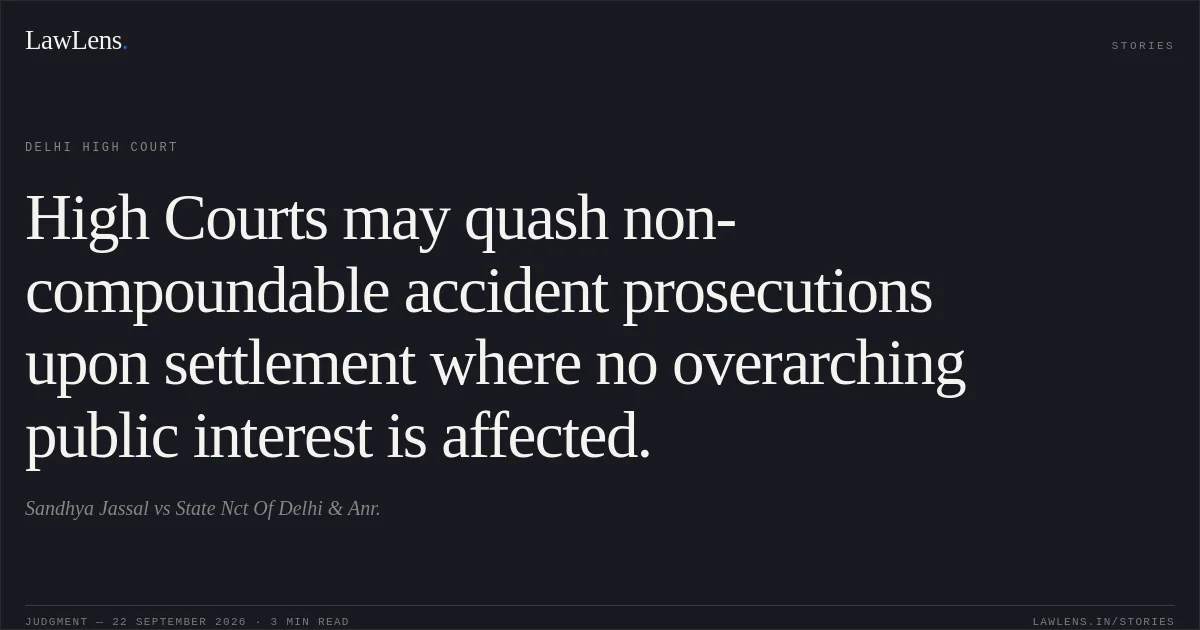
Whether the High Court could exercise its inherent jurisdiction under Section 528 of the BNSS, corresponding to Section 482 Cr.P.C., to quash proceedings arising from non-compoundable offences under Sections 279 and 338 IPC on the basis of a voluntary settlement between the accused and the injured complainant.
Source reference: p.4, paras. 11–16Whether, in view of the settlement, the predominantly private nature of the dispute, and the remote likelihood of conviction, continuation of the FIR and criminal proceedings would amount to an abuse of process or defeat the ends of justice.
Source reference: p.5, para. 17; p.7, paras. 18–19Law Applied
The Court applied Section 528 of the BNSS, corresponding to Section 482 Cr.P.C., which empowers the High Court to quash criminal proceedings to secure the ends of justice or prevent abuse of the process of court, even where the alleged offence is non-compoundable.
Source reference: pp.5–6, para. 17Relying on Gian Singh v. State of Punjab, (2012) 10 SCC 303, the Court held that proceedings may be quashed where the dispute is predominantly private or civil in nature, the parties have genuinely settled their differences, and continuation of the prosecution would serve no useful purpose, subject to the exclusion of heinous offences and offences affecting public interest.
Source reference: pp.5–6, para. 17Under Narinder Singh v. State of Punjab, (2014) 6 SCC 466, such power must be exercised sparingly after considering the nature and gravity of the offence, the voluntariness of the settlement, the likelihood of conviction, and whether continuation would cause injustice.
Source reference: pp.6–8, para. 18The Court also relied on Deepak Kumar v. State (NCT of Delhi), 2024 SCC OnLine Del 1305, for the principle that quashing on settlement depends on the facts of each case and requires consideration of the offence’s impact on society.
Source reference: p.8, para. 20Reasoning
The Court found that the allegations arose from a motor-vehicle accident causing personal bodily injury and did not involve murder, rape, dacoity, corruption, abuse of public office, or any other offence having an overriding public dimension.
Source reference: p.4, paras. 12–15Although Section 279 IPC was non-compoundable, the dispute was predominantly private and had been resolved through both the MACT settlement and the subsequent mediated settlement.
Source reference: p.4, paras. 10, 14The petitioner had paid the agreed ₹1,20,000, and respondent no. 2 voluntarily confirmed receipt of the full amount and the absence of any further claim.
Source reference: p.3, para. 4; p.4, paras. 10, 14In these circumstances, the Court concluded that the possibility of conviction was remote and that continuing the prosecution would serve no fruitful purpose, thereby making quashing appropriate to secure the ends of justice.
Source reference: p.8, paras. 19–20Holding
The High Court allowed the petition and exercised its inherent jurisdiction under Section 528 BNSS.
FIR No. 0274/2021 dated 31 May 2021, registered at PS Amar Colony under Sections 279 and 337 IPC, together with the chargesheet and all proceedings arising from it, was quashed on the basis of the parties’ settlement.
Source reference: p.9, paras. 21–22The parties were directed to remain bound by the Memorandum of Settlement dated 22 August 2024, and the pending application was also disposed of.
Source reference: p.9, paras. 23–24Acts & Sections Cited
7 provisions across 3 statutes referred to in this judgment. Each provision opens on LawLens.
Bharatiya Nagarik Suraksha Sanhita, 20231
Indian Penal Code, 18603
Code of Criminal Procedure, 19733
Original Court PDF
Sandhya JassalvsState Nct Of Delhi & Anr.
Click to open original judgment
Original judgment, available to read, download and summarize on LawLens.in