Facts
The petitioners and private respondents were serving as Sub-Divisional Engineers (SDEs) in the Haryana Development and Panchayats Department.
Source reference: paras. 7–15The private respondents had obtained Engineering degrees through distance education from deemed universities in Rajasthan during the academic sessions 2001–2005.
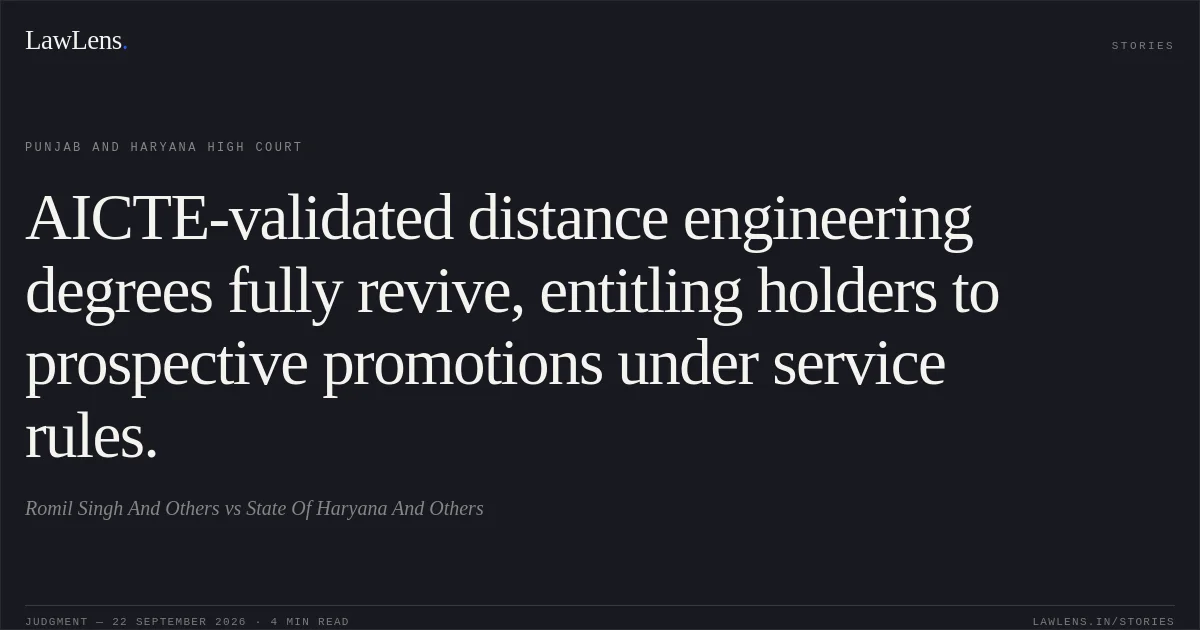
Source reference: paras. 7–15Their degrees were affected by the Supreme Court’s judgment in Orissa Lift Irrigation Corporation Ltd. v. Rabi Sankar Patro, but all private respondents cleared the AICTE-UGC special validation examination in the first attempt, resulting in revival and validation of their degrees.
Source reference: paras. 7–15, 27, 42, 54–59The State initiated consideration of the private respondents for promotion to Executive Engineer.
Source reference: paras. 15–24The petitioners challenged this process, contending that the private respondents’ distance-education degrees could not support further promotion and that the Supreme Court’s directions permitted only restoration of benefits enjoyed as on 3 November 2017, not future promotion.
Source reference: paras. 15–24, 47It was also established that they had been promoted as SDEs under the diploma-holder quota and not on the basis of their disputed Engineering degrees.
Source reference: paras. 49–52, 65, 70The Court further found that the petitioners were junior to the private respondents and lacked the requisite eight years’ experience as SDEs for consideration for promotion as Executive Engineers.
Source reference: para. 48Issues
1. Whether the private respondents, having obtained Engineering degrees through distance education during 2001–2005 but having cleared the AICTE-UGC validation examination in the first attempt, were eligible to be considered for promotion as Executive Engineers?
Source reference: paras. 47, 53–652. Whether the expression “no additional benefit” in Ashok Kumar v. Depinder Singh Dhesi barred the private respondents from obtaining future, prospective promotion after their degrees had been fully revived and validated?
Source reference: paras. 53, 60–643. Whether the petitioners had the locus to challenge the proposed promotion of the private respondents when they were junior to them and did not possess the requisite qualifying service?
Source reference: paras. 48, 654. Whether the initial promotion of the private respondents as SDEs was invalid because their Engineering degrees were obtained through distance education?
Source reference: paras. 49–52Law Applied
The Court applied Rule 9 and Appendix B of the Haryana Development and Panchayats Department (Group A) Service Rules, 1988, under which promotion to Executive Engineer requires the prescribed Engineering qualification and eight years’ experience as SDE.
Source reference: para. 5It also considered Rules 7 and 9 of the Haryana Development and Panchayats Department (Group B) Service Rules, 2016, including the separate promotional channels for appointment as SDE, particularly the diploma-holder quota, which did not require an Engineering degree.
Source reference: paras. 49–51Rule 17, concerning governmental power of relaxation, was also noted.
Source reference: paras. 6, 65Under Orissa Lift Irrigation Corporation Ltd. v. Rabi Sankar Patro, (2018) 1 SCC 468, Engineering degrees obtained through distance education by students enrolled in 2001–2005 were suspended pending an AICTE examination; on successful completion, the degrees and the advantages flowing from them were to be restored and the degrees were to revive fully.
Source reference: paras. 54–56The subsequent clarificatory order, reported as (2018) 2 SCC 298, permitted candidates who passed the examination in the first attempt to retain the benefits flowing from their degrees.
Source reference: paras. 57–59In Ashok Kumar v. Depinder Singh Dhesi, (2019) 8 SCC 280, the Supreme Court clarified that restoration meant restoration of benefits enjoyed on the date of the original judgment, but also stated that, once the degree stood restored, the candidate would be eligible for entitlements available in accordance with law.
Source reference: paras. 60–64The Court also relied on Rajpal v. State of Haryana, CWP-1591-2017, and State of Haryana v. Sanjeev Tanwar, LPA-1659-2024, holding that validated degree-holders could claim the ordinary fruits of their qualifications, including consideration for promotion.
Source reference: paras. 66–69Reasoning
The Court rejected the petitioners’ interpretation that the private respondents’ service status was permanently frozen as on 3 November 2017.
Source reference: paras. 60–64It distinguished between retrospective restoration of a benefit not previously enjoyed—which the Supreme Court had prohibited—and prospective entitlement arising under the service rules after the degree had been validated.
Source reference: paras. 60–64The terms “revived fully” and “all advantages or benefits shall be restored” in Orissa Lift Irrigation meant that, after successful completion of the AICTE test, the degrees became valid qualifications for all lawful purposes; the Supreme Court had not imposed a permanent embargo on future promotions.
Source reference: paras. 55–56, 64–65The private respondents had passed the AICTE examination in the first attempt, and their degrees had accordingly been validated.
Source reference: paras. 64–65Moreover, their initial appointment and promotion as SDEs were not founded on the disputed degrees but on their diplomas and length of service, so the challenge to their status as SDEs was factually unsustainable.
Source reference: paras. 49–52, 70The Court also held that the petitioners lacked a presently enforceable interest because they were junior to the private respondents and had not completed the required eight years’ service as SDEs.
Source reference: paras. 48, 65The decisions in Rajpal and Sanjeev Tanwar, including the dismissal of the challenge to the latter decision by the Supreme Court, reinforced the conclusion that a validated degree-holder could be considered for promotion in accordance with law.
Source reference: paras. 66–69Holding
The Court held that the private respondents’ Engineering degrees stood fully revived and validated after they cleared the AICTE-UGC examination in the first attempt.
The prohibition against “additional benefits” prevented only retrospective restoration of benefits not enjoyed on 3 November 2017; it did not bar prospective consideration for promotion under the applicable service rules.
Source reference: paras. 64–65, 69–70The private respondents were therefore eligible to be considered for promotion as Executive Engineers, subject to satisfaction of all other statutory requirements.
Source reference: paras. 64–65, 69–70The petitioners’ challenge was dismissed for lack of merit, and the pending applications were also disposed of.
Source reference: paras. 71–72The application for placing the replication on record was allowed.
Source reference: paras. 1–3Acts & Sections Cited
1 provisions across 1 statute referred to in this judgment. Each provision opens on LawLens.
Code of Civil Procedure, 19081
Original Court PDF
Romil Singh And OthersvsState Of Haryana And Others
Click to open original judgment
Original judgment, available to read, download and summarize on LawLens.in