Facts
The petitioner, a Head Assistant/Establishment Clerk with Jammu & Kashmir Projects Construction Corporation Ltd. (JKPCC), was implicated as a co-accused in FIR No. 07/2011, registered by the Vigilance Organization, Kashmir, concerning the preparation of the service book of an employee allegedly appointed on the basis of a forged matriculation certificate.
Source reference: p.2, para. 2Although the FIR was registered in 2011, no departmental or preliminary fact-finding inquiry was initiated against the petitioner for several years.
Source reference: no citationAfter the Vigilance investigation culminated in the filing of a charge-sheet before the Anti-Corruption Court, Anantnag, the Managing Director of JKPCC placed the petitioner under suspension by Order No. 168 of 2020 dated 18 December 2020.
Source reference: p.2, para. 1; p.3, para. 3The petitioner challenged the suspension, contending that it was belated, procedurally improper, and unsupported by any departmental inquiry.
Source reference: p.3, para. 4During the pendency of the proceedings, he retired from service on 31 May 2021.
Source reference: p.7, para. 12Issues
Whether the impugned suspension order was amenable to judicial review on the ground that it was arbitrary, procedurally improper, or based on irrelevant considerations.
Source reference: p.3, para. 6; p.4, para. 7Whether the petitioner’s prolonged suspension, in the absence of any departmental inquiry and notwithstanding the filing of the criminal charge-sheet and his subsequent retirement, could be sustained in law.
Source reference: p.7, para. 12; p.7–8, paras. 13–14Whether the principles governing prolonged suspension laid down in Ajay Kumar Choudhary v. Union of India applied to the petitioner’s case.
Source reference: p.7, para. 12Law Applied
The Court applied the principle of limited judicial review over administrative decisions, holding that interference is justified where the decision is illogical, procedurally improper, based on wholly irrelevant considerations, or so unreasonable that no rational authority could have reached it, as explained in Jayrajbhai Jayantibhai Patel v. Anilbhai Nathubhai Patel, (2006) 8 SCC 200.
Source reference: p.4, para. 7It relied on State of Orissa v. Bimal Kumar Mohanty, AIR 1994 SC 2296, for the rule that suspension is not an automatic or routine measure but must be based on the gravity of the alleged misconduct, the nature of the allegations, and the public interest involved.
Source reference: p.4, para. 9Under Union of India v. Ashok Kumar Agarwal, (2013) 16 SCC 147, suspension must ordinarily be supported by a strong prima facie case involving charges that may warrant a major penalty.
Source reference: p.5, para. 10The Court further applied Ajay Kumar Choudhary v. Union of India, (2015) 7 SCC 291, which held that suspension is transitory and should not ordinarily continue beyond three months where charges have not been served; if charges are served, any extension must be supported by a reasoned order, consistent with the employee’s dignity and right to a speedy conclusion of proceedings.
Source reference: p.5–7, para. 11Although suspension is not itself a punishment, prolonged suspension without progress in disciplinary proceedings may acquire a punitive and stigmatic character.
Source reference: p.8, para. 14Reasoning
The Court recognized that suspension and its continuation ordinarily lie within the employer’s domain and that judicial review in such matters is limited.
Source reference: p.7, para. 13However, the petitioner had remained under suspension from December 2020, had retired on 31 May 2021, and was not subjected to any parallel departmental inquiry despite the passage of almost six years.
Source reference: p.7, paras. 12–13The pendency of the criminal trial did not justify indefinite suspension, particularly because no departmental proceedings were shown to exist that could be prejudiced by revocation of the suspension.
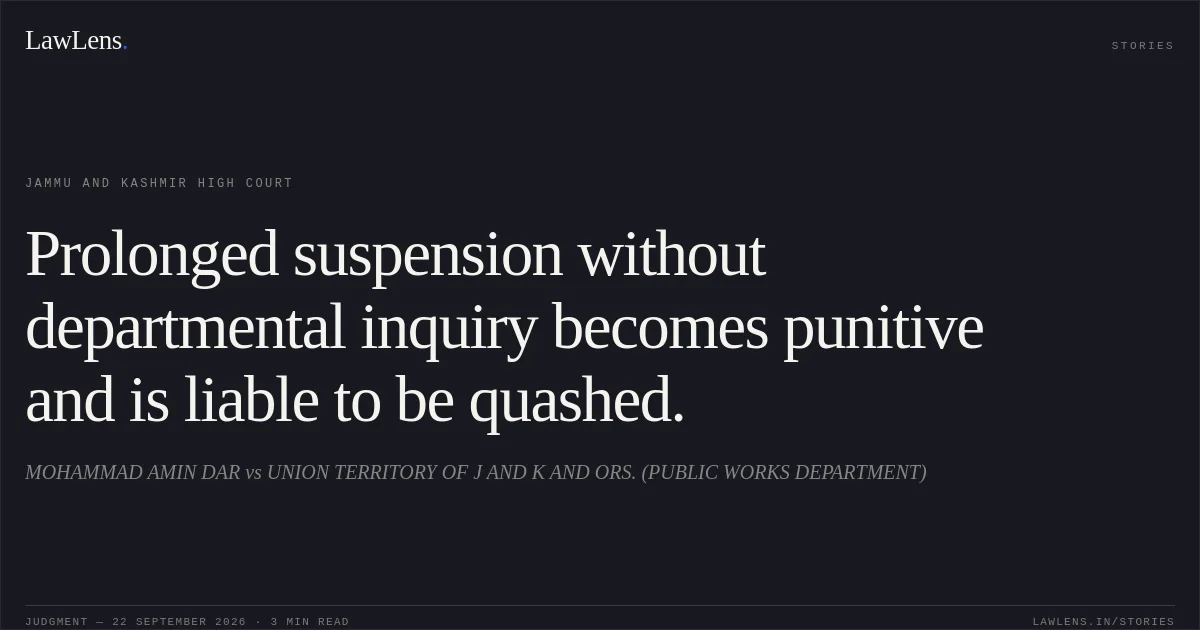
Source reference: no citationApplying Ajay Kumar Choudhary, the Court held that the prolonged suspension, unsupported by a charge-sheet or departmental inquiry and unexplained by any plausible reason, had ceased to be a temporary administrative measure and had effectively assumed a punitive and stigmatic character.
Source reference: p.7–8, paras. 13–14The respondents therefore failed to discharge their obligation to proceed expeditiously and in accordance with law.
Source reference: p.8, para. 14Holding
The Court allowed the writ petition and quashed Order No. 168 of 2020 dated 18 December 2020 by which the petitioner had been placed under suspension.
The respondents were directed to notionally reinstate the petitioner within six weeks, settle the period of suspension, release all consequential benefits, and process his pensionary benefits in accordance with the applicable rules.
Source reference: p.8, para. 15The writ petition and pending miscellaneous applications were disposed of accordingly.
Source reference: p.8, para. 16Acts & Sections Cited
1 provisions across 1 statute referred to in this judgment. Each provision opens on LawLens.
Code of Criminal Procedure, 19731
Original Court PDF
MOHAMMAD AMIN DARvsUNION TERRITORY OF J AND K AND ORS. (PUBLIC WORKS DEPARTMENT)
Click to open original judgment
Original judgment, available to read, download and summarize on LawLens.in