Facts
The appellant filed an application under Section 276 of the Indian Succession Act, 1925, seeking probate of a Will dated 23.12.2003 concerning Khasra No. 119/1, measuring 0.809 hectare.
Source reference: para. 1The IIIrd District Judge, Singrauli, rejected the application on 03.09.2022, holding that the appellant had failed to examine the attesting witnesses despite several opportunities.
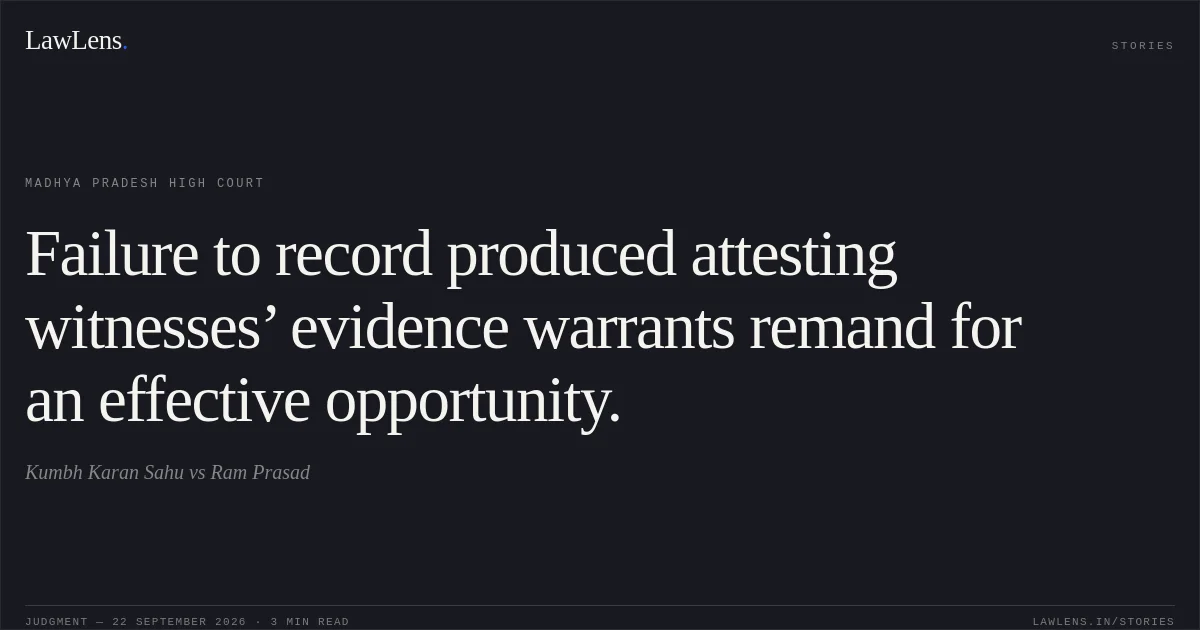
Source reference: para. 1Before the High Court, the appellant contended that both attesting witnesses had in fact been produced, but the Trial Court failed to record their evidence.
Source reference: para. 2On examination of the order-sheets, the High Court found that attesting witness Ramkripal was present on 04.01.2022 but his evidence was not recorded, and that attesting witness Kherai Shah was present on 28.07.2022 with his examination-in-chief affidavit already on record, yet neither his examination nor cross-examination was recorded before the evidence was closed.
Source reference: para. 5Issues
Whether the Trial Court was justified in rejecting the probate application for non-examination of the attesting witnesses when the record showed that the witnesses had been produced before it but their evidence was not recorded?
Source reference: paras. 5–6Whether the appellant was entitled to one effective opportunity to examine the attesting witnesses and have the probate application decided on merits?
Source reference: paras. 6–9Law Applied
The Court applied Section 276 of the Indian Succession Act, 1925, governing applications for grant of probate.
Source reference: para. 1It further applied the procedural principle that a party should receive a reasonable and effective opportunity to lead relevant evidence, particularly where the failure to record evidence is attributable to circumstances reflected in the court record rather than deliberate default by the party.
Source reference: paras. 5–8The Court also emphasized that the matter should be decided on its merits after affording due opportunity to both sides, while leaving the Trial Court to determine the probate claim independently and in accordance with law.
Source reference: paras. 6, 9, 11Reasoning
The High Court distinguished between a party’s failure to produce witnesses and the court’s failure to record the evidence of witnesses who were actually present.
Source reference: para. 5The order-sheets demonstrated that Ramkripal was present on 04.01.2022 and Kherai Shah was present on 28.07.2022, with his examination-in-chief affidavit already filed; nevertheless, their evidence was not recorded and the appellant’s evidence was closed.
Source reference: para. 5In these circumstances, rejection of the probate application solely for non-examination of the attesting witnesses deprived the appellant of an effective opportunity to establish the Will.
Source reference: para. 5The Court therefore held that the matter required reconsideration from the stage of recording the witnesses’ evidence, subject to the respondents’ right of cross-examination and the appellant’s obligation to avoid unnecessary adjournments.
Source reference: paras. 6–8Holding
The appeal was allowed to the extent that the order dated 03.09.2022 passed by the IIIrd District Judge, Singrauli, was set aside.
The matter was remanded for fresh consideration from the stage of recording the evidence of the attesting witnesses.
Source reference: para. 9The appellant was granted one effective opportunity and directed to produce the witnesses on 14.10.2026; the respondents were permitted to cross-examine them.
Source reference: para. 7The appellant was directed to pay costs of Rs. 5,000 to the respondents within ten days of receiving the certified copy of the order, and the Trial Court was directed thereafter to decide the application under Section 276 on its merits and in accordance with law.
Source reference: paras. 9–10The High Court expressly clarified that it had not expressed any opinion on the merits of the probate claim.
Source reference: para. 11Acts & Sections Cited
1 provisions across 1 statute referred to in this judgment. Each provision opens on LawLens.
Indian Succession Act, 19251
Original Court PDF
Kumbh Karan SahuvsRam Prasad
Click to open original judgment
Original judgment, available to read, download and summarize on LawLens.in