Facts
The respondents’ fathers, who were working as Bandh Peons in the Land Records Department, died in harness in March and June 2017 respectively.
Source reference: para. 3; pp. 4–6The respondents thereafter sought compassionate appointment and were appointed as Second Division Assistants (SDAs), a Group-C post, in March and July 2018.
Source reference: para. 3; pp. 4–6After joining service, each respondent represented that, because of possessing a degree qualification, he ought to have been appointed as a First Division Assistant (FDA).
Source reference: para. 3; pp. 4–6After approximately six years, the respondents challenged the endorsements before the Karnataka State Administrative Tribunal, which allowed their applications and directed the State to consider them for appointment as FDAs.
Source reference: para. 3; pp. 19–20Issues
Whether a dependent who has accepted compassionate appointment to a Group-C post as an SDA can subsequently claim appointment or transposition to the higher post of FDA solely on the basis of possessing a higher educational qualification?
Source reference: paras. 7–12; pp. 8–12, 48–50Whether Rule 6(4) of the Karnataka Civil Services (Appointment on Compassionate Grounds) Rules, 1996 bars a fresh claim for appointment to a different or higher post after compassionate appointment has been accepted?
Source reference: para. 7; pp. 10–12Whether the respondents’ applications before the Tribunal, filed approximately six years after their appointments, were barred by limitation under Section 21 of the Administrative Tribunals Act, 1985?
Source reference: paras. 13–15; pp. 50–52Whether the respondents could invoke Article 14 to claim the same benefit allegedly granted to other persons who had been transposed from SDA to FDA?
Source reference: paras. 16–17; pp. 52–54Law Applied
The Court applied Rules 4 and 6 of the Karnataka Civil Services (Appointment on Compassionate Grounds) Rules, 1996.
Source reference: para. 7; pp. 8–12Rule 4 confines compassionate appointment to eligible Group-C or Group-D posts according to the governing scheme, while Rule 6(4) provides that an appointment once made is final and that no fresh appointment to a different or higher post is permissible; Rule 6(7) requires the appointment to be made under the provisions prevailing on the date of application.
Source reference: para. 7; pp. 8–12The Court relied principally on Director of Town Panchayat v. M. Jayabal, 2025 SCC OnLine SC 2794, and State of Rajasthan v. Umrao Singh, holding that once compassionate appointment is accepted, the right is exhausted and a claim for a higher post would amount to “endless compassion”.
Source reference: para. 8.4; pp. 30–36It also applied the principle that compassionate appointment is an exceptional measure intended to relieve immediate financial hardship and does not confer a right to the highest post for which the dependent is educationally qualified.
Source reference: paras. 8.4–8.5; pp. 31–43Section 21 of the Administrative Tribunals Act, 1985 was applied to hold that stale claims cannot be revived through repeated representations.
Source reference: paras. 13–15; pp. 50–52Finally, relying on the doctrine against negative equality, the Court held that Article 14 cannot be invoked to compel the State to repeat an illegality or irregularity allegedly committed in favour of another person.
Source reference: paras. 8.4, 16–19; pp. 33–35, 52–55Reasoning
The Court held that the respondents were validly appointed as SDAs, which were Group-C posts contemplated by the governing compassionate-appointment scheme.
Source reference: para. 10; p. 48Their superior educational qualifications made them eligible for consideration for an FDA post but did not create an enforceable entitlement to that post, since the scheme did not require appointment to the highest Group-C post corresponding to the claimant’s qualifications.
Source reference: para. 11; p. 49By accepting the SDA appointments and continuing in service from 2018, the respondents exhausted their right to compassionate appointment; Rule 6(4) therefore precluded a subsequent claim for a higher post.
Source reference: no citationThe Court distinguished earlier decisions such as Surya Kant Kadam, H.N. Guruprasad, and Jamadagni on their facts, particularly where the authorities had appointed candidates to an impermissibly lower post or had ignored qualifications relevant at the time of appointment.
Source reference: paras. 8.1–8.3, 12; pp. 20–30, 49–50The respondents’ applications filed in 2024 were also substantially delayed, and repeated representations did not extend limitation under Section 21.
Source reference: paras. 13–15; pp. 50–52Further, any prior transposition of similarly placed employees could not establish a right through negative equality or require the State to perpetuate an alleged illegality.
Source reference: paras. 16–17; pp. 52–54Holding
The High Court answered the issues in favour of the State.
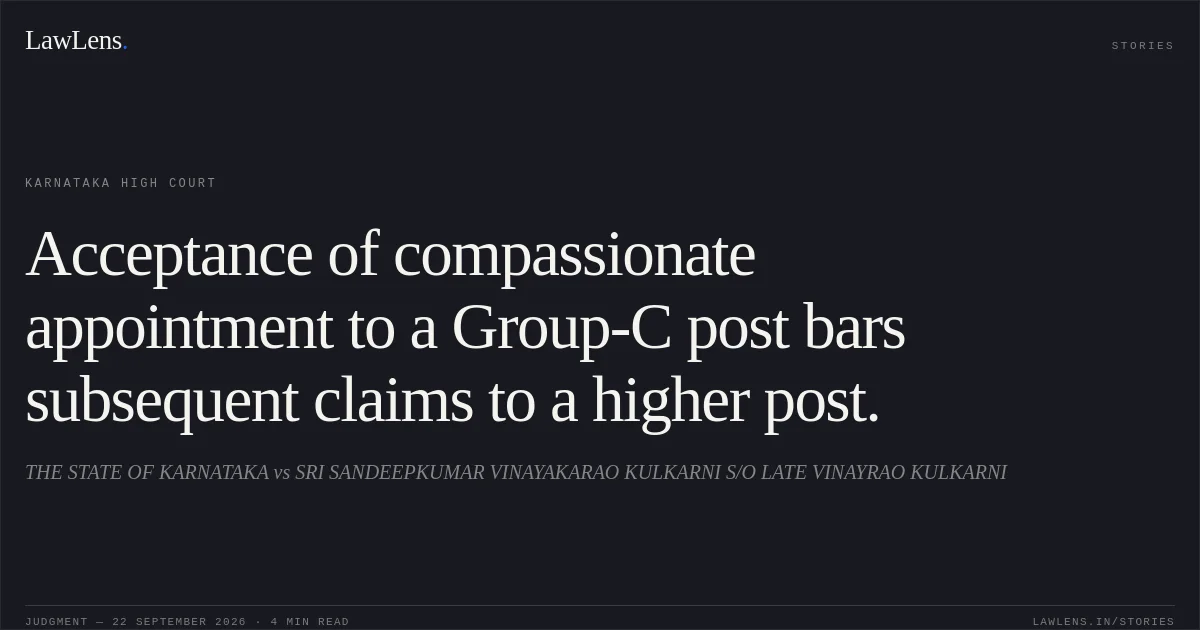
It held that compassionate appointment is a one-time measure, that acceptance of appointment as an SDA brought the respondents’ compassionate-appointment claims to an end, and that possession of higher qualifications did not confer a right to subsequent appointment or transposition as an FDA.
Source reference: paras. 17–19; pp. 53–55The respondents’ delayed claims were additionally unsustainable under Section 21 of the Administrative Tribunals Act, and Article 14 could not be used to claim parity based on alleged earlier irregularities.
Source reference: paras. 13–17; pp. 50–54Accordingly, both writ petitions were allowed, and the Tribunal’s orders dated 24 March 2026 in Applications Nos. 10758 and 10759 of 2024 were quashed.
Source reference: para. 22; p. 56Acts & Sections Cited
2 provisions across 1 statute referred to in this judgment. Each provision opens on LawLens.
Administrative Tribunals Act, 19852
Original Court PDF
THE STATE OF KARNATAKAvsSRI SANDEEPKUMAR VINAYAKARAO KULKARNI S/O LATE VINAYRAO KULKARNI
Click to open original judgment
Original judgment, available to read, download and summarize on LawLens.in