Facts
The petitioner, an Inspector in the Railway Protection Force (“RPF”), was placed under suspension on 14 December 2010 under Section 9(1)(i) of the Railway Protection Force Act, 1957 read with Rule 133 of the RPF Rules, 1987, on the ground that disciplinary proceedings were contemplated against him.
Source reference: paras. 2, 10A draft charge-sheet alleged that he had unlawfully appointed a Sub-Inspector as Malkhana In-charge, failed to take over and secure case properties, connived in the disappearance of 44 pieces of pig iron and other materials, and illegally disposed of 678 G.C. sheets for personal gain.
Source reference: paras. 3–9After rejecting the petitioner’s explanation, the Disciplinary Authority issued the final charge-sheet dated 9 February 2011 and appointed an Enquiry Officer.
Source reference: para. 9During the enquiry, the petitioner sought various documents, requested assistance in securing 16 defence witnesses, and sought permission to engage a retired official as his defence friend. These requests were substantially rejected or not facilitated.
Source reference: paras. 13–14The Enquiry Officer submitted a report dated 29 June 2012 finding the petitioner guilty, and the Disciplinary Authority subsequently imposed reduction of pay by three stages for three years with cumulative effect by order dated 6 July 2025.
Source reference: paras. 14–15Issues
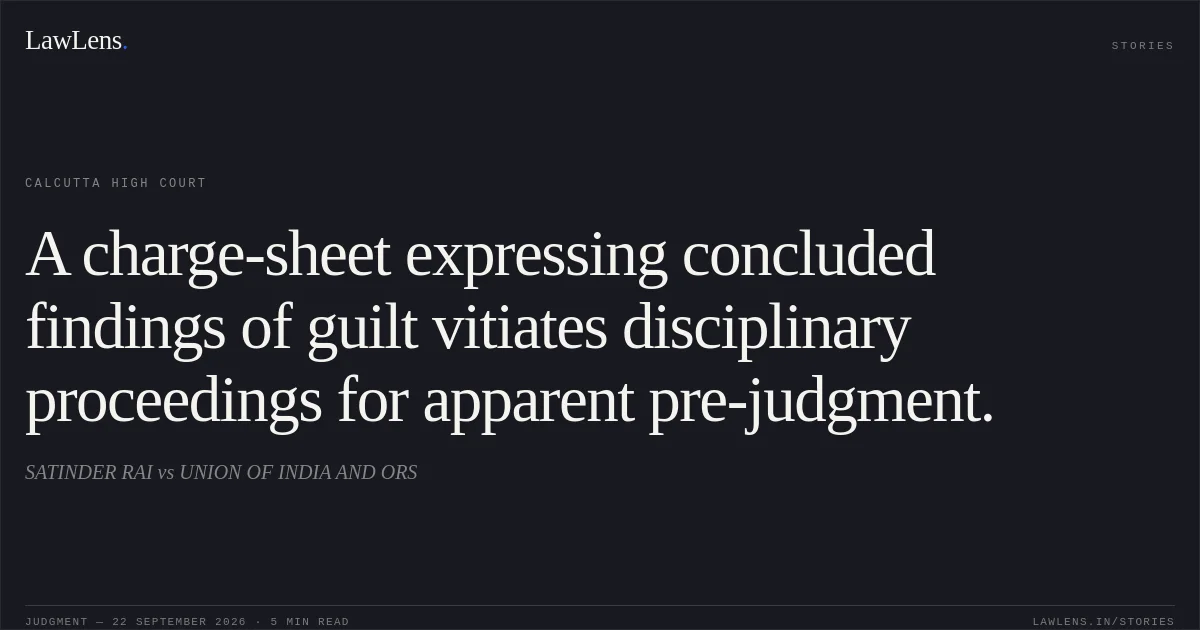
Whether the charge-sheet was vitiated because it expressed a concluded opinion regarding the petitioner’s guilt, thereby demonstrating a pre-determined mind and reducing the disciplinary enquiry to an empty formality?
Source reference: paras. 42–44Whether the charges were vague, indefinite or internally contradictory so as to deny the petitioner a reasonable opportunity to defend himself?
Source reference: paras. 45–50Whether the Enquiry Officer failed to independently and objectively assess the evidence and instead merely endorsed the report of the preliminary Court of Enquiry?
Source reference: paras. 51–53Whether the refusal to secure the petitioner’s defence witnesses and documents violated Rule 153.16 of the RPF Rules, 1987 and the principles of natural justice?
Source reference: para. 54Whether the disciplinary proceedings, including the suspension, charge-sheet, enquiry report and punishment order, were liable to be quashed in judicial review?
Source reference: paras. 55–60Law Applied
The Court applied the principles of judicial review concerning illegality, irrationality, Wednesbury unreasonableness, procedural impropriety, bias and violation of natural justice, while recognising that judicial review ordinarily concerns the decision-making process rather than the merits of the disciplinary decision.
Source reference: paras. 37–41Under the Railway Protection Force Act, 1957 and the RPF Rules, 1987, disciplinary proceedings must comply with the prescribed procedure, including Rule 135 concerning the issuance of a charge-sheet after suspension, Rule 153 governing departmental enquiries, and Rule 153.16, which permits the Enquiry Officer to refuse defence witnesses or documents only for recorded reasons of irrelevance or inadmissibility.
Source reference: paras. 20–21, 54Relying on Oryx Fisheries Pvt. Ltd. v. Union of India, (2010) 13 SCC 427, the Court held that a charge-sheet expressing a concluded view of guilt may vitiate the subsequent enquiry by rendering it an empty formality.
Source reference: paras. 43–44Under Union of India v. Gyan Chand Chattar, (2009) 12 SCC 78, disciplinary charges must be clear, definite and sufficiently particularised to enable an effective defence.
Source reference: para. 46The Court further relied on Rup Singh Negi v. Punjab National Bank, (2009) 2 SCC 570, Union of India v. Prakash Kumar Tandon, (2009) 2 SCC 541, and Anil Kumar v. Presiding Officer, 1985 SCC (L&S) 815, for the requirement that an Enquiry Officer act as an impartial quasi-judicial authority and record reasoned findings based on evidence.
Source reference: para. 53The test for bias was drawn from N.K. Bajpai v. Union of India, (2012) 4 SCC 653, namely whether a reasonable person apprised of the circumstances would apprehend a real danger of bias.
Source reference: para. 56Reasoning
The Court found that the charge-sheet repeatedly used expressions such as “clearly violated,” “proved,” “crystal clear” and “clearly shows,” which indicated that the petitioner’s guilt had been determined before the enquiry commenced.
Source reference: paras. 42–44The use of the word “proposed” in the covering letter could not cure the conclusive language used in the charge-sheet itself.
Source reference: paras. 42–44Charge No. 1 was vague because it alleged violation of a lawful order of the DG/RPF without identifying the order’s date, number, contents or nature, while also failing to address the petitioner’s specific defence that he had taken charge of the case properties under superior supervision.
Source reference: paras. 45–47Charge No. 2 impermissibly conflated supervisory negligence with direct connivance in theft and failed to reconcile the allegation of involvement with the fact that the petitioner had lodged the FIR leading to recovery of the missing pig iron.
Source reference: paras. 48–49In relation to Charge No. 3, the evidence established, at most, that 678 G.C. sheets were missing and that 666 sheets of a different quality were found; it did not establish the petitioner’s role in either the disposal or substitution.
Source reference: paras. 50–52The enquiry report substantially reproduced the allegations and endorsed the preliminary Court of Enquiry without independently explaining how each charge was proved.
Source reference: para. 53It therefore lacked the reasoned, objective assessment required of a quasi-judicial Enquiry Officer.
Source reference: para. 53Further, under Rule 153.16, the Enquiry Officer could not simply shift responsibility for producing defence witnesses to the petitioner or reject requested documents solely because they were not already in his possession; refusal required recorded reasons based on relevance or admissibility.
Source reference: para. 54Viewed cumulatively, the predetermined language, vague and contradictory charges, failure to consider material defences, inadequate reasoning, and denial of procedural assistance established a reasonable apprehension of bias and denial of a fair enquiry.
Source reference: paras. 55–58Holding
The Court held that the disciplinary process was vitiated by pre-determination, vague and defective charges, failure to independently assess the evidence, and breach of the principles of natural justice.
It accordingly allowed the writ petition and quashed the suspension order dated 14 December 2010, charge-sheet dated 9 February 2011, enquiry report dated 29 June 2012 and punishment order dated 6 July 2025.
Source reference: para. 60The respondents were directed to release and disburse the petitioner’s full salary and admissible arrears as if the disciplinary proceeding had not been initiated, within eight weeks from receipt of the judgment.
Source reference: para. 60The writ petition and connected application were disposed of without costs.
Source reference: para. 61Acts & Sections Cited
3 provisions across 2 statutes referred to in this judgment. Each provision opens on LawLens.
Railway Protection Force Act, 19571
Original Court PDF
SATINDER RAIvsUNION OF INDIA AND ORS
Click to open original judgment
Original judgment, available to read, download and summarize on LawLens.in