Facts
The petitioner, a Revenue Inspector, was accused of demanding and accepting a bribe of ₹4,000 for entering the complainant’s name in the revenue khata.
Source reference: para. 3A criminal case was registered under Sections 7 and 13(1)(d) read with Section 13(2) of the Prevention of Corruption Act, 1988, and a departmental inquiry was initiated on the same allegations.
Source reference: para. 3In the criminal case, the Sessions Court acquitted the petitioner and the co-accused, finding material inconsistencies in the evidence of the complainant and shadow witness, absence of reliable proof of demand or acceptance, and deficiencies in the electronic evidence and trap proceedings.
Source reference: pp. 6–14; para. 7Despite the acquittal, the departmental inquiry held the petitioner guilty and recommended compulsory retirement with permanent withholding of 25% of his pension.
Source reference: pp. 15–17; para. 8.2The Government imposed that penalty by order dated 23 July 2019.
Source reference: pp. 15–17; para. 8.2The Karnataka State Administrative Tribunal dismissed the petitioner’s challenge on 28 September 2022, holding that departmental proceedings operate on the standard of preponderance of probabilities and are independent of criminal proceedings.
Source reference: para. 8The petitioner consequently invoked Articles 226 and 227 of the Constitution before the High Court.
Source reference: no citationIssues
Whether an acquittal in a criminal prosecution automatically invalidates or requires setting aside a penalty imposed in departmental proceedings based on the same allegations?
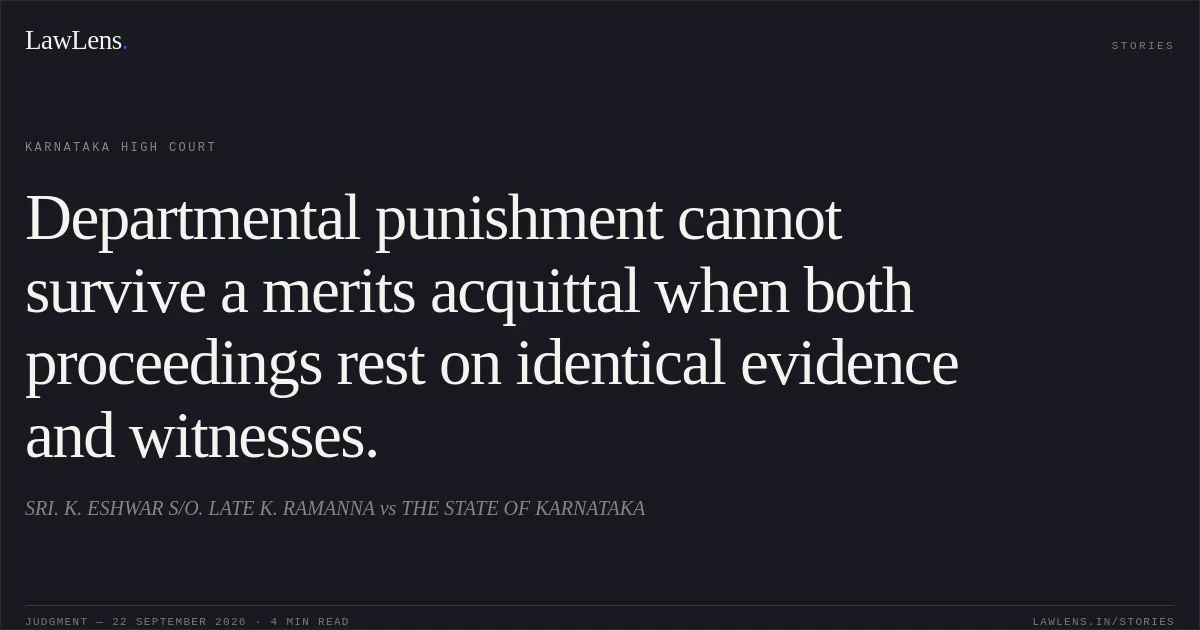
Source reference: paras. 9–10, 13Whether, where the criminal and departmental proceedings are founded on substantially identical charges, evidence, witnesses and circumstances, and the criminal court has found that the prosecution failed to establish demand and acceptance, it would be unjust, unfair and oppressive to sustain the departmental penalty?
Source reference: paras. 12.1–12.3, 13–17Whether the Tribunal erred in refusing to interfere with the penalty solely on the ground that the departmental standard of proof is preponderance of probabilities?
Source reference: para. 8; pp. 17–18Law Applied
The Court applied the principle that criminal and departmental proceedings ordinarily operate in distinct fields: criminal guilt must be proved beyond reasonable doubt, whereas departmental misconduct may be established on a preponderance of probabilities; therefore, an acquittal does not, by itself, bar or invalidate departmental action, as held in Karnataka Power Transmission Corporation Ltd. v. C. Nagaraju, State of Karnataka v. Umesh and Director Marketing of Agricultural v. D. Khasim Saheb.
Source reference: paras. 11.1–11.3However, under the exception recognised in G.M. Tank v. State of Gujarat, Ram Lal v. State of Rajasthan and Maharana Pratap Singh v. State of Bihar, where the charges, evidence, witnesses and circumstances in both proceedings are identical or substantially similar, and the criminal court has acquitted the accused after fully considering and disbelieving the prosecution case, sustaining the departmental penalty may be unjust, unfair and oppressive.
Source reference: paras. 12.1–12.2The Court also applied the judicial-review principles that departmental findings must be based on some relevant evidence, comply with natural justice and statutory procedure, be free from perversity, and not attract a disproportionate penalty.
Source reference: paras. 12.3, 15The terminology of “benefit of doubt” or “honourable acquittal” is not decisive; the substance of the criminal judgment must be examined.
Source reference: para. 12.1Reasoning
The Court distinguished the ordinary rule of departmental independence from the exceptional case warranting judicial interference.
Source reference: no citationHere, the departmental charge was founded on the very same allegation of demand and acceptance of ₹4,000 that formed the basis of the criminal prosecution.
Source reference: paras. 3, 8, 13–16The principal witnesses in the criminal case—the complainant and the shadow witness—did not support the prosecution’s case, and the criminal court found that their versions were inconsistent regarding who demanded the bribe, who received the money, and whether the petitioner directed the co-accused to accept it.
Source reference: pp. 6–14; para. 7The court also found the voice recording and transcript unreliable and held that the recovery and chemical test, without proof of conscious and voluntary acceptance of illegal gratification, were insufficient.
Source reference: no citationThe departmental proceeding relied on substantially the same evidentiary foundation and did not disclose independent or additional evidence capable of sustaining the charge.
Source reference: paras. 15–16Accordingly, the Tribunal’s reliance solely on the different standard of proof was inadequate.
Source reference: no citationSince the evidentiary basis of the departmental finding had collapsed in the criminal judgment, continuing the severe penalty of compulsory retirement and permanent pension reduction would be unjust and oppressive.
Source reference: paras. 16–17Holding
The High Court allowed the writ petition and quashed the Tribunal’s order dated 28 September 2022 and the Government’s penalty order dated 23 July 2019.
Application No.10346 of 2019 before the Tribunal was consequently allowed.
Source reference: para. 18(iv)The petitioner was granted consequential service and retiral benefits; the period from compulsory retirement until the date on which he would have attained superannuation was directed to be counted as qualifying service.
Source reference: para. 18(iii)However, he was denied arrears of salary for that period.
Source reference: para. 18(iii)The respondents were directed to calculate and disburse the consequential monetary and retiral benefits within three months of receiving the judgment.
Source reference: para. 18(v)Acts & Sections Cited
10 provisions across 3 statutes referred to in this judgment. Each provision opens on LawLens.
Prevention of Corruption Act, 19883
Code of Criminal Procedure, 19733
Indian Penal Code, 18604
Original Court PDF
SRI. K. ESHWAR S/O. LATE K. RAMANNAvsTHE STATE OF KARNATAKA
Click to open original judgment
Original judgment, available to read, download and summarize on LawLens.in