Facts
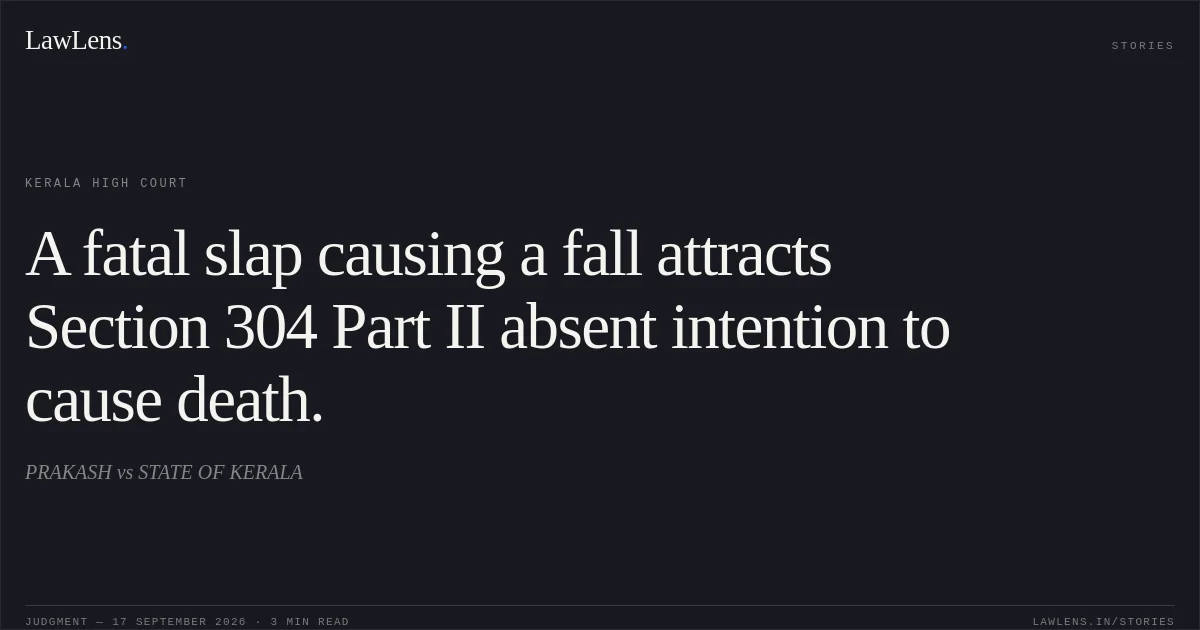
The appellant, the first accused, was prosecuted along with the second accused for allegedly entering the residence of Shaji during the night of 19 January 2011, taking him outside, and slapping him, causing him to fall on the tar road and sustain fatal head injuries.
Source reference: paras. 3, 9–10, 18Shaji subsequently died while being taken to hospital.
Source reference: paras. 3, 9–10, 18The prosecution relied principally on the testimony of PW2, the deceased’s wife, supported by PW1, the owner of the building, and the medical evidence of PW19, who conducted the autopsy.
Source reference: paras. 3, 9–10, 18The Sessions Court acquitted the second accused but convicted the appellant under Sections 448 and 304 IPC, sentencing him to five years’ rigorous imprisonment and fine for Section 304, and six months’ rigorous imprisonment for Section 448.
Source reference: para. 5The appellant challenged the conviction, disputing the credibility of PW2, the causal connection between the slap and the fatal injuries, and the applicability of Section 304 IPC.
Source reference: paras. 6–7Issues
Whether the appellant committed house-trespass punishable under Section 448 IPC by entering the residence occupied by the deceased and PW2?
Source reference: para. 8(1); paras. 17–20Whether the appellant’s act of slapping the deceased, causing him to fall and sustain fatal head injuries, constituted culpable homicide not amounting to murder under Section 304 IPC?
Source reference: para. 8(2); paras. 16, 18Whether the proved offence under Section 304 IPC fell under Part I or Part II?
Source reference: paras. 16, 18Whether the conviction and sentence imposed by the Sessions Court required appellate interference?
Source reference: para. 8(3)–(4); paras. 21–23Law Applied
The Court applied Section 304 IPC, distinguishing Part I, which requires intention to cause death or such bodily injury as is likely to cause death, from Part II, which requires knowledge that the act is likely to cause death without such intention.
Source reference: paras. 16, 18Relying on Richhpal Singh Meena v. Ghasi, the Court noted that the proper inquiry requires determining whether there was a homicide, whether it was culpable, and whether it amounted to murder or culpable homicide not amounting to murder.
Source reference: paras. 16Referring to Jagriti Devi v. State of Himachal Pradesh, the Court reiterated that intention and knowledge involve a positive mental attitude; where knowledge exists without the requisite intention, Section 304 Part II applies.
Source reference: para. 16For house-trespass, the Court applied Sections 441, 442 and 448 IPC: criminal trespass requires unlawful entry or unlawful remaining upon property with intent to commit an offence or to intimidate, insult or annoy a person in possession, and becomes house-trespass when committed in a dwelling house.
Source reference: paras. 17, 19Reasoning
The Court found PW2’s account of the appellant entering the residence, awakening Shaji, taking him outside and slapping him to be substantially reliable; the alleged contradiction concerning an earlier injury did not materially affect the prosecution case.
Source reference: para. 9PW1 corroborated the appellant’s arrival, his entry into the upstairs residence, and the immediate circumstances in which PW2 raised an alarm.
Source reference: para. 10The medical evidence established that death resulted from head injuries, while the doctor opined that the facial injury could have been caused by a slap and that several head injuries could have resulted from a fall on the tar road.
Source reference: paras. 10, 15The Court therefore accepted the causal link between the appellant’s act and the deceased’s fatal injuries.
Source reference: no citationHowever, because the prosecution did not establish an intention to cause death or such bodily injury as was likely to cause death, the case fell under Section 304 Part II rather than Part I.
Source reference: para. 18The appellant’s entry into the occupied dwelling for the purpose of confronting Shaji and committing the assault satisfied the requirements of criminal trespass and house-trespass under Sections 441 and 442, attracting Section 448 IPC.
Source reference: paras. 17, 19–20Holding
The appeal was partly allowed.
The conviction was modified from an unspecified conviction under Section 304 IPC to Section 304 Part II IPC, while the conviction under Section 448 IPC was affirmed.
Source reference: para. 22The appellant was sentenced to four years’ rigorous imprisonment and a fine of ₹25,000 for Section 304 Part II, with three months’ rigorous imprisonment in default, and six months’ rigorous imprisonment under Section 448 IPC; the substantive sentences were directed to run concurrently.
Source reference: para. 23The fine, if realised, was ordered to be paid to PW2 as compensation under Section 357(1)(c) CrPC.
Source reference: para. 23The suspension of sentence and bail were cancelled, and the appellant was directed to surrender before the Sessions Court to undergo the sentence.
Source reference: para. 23Acts & Sections Cited
13 provisions across 2 statutes referred to in this judgment. Each provision opens on LawLens.
Indian Penal Code, 1860
Code of Criminal Procedure, 19731
Original Court PDF
PRAKASHvsSTATE OF KERALA
Click to open original judgment
Original judgment, available to read, download and summarize on LawLens.in