Facts
Rajammal sued for a declaration permitting her to install a separate electric motor to draw water from a common well and for an injunction against interference.
Source reference: p.2The defendants counterclaimed to restrain her from erecting a motor, pump shed, or other construction on the well.
Source reference: p.2The trial court dismissed her suit and allowed the counterclaim.
Source reference: p.3On appeal, the first appellate court dismissed her appeal against the counterclaim decree but granted limited relief in her suit, permitting a small cement platform and cover adjoining the well.
Source reference: p.3Rajammal’s second appeal challenging the counterclaim decree was dismissed as abated after her legal representatives failed to take steps to be substituted; the counterclaim decree consequently attained finality.
Source reference: pp.4–5Issues
Whether the first appellate court’s decree in A.S. No. 20 of 2009 was liable to be reversed insofar as it was inconsistent with its decision in A.S. No. 21 of 2009
Source reference: p.5Whether the first appellate court could pass mutually conflicting judgments and decrees in the proceedings arising from the same suit
Source reference: p.5Law Applied
Under Order VIII Rules 6-A(2) and 6-A(4) of the Code of Civil Procedure, a counterclaim has the effect of a cross-suit, is treated as a plaint, and is to be adjudicated along with the plaintiff’s claim; Rule 6-D permits a counterclaim to proceed even if the suit is stayed, discontinued, or dismissed.
Source reference: pp.6–7Section 2(2) CPC defines a decree as the formal expression of an adjudication conclusively determining rights in controversy.
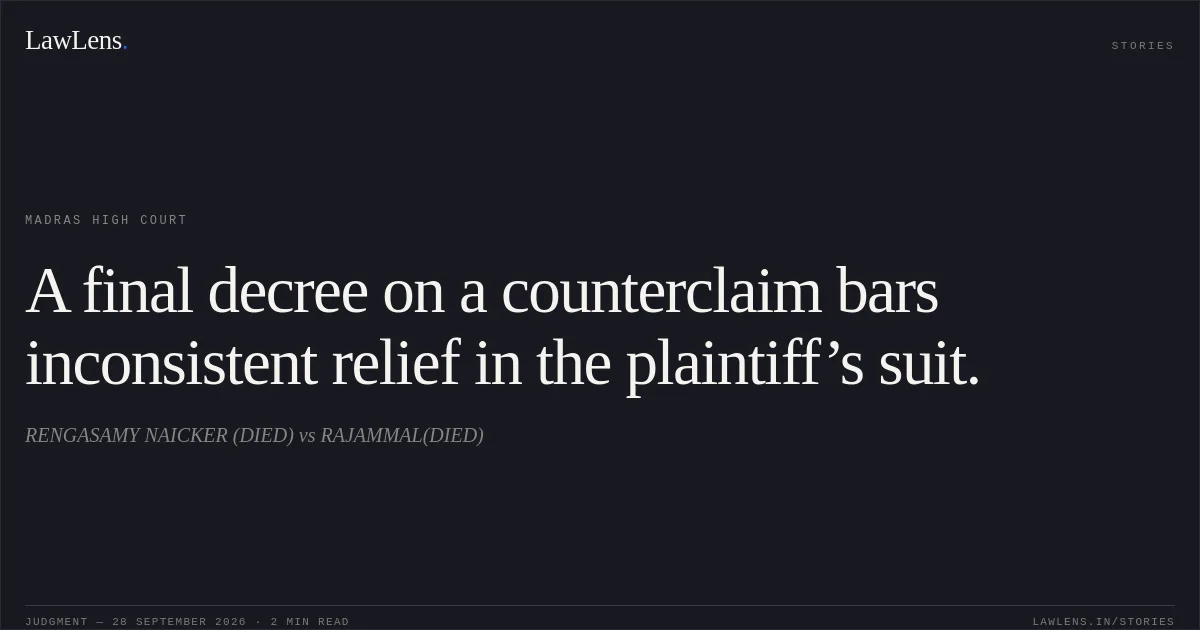
Source reference: p.8Relying on Rajni Rani v. Khairati Lal, (2015) 2 SCC 682, and the authorities discussed there, the Court treated an adjudicated counterclaim as having independent status and held that a final decree on it cannot be contradicted by inconsistent relief in the original suit.
Source reference: pp.6–9Reasoning
The counterclaim decree permanently restrained Rajammal from erecting an electric motor, pump shed, or other construction on the well, and her appeal against that decree had abated, leaving it final.
Source reference: pp.5, 9–10The limited relief granted in her original suit—permission to construct a platform for an electric motor—would conflict with that final restraint.
Source reference: pp.9–10The first appellate court therefore could not maintain both decrees, and the appellants were entitled to succeed.
Source reference: pp.9–10Holding
The Court answered the substantial questions of law in favour of the appellants.
The Court allowed the second appeal, set aside the first appellate court’s judgment and decree in A.S. No. 20 of 2009, and dismissed O.S. No. 284 of 2005.
Source reference: p.10No costs were ordered.
Source reference: p.10Acts & Sections Cited
3 provisions across 1 statute referred to in this judgment. Each provision opens on LawLens.
Code of Civil Procedure, 19083
Original Court PDF
RENGASAMY NAICKER (DIED)vsRAJAMMAL(DIED)
Click to open original judgment
Original judgment, available to read, download and summarize on LawLens.in