Facts
The respondents-plaintiffs, members of the same family and claiming to be long-standing tenants/occupiers of premises in Jarivala Chawl, Ahmedabad, challenged the implementation of Town Planning Scheme No. 8, Asarwa, which provided for an 80-foot-wide road affecting the suit premises.
Source reference: paras. 3–3.8They contended that the Town Planning Officer and Ahmedabad Municipal Corporation had failed to serve them individual notices under Rules 21(3) and 21(4) of the Bombay Town Planning Rules and that possession could not be taken without providing alternative accommodation.
Source reference: paras. 3.3–3.6The City Civil Court rejected the prayer to declare the varied scheme void but directed the Corporation to provide suitable alternative accommodation and protected the plaintiffs’ possession until such accommodation was provided.
Source reference: para. 2The Corporation and the Town Planning Officer appealed under Section 96 of the Code of Civil Procedure, 1908.
Source reference: paras. 2.1–2.4Earlier, while disposing of the plaintiffs’ appeals against refusal of interim relief, the High Court had permitted them to remain only up to the stipulated date and directed them to hand over peaceful possession to the Corporation.
Source reference: paras. 11–12The varied Town Planning Scheme had been sanctioned and brought into force long before the suits were filed in 1997.
Source reference: paras. 30–31Issues
1. Whether the Civil Court had jurisdiction to entertain suits which directly or indirectly challenged the finalisation and implementation of the Town Planning Scheme.
Source reference: para. 8(i)2. Whether the plaintiffs were entitled to individual notice under Rules 21(3) and 21(4) of the Bombay Town Planning Rules, notwithstanding the applicability of the Gujarat Town Planning and Urban Development Act, 1976 and the Rules framed thereunder.
Source reference: para. 8(i); paras. 17–203. Whether the plaintiffs, merely as tenants or occupiers, had a legal right to alternative accommodation before eviction for implementation of the Town Planning Scheme.
Source reference: para. 8(ii)4. Whether the City Civil Court could direct the Ahmedabad Municipal Corporation to provide alternative accommodation in the absence of a statutory, contractual, policy-based, or otherwise enforceable right.
Source reference: para. 8(ii); paras. 34–385. Whether the City Civil Court erred in granting relief to the plaintiffs.
Source reference: para. 8(iii)Law Applied
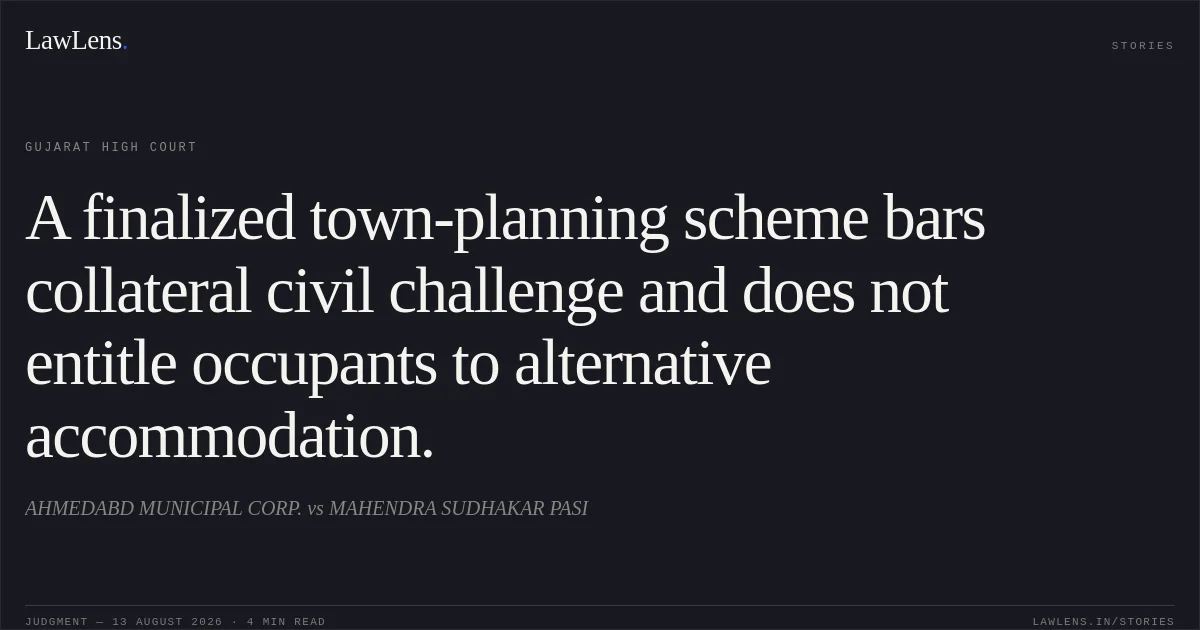
The Court applied Section 9 of the Code of Civil Procedure, 1908, recognising that Civil Courts ordinarily possess jurisdiction over civil rights unless expressly or impliedly barred, but held that the Gujarat Town Planning and Urban Development Act, 1976 constitutes a substantially self-contained statutory framework for finalised Town Planning Schemes.
Source reference: paras. 6.1–6.4, 38–39Under Sections 65 and 67 of the 1976 Act, a sanctioned preliminary or final scheme operates as if enacted in the Act, and land required for the scheme vests absolutely in the appropriate authority free from encumbrances; Section 68 read with Rule 33 authorises summary eviction of persons continuing to occupy land which they are not entitled to occupy under the scheme.
Source reference: paras. 9–10, 19–21The Gujarat Rules, particularly Rule 26, require prescribed public notice and opportunity to submit objections, but do not require the individual special notice contemplated by the unamended Bombay Rule 21(3) and (4).
Source reference: paras. 17–20Relying on Shilpa Park Co-operative Housing Society Ltd. v. Surat Urban Development Authority, Jaswantsingh Mathurasingh v. Ahmedabad Municipal Corporation, Kanjibhai Dahyabhai Malsattar v. State of Gujarat, Chandravadan Chunilal Shah v. State of Gujarat, and Babulal Badriprasad Varma v. Surat Municipal Corporation, the Court held that a finalised scheme can be questioned only on limited grounds such as jurisdictional transgression, total inconsistency with the governing statute, or non-compliance with essential statutory requirements.
Source reference: paras. 17–24Alternative accommodation cannot be ordered merely on equitable, humanitarian, or hardship considerations; it requires a legally enforceable right arising from statute, contract, binding policy, or enforceable promise.
Source reference: paras. 35–38Reasoning
The Court found that the scheme had been processed and sanctioned under the 1976 Act, which governed the proceedings after repeal and saving of actions under the Bombay Town Planning Act.
Source reference: paras. 5.1, 5.5–5.9, 31The plaintiffs’ reliance on Bombay Rules 21(3) and (4) was therefore misplaced; even if the amended Bombay Rule were considered, the requirement of individual special notice had been removed, while Rule 26 of the Gujarat Rules contemplated public notice and invitation of objections, not individual service.
Source reference: paras. 17–20The plaintiffs had in any event received statutory eviction notices and an opportunity to make representations.
Source reference: paras. 9, 32Once the scheme had acquired statutory force, the land required for the proposed road vested in the Corporation and the plaintiffs could not retain possession contrary to the scheme.
Source reference: paras. 19–21, 25, 39The earlier High Court order directing the plaintiffs to vacate had also not been challenged and was binding; the City Civil Court acted improperly in proceeding on a legal basis inconsistent with that order.
Source reference: paras. 11–16, 33Finally, the plaintiffs produced no statute, contract, policy, or promise conferring a right to alternative accommodation. Their long occupation and alleged hardship could not create such a right or authorise the Civil Court to modify or obstruct a finalised statutory scheme.
Source reference: paras. 34–38Holding
The Court held that the plaintiffs could not invalidate or obstruct the finalised Town Planning Scheme on the ground of non-service of individual notices under Bombay Rules 21(3) and (4).
The finalised scheme had statutory force, the affected land stood vested in the appropriate authority, and the plaintiffs had no enforceable right to remain in possession or to receive alternative accommodation merely because of their long occupation or hardship.
Source reference: paras. 30, 38–40All four appeals were allowed; the common judgment and decree dated 7 November 2002 passed by the City Civil Court in Civil Suit Nos. 145–148 of 1997 were quashed and set aside, with costs following the cause.
Source reference: paras. 41–43The request to stay operation of the judgment was rejected in view of the plaintiffs’ non-compliance with the earlier direction to vacate and hand over possession.
Source reference: post-para. 43Acts & Sections Cited
23 provisions across 3 statutes referred to in this judgment. Each provision opens on LawLens.
Code of Civil Procedure, 19082
Gujarat Provincial Municipal Corporations Act, 19491
Gujarat Town Planning And Urban Development Act, 1976
Original Court PDF
AHMEDABD MUNICIPAL CORP.vsMAHENDRA SUDHAKAR PASI
Click to open original judgment
Original judgment, available to read, download and summarize on LawLens.in