Facts
Makhan Ram, aged 36 years, died in a motor vehicle accident on 29 July 2000 caused by the rash and negligent driving of Truck No. PUG-8861 by respondent No. 1, Gurmeet Singh.
Source reference: p.1–2, paras. 2, 5The truck was owned by respondent No. 2.
Source reference: p.1–2, paras. 2, 5The Motor Accidents Claims Tribunal, Nawanshahr, awarded ₹50,000 with interest at 9% per annum from the date of filing of the claim petition, holding respondents jointly and severally liable.
Source reference: p.1–2, paras. 2, 5The deceased’s mother and younger brother, Ranjit Singh @ Rana, appealed seeking enhancement.
Source reference: p.2–3, para. 7The finding regarding rash and negligent driving was not challenged in appeal and therefore was not interfered with.
Source reference: p.2–3, para. 7Respondent No. 1 was proceeded against ex parte, while respondent No. 2 was stated to have died without his legal representatives being brought on record; the Court noted the obligation under Order XXII Rule 4 CPC to bring the legal representatives on record.
Source reference: p.1, para. 1Issues
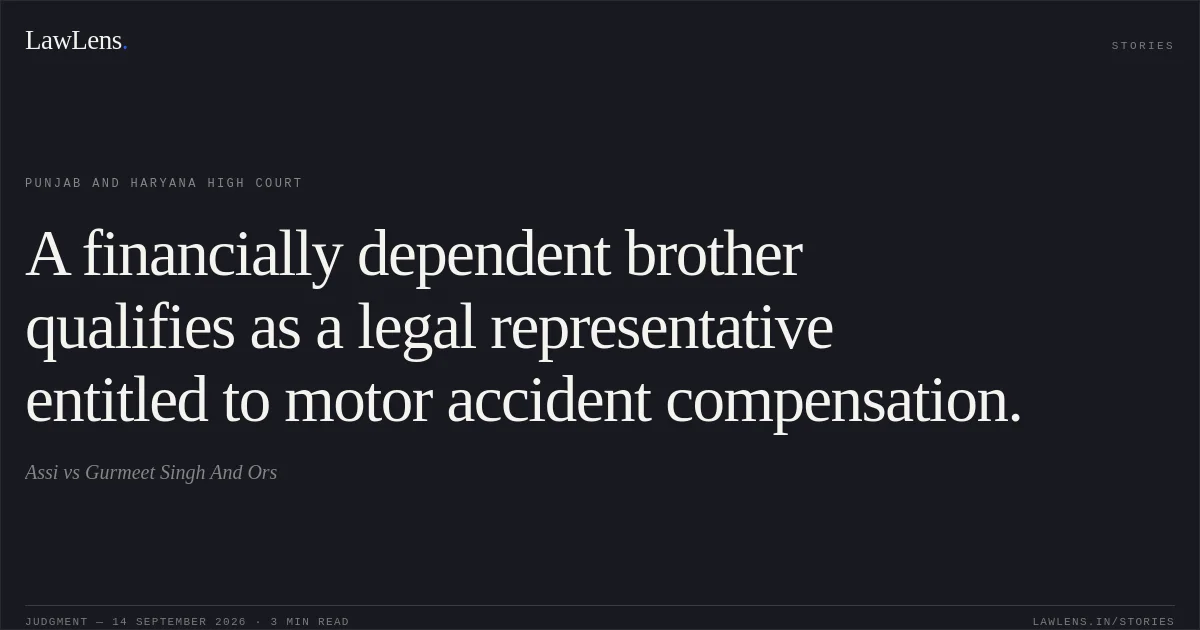
Whether the deceased’s brother, Ranjit Singh @ Rana, qualified as a legal representative and dependent entitled to claim compensation under Section 166 of the Motor Vehicles Act, 1988?
Source reference: p.4–5, paras. 10–12Whether the Tribunal had correctly assessed the deceased’s income, future prospects, deduction for personal expenses, multiplier, and compensation under conventional heads?
Source reference: p.5–8, paras. 13–19What compensation and interest were payable, and against whom?
Source reference: p.8, para. 20Law Applied
The Court applied Section 166 of the Motor Vehicles Act, 1988, which permits every legal representative suffering loss because of a motor accident death to seek compensation.
Source reference: p.4, para. 10Relying on N. Jayasree v. Cholamandalam MS General Insurance Co. Ltd., the Court held that “legal representative” must receive a broad and liberal interpretation and is not confined to the spouse, parents, or children; proof of dependency is sufficient.
Source reference: p.4, para. 10The same principle was supported by Sadhana Tomar v. Ashok Kushwaha, Gujarat State Road Transport Corporation v. Ramanbhai Prabhatbhai, and Hafizun Begum v. Mohd. Ikram Heque.
Source reference: p.5, paras. 11–12For computation, the Court applied the “just compensation” principle under Syed Basheer Ahamed v. Mohd. Jameel, while cautioning that compensation must not be arbitrary, punitive, or a source of profit.
Source reference: p.5–6, para. 13It applied Pranay Sethi for 40% future prospects and conventional heads, and Sarla Verma for a 50% deduction towards personal expenses and a multiplier of 15 for a deceased aged 36 years.
Source reference: p.6–8, paras. 15–19The Court also applied Order XXII Rule 4 CPC concerning substitution of the legal representatives of a deceased respondent.
Source reference: p.1, para. 1Reasoning
The Court accepted the Tribunal’s finding that the accident resulted from respondent No. 1’s rash and negligent driving, since that finding had not been appealed or challenged.
Source reference: p.2–3, para. 7It held that Ranjit Singh, although the deceased’s brother, was a legal representative because the Motor Vehicles Act requires a liberal interpretation and does not restrict compensation claims to immediate family members; the Court treated him as dependent on the deceased.
Source reference: p.4–5, paras. 10–12The deceased’s monthly income was fixed at ₹2,500, considering his occupation as a labourer and the circumstances prevailing in 2000.
Source reference: p.6, para. 14Applying 40% future prospects, the monthly income became ₹3,500.
Source reference: p.6–7, paras. 15–17Since the deceased was a bachelor, 50% was deducted for personal expenses, resulting in a monthly dependency loss of ₹1,750 and an annual loss of ₹21,000.
Source reference: p.6–7, paras. 15–17Applying the multiplier of 15 produced a dependency loss of ₹3,15,000.
Source reference: p.6–7, paras. 15–17The Court added ₹70,000 under conventional heads—₹40,000 for loss of consortium, ₹15,000 for loss of estate, and ₹15,000 for funeral expenses—bringing the total compensation to ₹3,85,000.
Source reference: p.7–8, paras. 18–19Holding
The appeal was partly allowed.
The total compensation was enhanced from ₹50,000 to ₹3,85,000, resulting in enhanced compensation of ₹3,35,000, with interest at 9% per annum from 9 September 2000, the date of filing of the claim petition, until realization.
Source reference: p.8, para. 20Respondents No. 1 and 2 were held jointly and severally liable; however, the legal representatives of respondent No. 2 would be liable only to the extent of any estate inherited from him.
Source reference: p.8, para. 20As claimant No. 1 had died during the appeal, her share of compensation and interest was directed to be released in favour of claimant No. 2, who was also treated as her legal representative.
Source reference: p.8, para. 20Pending miscellaneous applications, if any, were disposed of.
Source reference: p.8, para. 21Acts & Sections Cited
1 provisions across 1 statute referred to in this judgment. Each provision opens on LawLens.
Motor Vehicles Act, 19881
Original Court PDF
AssivsGurmeet Singh And Ors
Click to open original judgment
Original judgment, available to read, download and summarize on LawLens.in