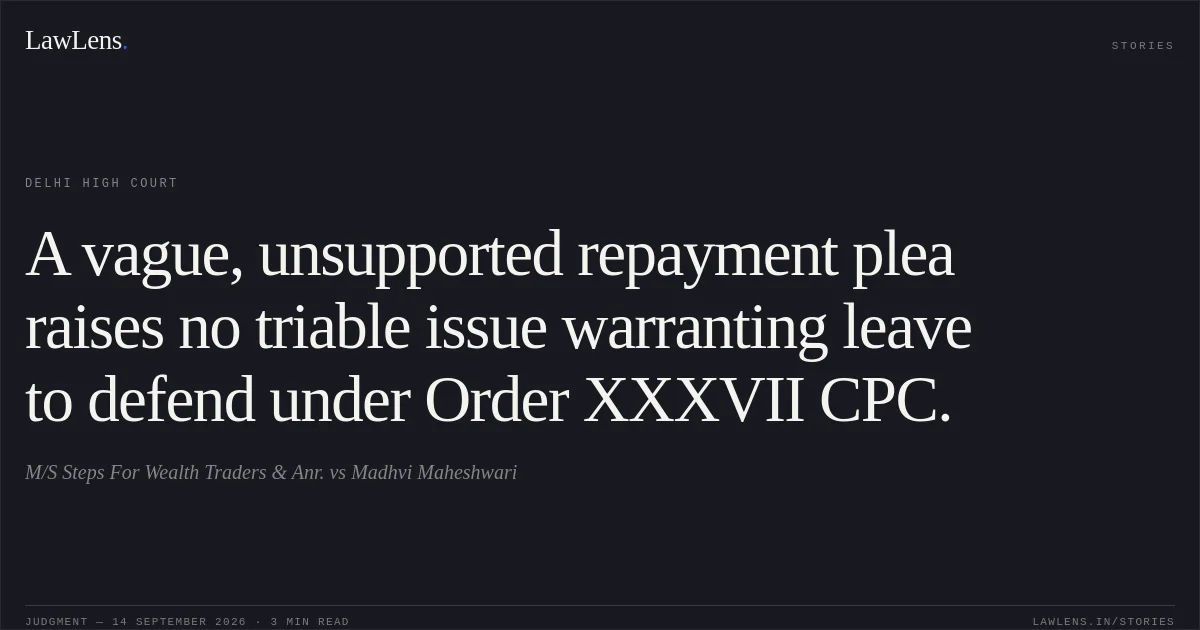
Facts
The respondent-plaintiff instituted a summary suit under Order XXXVII CPC for recovery of ₹2,00,000 with interest, relying on a Memorandum of Understanding dated 20 January 2016 executed between herself and M/s Steps for Wealth Traders, through its partner, the second appellant.
Source reference: paras. 2–4; pp. 2–3The appellants sought leave to defend, contending that the transaction was with the plaintiff’s husband, that the cheque had been issued only as security, and that the amount had already been repaid in cash.
Source reference: paras. 5–8; pp. 2–3The Civil Judge rejected the application for leave to defend and decreed the suit for ₹2,00,000 with pendente lite interest at 9% per annum.
Source reference: paras. 9–11; pp. 3–4The First Appellate Court affirmed the decree, holding that the MoU established the contractual relationship and that the plea of repayment was unsupported by particulars or documentary evidence.
Source reference: paras. 16–18; pp. 5–6In the Regular Second Appeal, the appellants additionally contended that the suit was barred by the Punjab Registration of Money-Lenders Act, 1938, and that non-presentation of the cheque raised triable issues.
Source reference: paras. 20–25; pp. 6–7Issues
1. Whether the concurrent findings of the courts below disclosed any substantial question of law warranting interference in a Regular Second Appeal under Section 100 CPC.
Source reference: para. 27; p. 72. Whether the appellants established that there was no privity of contract between them and the plaintiff because the transaction was allegedly with her husband.
Source reference: paras. 28–32; pp. 7–83. Whether the plea that the amount had been repaid, and that the cheque was issued only as security and was never presented, raised a genuine triable issue requiring leave to defend under Order XXXVII CPC.
Source reference: paras. 33–36; pp. 8–94. Whether the suit was barred under Section 3 of the Punjab Registration of Money-Lenders Act, 1938, on the ground that the plaintiff was an unlicensed money-lender.
Source reference: para. 37; p. 9Law Applied
The Court applied Section 100 CPC, under which a Regular Second Appeal lies only upon the existence of a substantial question of law, and Order XLII Rule 1 CPC.
Source reference: para. 1; p. 1Under Order XXXVII Rules 3(5) and 3(6)(a) CPC, leave to defend is required where the defendant discloses a genuine and substantial defence; a vague or unsupported denial does not constitute a triable issue.
Source reference: paras. 9–11; pp. 3–4The Court relied on the contractual principle that consideration may move from the promisee or any other person, and that privity of contract—not privity of consideration—is determinative.
Source reference: para. 32; p. 8It also considered Sections 2(9) and 3 of the Punjab Registration of Money-Lenders Act, 1938, holding that the statutory bar applies only where the plaintiff is shown to be carrying on the business of money-lending without the requisite registration or licence.
Source reference: paras. 20–21, 37; pp. 6, 9A cheque issued as security does not, by itself, extinguish or negate the underlying contractual transaction, particularly where the transaction is independently evidenced by a written agreement.
Source reference: paras. 35–36; p. 9Reasoning
The MoU was executed between the plaintiff and Defendant No. 1 and bore the admitted signatures of Defendant No. 2 on behalf of the firm; consequently, the appellants’ assertion that they had dealt only with the plaintiff’s husband was contradicted by the written contract.
Source reference: para. 29; p. 8Even assuming that the husband physically advanced the money, that circumstance did not defeat the plaintiff’s contractual rights because consideration may proceed from a third person.
Source reference: para. 32; p. 8The repayment defence was vague: the appellants disclosed neither the dates, mode, recipient, nor other particulars of payment, and produced no receipt, account statement, or contemporaneous document.
Source reference: paras. 33–34; pp. 8–9Similarly, non-presentation of the cheque did not negate the MoU or create a triable issue, since the cheque was referred to in the MoU and its signatures were not denied.
Source reference: paras. 35–36; p. 9The money-lending objection, raised for the first time in the second appeal, was unsupported because the pleadings described an isolated investment/business transaction and did not establish that the plaintiff carried on the business of money-lending.
Source reference: para. 37; p. 9The courts below therefore correctly concluded that no genuine triable issue had been disclosed and that no substantial question of law arose.
Source reference: paras. 38–40; pp. 9–10Holding
The Delhi High Court held that the appellants had not raised any substantial question of law or demonstrated perversity or legal infirmity in the concurrent findings of the courts below.
The challenge to privity, repayment, the security cheque, and the alleged bar under the Money-Lenders Act was rejected.
Source reference: paras. 39–40; p. 10The Regular Second Appeal was dismissed, the decree for ₹2,00,000 with pendente lite interest at 9% per annum was upheld, and all pending applications were disposed of.
Source reference: paras. 41–42; p. 10Acts & Sections Cited
1 provisions across 1 statute referred to in this judgment. Each provision opens on LawLens.
Code of Civil Procedure, 19081
Original Court PDF
M/S Steps For Wealth Traders & Anr.vsMadhvi Maheshwari
Click to open original judgment
Original judgment, available to read, download and summarize on LawLens.in
![Long-serving casual labourers performing regular duties must receive 1/30th minimum pay plus DA and be considered for regularization.. SMT S D SRIVASTAVA vs Archoelogical Survey Of India. CAT - ['Allahabad']. LawLens](/stories/thumbnails/long-serving-casual-labourers-performing-regular-duties-must-receive-1-30th-minimum-pay-pl-545c373533744ff49cae0672d629ab9b.webp)