Facts
The respondent-workman, a Steno-Typist in the petitioner hospital’s Pathology Department, was alleged to have refused a routine security check of his bags while leaving the clinic on 23 September 2014.
Source reference: para. 3After receiving a show-cause notice dated 27 September 2014, he stated that he had returned upstairs to switch off a computer.
Source reference: para. 3A domestic enquiry was conducted in which he was represented by a defence representative; the Enquiry Officer considered the CCTV footage and found the charge proved.
Source reference: para. 4The workman was dismissed from service by order dated 5 May 2015.
Source reference: para. 5On reference under the Industrial Disputes Act, 1947, the Fifth Industrial Tribunal invalidated the domestic enquiry by order dated 28 April 2022 and, by award dated 12 February 2024, held that reinstatement was not possible because the workman had superannuated, but awarded 75% back wages from dismissal until superannuation.
Source reference: paras. 2, 7The management challenged the preliminary order and the award under Article 226 of the Constitution.
Source reference: para. 1Issues
Whether the Industrial Tribunal erred in invalidating the domestic enquiry and in substituting its own assessment of the evidence, particularly the CCTV footage, for that of the Enquiry Officer.
Source reference: paras. 8, 21–27Whether the domestic enquiry complied with the principles of natural justice and whether the charge was established on the standard of preponderance of probabilities.
Source reference: paras. 18, 28–31Whether the Tribunal’s award of 75% back wages was sustainable after holding that the dismissal was unjustified and reinstatement was unavailable due to superannuation.
Source reference: para. 2Law Applied
Section 11A of the Industrial Disputes Act, 1947 empowers a Labour Court or Tribunal to determine whether discharge or dismissal is justified and, if not, to grant reinstatement or other appropriate relief, including a lesser punishment; the Tribunal must rely on the material on record and cannot take fresh evidence.
Source reference: para. 25Under The Workmen of Firestone Tyre & Rubber Co. v. Management, the Tribunal may examine whether misconduct is proved and whether the punishment is justified, but its determination must be based on the materials before it.
Source reference: para. 9(i)Neeta Kaplish v. Presiding Officer, Labour Court establishes that where an enquiry is defective, the employer may justify the dismissal by leading fresh evidence, and the defective enquiry record cannot ordinarily be treated as substantive material on the merits.
Source reference: para. 15(c)The decisions in Cholan Roadways Ltd. v. G. Thirugnanasambandam, High Court of Judicature at Bombay v. Uday Singh and State of Bihar v. Phulpari Kumari recognise that departmental enquiries apply the test of preponderance of probabilities, not proof beyond reasonable doubt, and that judicial review does not extend to reassessing the sufficiency of evidence.
Source reference: paras. 9(ii), 9(iv), 9(v)However, under Allahabad Bank v. Krishna Narayan Tewari, interference is permissible where findings are unsupported by evidence, perverse, procedurally unfair, or vitiated by non-application of mind.
Source reference: paras. 9(vi), 16Reasoning
The High Court held that the Tribunal had improperly reassessed the CCTV footage and substituted its own view for that of the Enquiry Officer, instead of determining whether the enquiry was procedurally fair and whether the finding had evidentiary support.
Source reference: paras. 21, 26–27On independently viewing the footage, the Court found that the workman was carrying more than two heavy white plastic bags in addition to his ordinary office bag, turned back hurriedly when stopped by the security guard, and appeared to return with lighter bags.
Source reference: paras. 22–24The Court considered the workman’s explanation—that he had returned to switch off his computer—to be inconsistent with his conduct and with the routine nature of the security check.
Source reference: paras. 23–24It further found that the management’s witnesses had been examined and cross-examined, and that the workman had received adequate opportunity to present his defence; consequently, the domestic enquiry substantially complied with natural justice and the finding of misconduct was supported by sufficient evidence.
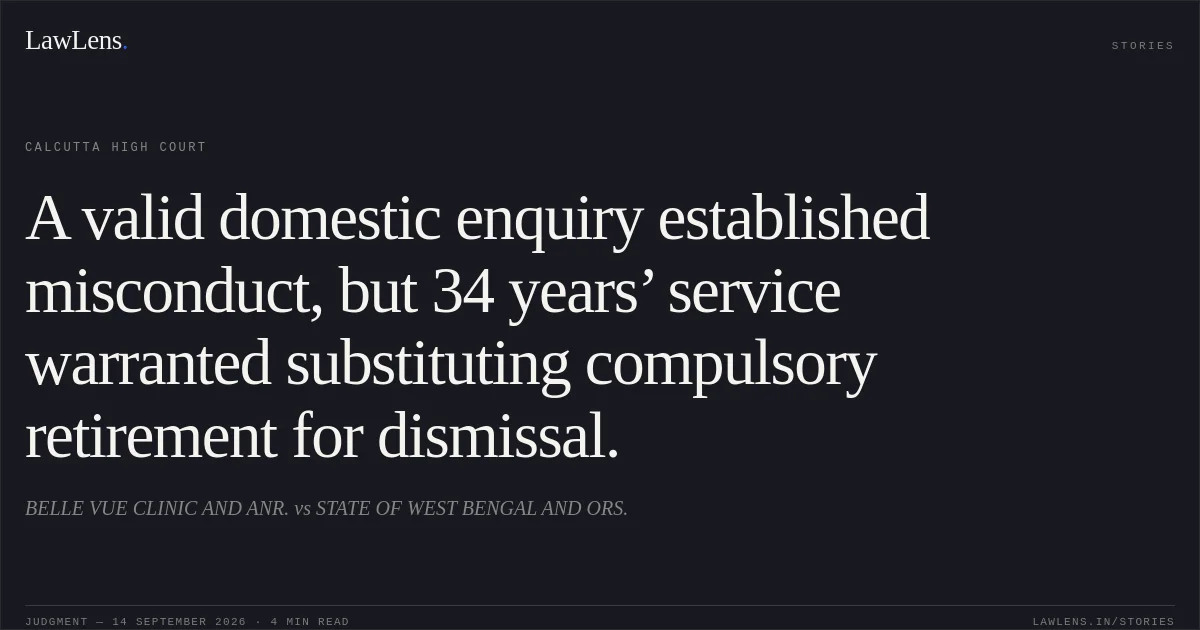
Source reference: paras. 28–29Although the misconduct was established, the Court considered the workman’s 34 years of service and treated dismissal as excessive, warranting modification of the punishment under Section 11A.
Source reference: paras. 30–32Holding
The writ petition was allowed in substance.
The Tribunal’s award dated 12 February 2024 was set aside because the Tribunal had improperly invalidated the domestic enquiry and interfered with a finding supported by evidence.
Source reference: para. 32The dismissal was modified to compulsory retirement, having regard to the respondent’s 34 years of service.
Source reference: para. 32The Court directed that all consequential dues payable to the respondent be released within three months from the date of the judgment.
Source reference: para. 33The writ petition was accordingly disposed of, with connected applications and interim orders dealt with as stated in the judgment.
Source reference: paras. 34–36Acts & Sections Cited
1 provisions across 1 statute referred to in this judgment. Linked provisions open on LawLens.
Industrial Disputes Act, 19471
Original Court PDF
BELLE VUE CLINIC AND ANR.vsSTATE OF WEST BENGAL AND ORS.
Click to open original judgment
Original judgment, available to read, download and summarize on LawLens.in