Facts
The dispute concerned a religious shrine and adjoining burial ground situated on Survey No. 935, Village Anavada, Patan, registered as Waqf/Trust B-97/Mehsana.
Source reference: paras. 5.1–5.6The appellants claimed that it was historically known as “Maulana Mehboob Dargah Masjid and Kabrastan,” belonged to the Sunni-Hanafi-Barelvi community, and had been managed by their family for generations.
Source reference: paras. 5.1–5.6The shrine was registered as a public trust in 1953 on an application made by Nanibi, who described herself as a Mujawar. After her death, her daughter Badibi was recorded as Mujawar.
Source reference: paras. 5.3–5.8In 2014, the appellants relied on an internal family resolution and Change Report No. 207 of 2014 to have themselves recorded as Mutawallis.
Source reference: paras. 5.3–5.8, 36, 43Upon remand, the Waqf Board passed Resolution No. 11A dated 24 April 2025 and the Chief Executive Officer issued a consequential order dated 30 April 2025.
Source reference: paras. 5.27–5.30The Waqf Tribunal dismissed Waqf Appeal No. 15 of 2025 on 9 February 2026 and upheld the Board’s decision.
Source reference: paras. 5.27–5.30Issues
Whether the appellants were denied a fair and effective opportunity of hearing before the Waqf Board and the Waqf Tribunal?
Source reference: paras. 18(i), 92–106Whether the Waqf Board had jurisdiction under Sections 32, 40 and 41 of the Waqf Act, 1995 to investigate the identity, nature and character of the shrine and amend the Waqf register?
Source reference: paras. 18(ii), 93–100, 120–122Whether the Waqf Board’s Resolution dated 24 April 2025 was invalid for want of quorum or because it was passed without first deciding the appellants’ preliminary objections?
Source reference: paras. 18(vi), 102–103, 113–115Whether the CEO’s order dated 30 April 2025 was without jurisdiction because the CEO supplied reasons for the Board’s resolution without independently hearing the parties?
Source reference: paras. 107–112Whether the appellants were legally appointed Mutawallis, or were merely Mujawars without an inheritable or proprietary right in the Waqf property?
Source reference: paras. 18(v), 37–44, 71–83Whether the alteration of the shrine’s name and administrative character amounted to conversion of a place of worship in violation of Section 3 of the Places of Worship (Special Provisions) Act, 1991?
Source reference: paras. 18(iii)–(iv), 116–119Whether the judgment of the Waqf Tribunal was invalid because a third member, who had not heard the arguments, signed the judgment?
Source reference: paras. 7.3–7.7, 124–127Law Applied
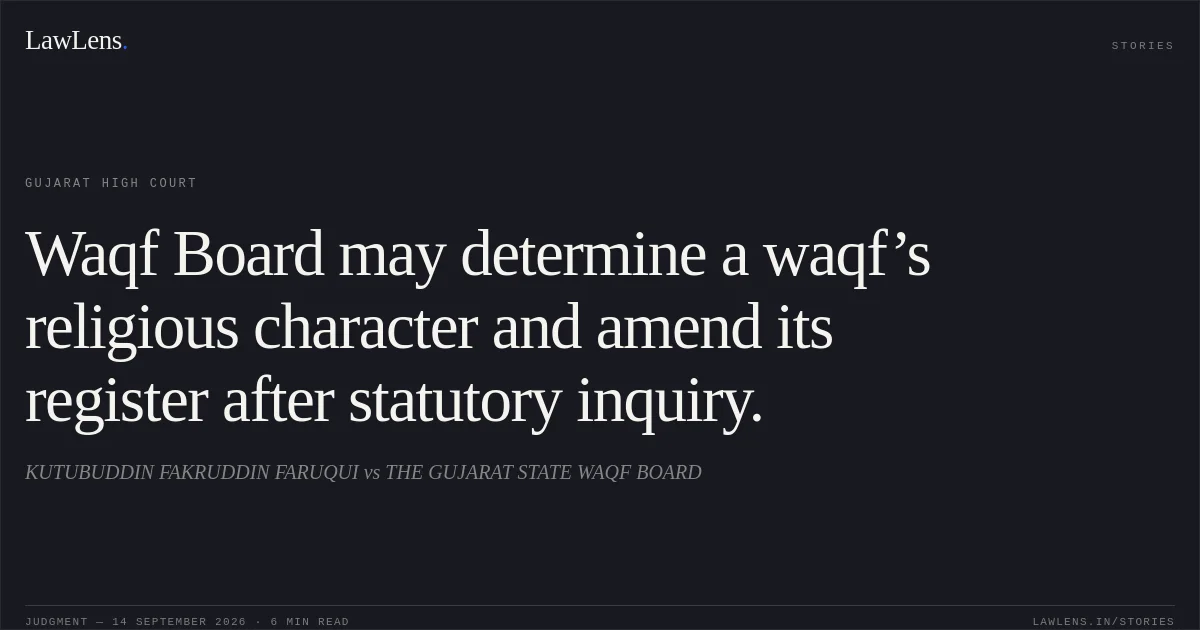
The Court applied Sections 32(2)(n), 40 and 41 of the Waqf Act, 1995, holding that the Waqf Board may investigate and determine the nature and extent of Waqf property, decide whether a property is Sunni or Shia Waqf, and amend the Waqf register after inquiry.
Source reference: paras. 93–100, 121Sections 23, 25 and 26 of the Act, read with Rule 47 of the Gujarat State Waqf Board Rules, 1923 and Regulation 54 of the Gujarat State Waqf Regulations, 2000, authorize the CEO, as ex officio Secretary, to authenticate and implement Board resolutions.
Source reference: paras. 107–112Section 63 provides the statutory mechanism for appointment of a Mutawalli where the right to act is disputed, while Section 64 recognizes the Board’s power to remove a Mutawalli in the circumstances specified by law.
Source reference: paras. 77, 91The Court treated a Mujawar as a servant or caretaker of a shrine, not as a person having proprietary or automatically hereditary rights, relying on Muslim-law commentaries and Abdul Aziz Valad Haji Subhan v. Mohammed Ibrahim Ghatkari, AIR 1939 Bom 487.
Source reference: paras. 37–44Natural justice is flexible and does not invariably require an oral hearing where an effective written opportunity has been provided, as recognised in A.K. Kraipak v. Union of India, Natwar Singh v. Directorate of Enforcement, and State Bank of India v. Amit Iron Pvt. Ltd.
Source reference: paras. 104–106Section 3 of the Places of Worship Act prohibits conversion of the religious character of a place of worship, but does not bar an inquiry into the original identity and character of a disputed shrine.
Source reference: paras. 116–119Rule 71 of the Gujarat State Waqf Rules, as amended, permits the Tribunal to function despite vacancy or absence of a member and validates adjudication by the Chairman and available member.
Source reference: paras. 124–127Reasoning
The Court found that the historical revenue records, including records from the Gaekwad period and entries from 1916–17 onwards, described the property as “Maulana Yakub Saheb Dargah,” “Dawoodi Bohra Kabrastan,” or “Malan Shah Pir Ni Jago,” whereas the description “Maulana Mehboob Dargah Masjid and Kabrastan” appeared only in or after the 1953 registration proceedings.
Source reference: paras. 52–63The appellants produced no Waqf deed, deed of dedication, reliable document establishing the shrine’s origin, or evidence proving that it was a Sunni-Hanafi-Barelvi institution as of 15 August 1947.
Source reference: paras. 45–48, 116–123The Court also relied on the ancient inscription referring to Maulana Yakub and held that the appellants had not established the alleged interpolation in the revenue records; the earlier Tribunal’s findings had been set aside by consent and therefore could not be relied upon as binding findings.
Source reference: paras. 64–70The Court held that Nanibi and Badibi had consistently described themselves as Mujawars. Their status as caretakers did not confer an inheritable right to trusteeship or ownership.
Source reference: paras. 71–83The appellants’ later attempt to appoint themselves as Mutawallis through a family resolution was inconsistent with the registered mode of succession and was not supported by a valid appointment under Section 63 or by the Muslim congregation.
Source reference: paras. 71–83On procedure, the Court held that the proceedings before the Board under Sections 32, 40 and 41 were an inquiry and not a full civil trial requiring formal framing and adjudication of preliminary issues.
Source reference: paras. 100–106, 113–115The appellants had participated in the proceedings, filed written submissions on the merits, and had an effective opportunity to present their case. The absence of a separate oral hearing or separate decision on the preliminary application did not cause demonstrable prejudice.
Source reference: paras. 100–106, 113–115The resolution was passed in a meeting attended by all eight Board members and was therefore not invalid for want of quorum. The CEO merely authenticated and implemented the Board’s resolution in accordance with his statutory duties.
Source reference: paras. 107–112The Court further held that the inquiry did not convert the shrine from Sunni to Shia, because the appellants failed to prove that the shrine had originally possessed the claimed Sunni-Hanafi-Barelvi character.
Source reference: paras. 116–123The dispute was treated as one concerning the correct identification and management of the shrine, rather than a prohibited conversion under Section 3 of the Places of Worship Act.
Source reference: paras. 116–123The participation and signature of the subsequently appointed third Tribunal member did not invalidate the judgment, since the Chairman and the member who heard and decided the matter constituted a valid Tribunal bench under Rule 71.
Source reference: paras. 124–127Holding
The Gujarat High Court dismissed the First Appeal and affirmed the Waqf Tribunal’s judgment dated 9 February 2026, the Waqf Board’s Resolution No. 11A dated 24 April 2025, and the CEO’s consequential order dated 30 April 2025.
It held that the Board had jurisdiction to investigate and correct the Waqf register; the appellants had not established a valid hereditary or statutory right as Mutawallis; the shrine was not shown to have been converted from a Sunni to a Shia place of worship; and the proceedings were not vitiated by denial of natural justice, want of quorum, improper authentication, or participation of the third Tribunal member.
Source reference: paras. 106, 112, 121, 123, 127Any interim relief was vacated, and the connected Civil Application for stay was disposed of as infructuous.
Source reference: paras. 129–130Acts & Sections Cited
6 provisions across 4 statutes referred to in this judgment. Each provision opens on LawLens.
Bombay Public Trusts Act, 19502
Places of Worship (Special Provisions) Act, 19911
Code of Civil Procedure, 19081
Limitation Act, 19632
Original Court PDF
KUTUBUDDIN FAKRUDDIN FARUQUIvsTHE GUJARAT STATE WAQF BOARD
Click to open original judgment
Original judgment, available to read, download and summarize on LawLens.in