Facts
V.S. Tyagi, a Pharmacist employed in the Delhi Division Hospital of the Northern Railway, claimed unpaid employment dues, including half-average-pay leave wages of ₹1,972.80, arrears of increments amounting to ₹2,173, and full wages for the suspension period from 3 March 1983 to 24 November 1985.
Source reference: pp. 2–4His disciplinary proceedings and the orders of the disciplinary and appellate authorities had been set aside by the Central Administrative Tribunal, which granted him consequential benefits.
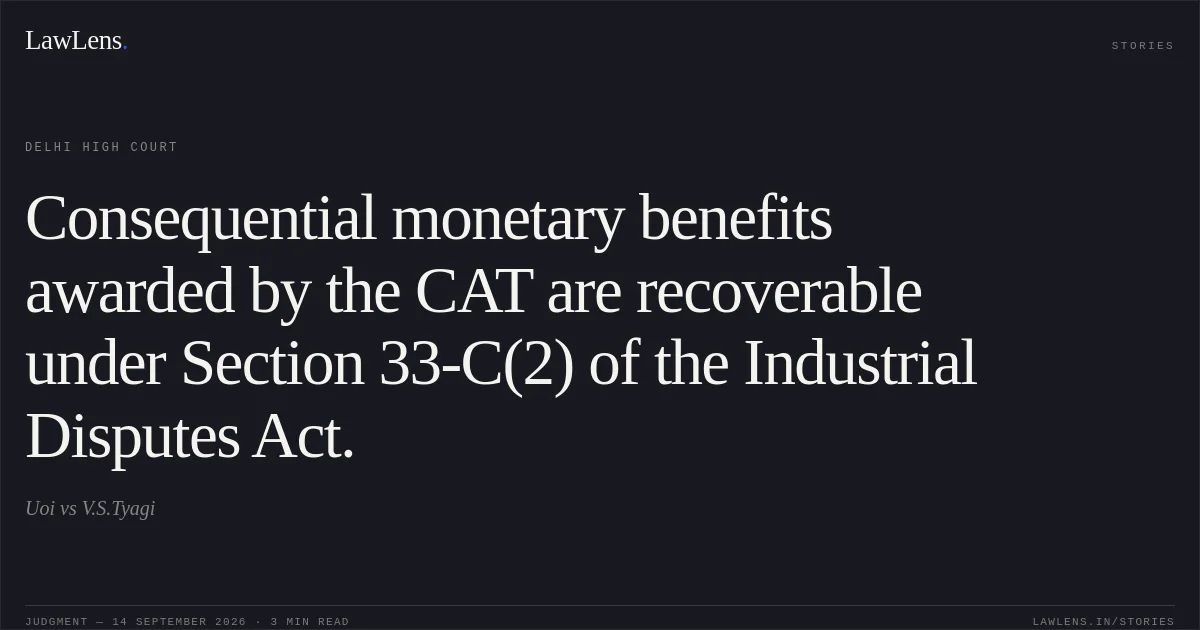
Source reference: pp. 2–4Tyagi consequently filed an application under Section 33-C(2) of the Industrial Disputes Act, 1947, seeking recovery of ₹67,296.80.
Source reference: pp. 2–3By order dated 16 December 2004, the Labour Court allowed the application and directed payment of ₹67,296.80.
Source reference: para. 1; p. 1The Union of India challenged that order under Article 226 of the Constitution.
Source reference: para. 1; p. 1During the writ proceedings, the Union raised an additional allegation that Tyagi had worked for the CGHS during the relevant period and that an FIR had been registered against him; this objection had not been raised before the Labour Court.
Source reference: paras. 6–8; pp. 4–5Issues
Whether the Labour Court could entertain and allow Tyagi’s application under Section 33-C(2) of the Industrial Disputes Act for computation and recovery of consequential monetary benefits flowing from the Central Administrative Tribunal’s orders.
Source reference: paras. 4–5; pp. 3–4Whether the claims were barred by limitation or otherwise unavailable because of alleged prior proceedings and payments.
Source reference: para. 4; pp. 2–4Whether the Union could rely, at the writ stage, on the subsequent allegation that Tyagi had worked for the CGHS during the period for which wages were claimed.
Source reference: paras. 6–8; pp. 4–5Whether the Labour Court’s order disclosed perversity or jurisdictional error warranting interference under Article 226 of the Constitution.
Source reference: para. 5; p. 4Law Applied
Section 33-C(2) of the Industrial Disputes Act, 1947 permits the Labour Court to compute and recover money or benefits due to a workman where the underlying entitlement has already been established.
Source reference: paras. 4–5; pp. 3–4The Court relied on the principle that an order setting aside disciplinary action and granting “all consequential benefits” may include back wages, increments, and other monetary benefits arising from the setting aside of the order.
Source reference: paras. 4–5; pp. 3–4The Court also applied the limited scope of judicial review under Article 226, under which the High Court does not act as an appellate court over factual findings of the Labour Court and interferes only where there is perversity, jurisdictional error, or a manifest legal infirmity.
Source reference: para. 5; p. 4The Labour Court had additionally relied on the principle, supported by the decision referred to as Bangalore Water Supply, that the Railway administration constitutes an “industry” for purposes of the Industrial Disputes Act.
Source reference: para. 4; p. 4Reasoning
The High Court held that the Central Administrative Tribunal’s orders, which set aside the disciplinary and appellate orders and granted consequential benefits, furnished the basis for Tyagi’s monetary claims.
Source reference: paras. 4–5; pp. 3–4The Labour Court was therefore entitled to compute the unpaid leave wages, arrears of increments, and wages for the suspension period under Section 33-C(2).
Source reference: paras. 4–5; pp. 3–4The Union failed to establish that the amounts had already been paid or that the claims were excluded from the earlier proceedings.
Source reference: para. 4; p. 4The High Court found the Labour Court’s conclusion that the claims were not time-barred, particularly in light of the subsequent proceedings and representations, to be a plausible view supported by the record.
Source reference: para. 4; p. 4The alleged CGHS employment could not defeat the award because the contention had not been raised before the Labour Court, the FIR remained pending, and the Union had not taken any consequential administrative or legal action.
Source reference: paras. 6–8; pp. 4–5At most, the allegation could constitute a separate cause of action for appropriate proceedings, but it could not be used in the writ petition to deny the already adjudicated monetary relief.
Source reference: paras. 6–8; pp. 4–5Since no perversity or jurisdictional error was demonstrated, Article 226 review was not warranted.
Source reference: para. 5; p. 4Holding
The High Court dismissed the writ petition and upheld the Labour Court’s order directing the Union of India to pay ₹67,296.80 to V.S. Tyagi.
The amount deposited by the Union pursuant to the interim order dated 4 April 2008, together with accrued interest, was directed to be released to Tyagi in terms of the Labour Court’s order.
Source reference: para. 9; p. 6The Union was left at liberty to take appropriate legal action, if permissible, concerning the allegation that Tyagi had worked for the CGHS during the relevant period; however, that allegation could not be relied upon to withhold the awarded amount in the present proceedings.
Source reference: paras. 7–8; p. 5Acts & Sections Cited
1 provisions across 1 statute referred to in this judgment. Linked provisions open on LawLens.
Industrial Disputes Act, 19471
Original Court PDF
UoivsV.S.Tyagi
Click to open original judgment
Original judgment, available to read, download and summarize on LawLens.in
![Similarly situated Laboratory Attendants are entitled to equivalent pay-scale and ACP benefits, subject to eligibility.. Chaman Lall vs Education. CAT - ['Kolkata']. LawLens](/stories/thumbnails/similarly-situated-laboratory-attendants-are-entitled-to-equivalent-pay-scale-and-acp-bene-888ed0be7a204600a029e484ddf5176a.webp)