Facts
The petitioner was appointed as a Section Officer on 7 February 1973, later redesignated as Junior Engineer (Civil), and confirmed on 26 August 1981.
Source reference: para. 2In the Junior Engineer seniority list, he was senior to Amar Nath, Harnam Singh and Sahib Singh, who were appointed on 1, 4 and 9 October 1973, respectively.
Source reference: para. 2The three juniors, belonging to the Scheduled Caste category, were promoted as Assistant Engineers on 27 May 1998 under the reservation policy.
Source reference: para. 2The petitioner was promoted on an ad hoc basis on 25 March 2005 and regularly on 5 April 2006.
Source reference: paras. 2, 5, 8Despite his earlier seniority in the feeder cadre, he was placed below those officers in the Assistant Engineers’ seniority list and received lower pay.
Source reference: paras. 3–4He sought restoration of his seniority under the catch-up principle and stepping up of pay at par with his juniors.
Source reference: paras. 3–4The State opposed the claim, relying on the reservation roster and paragraph 6(c) of the Finance Department’s memorandum dated 21 September 1999, which excluded stepping up where a senior joined the higher post later than the junior.
Source reference: paras. 5–6Issues
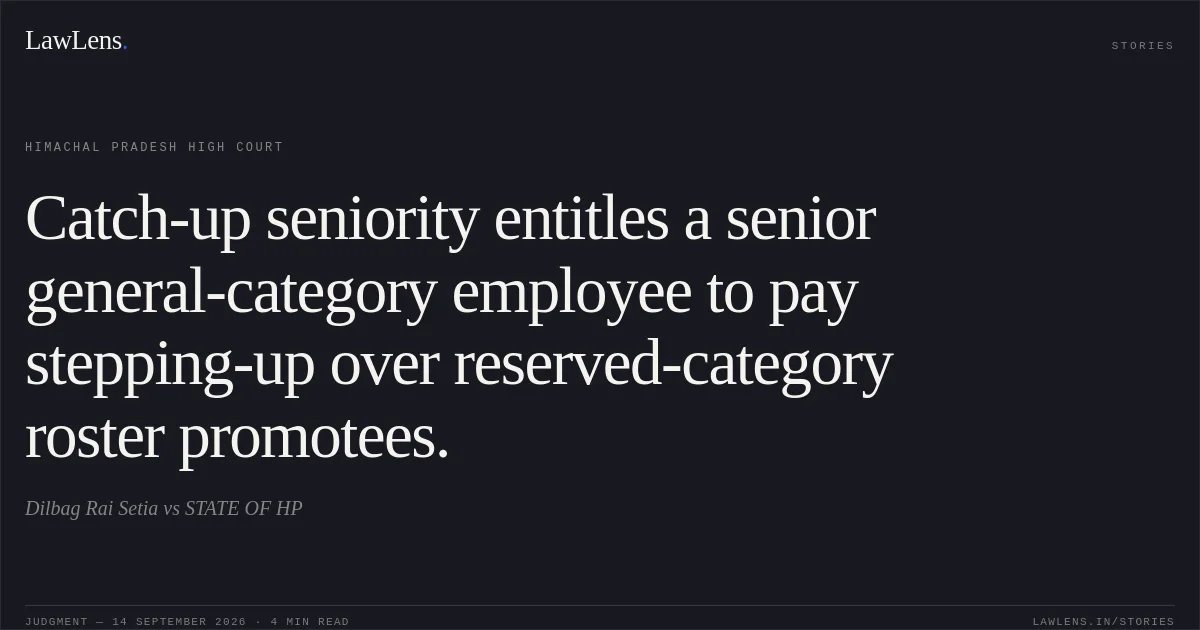
Whether a general-category employee who was senior in the feeder cadre but was promoted later than reserved-category juniors was entitled to regain his original inter se seniority in the promotional cadre under the catch-up principle.
Source reference: paras. 8–9Whether the petitioner was entitled to stepping up of pay at par with his reserved-category juniors despite having been promoted to the higher post later.
Source reference: paras. 10–17Whether arrears of consequential monetary benefits were subject to limitation in view of the petitioner’s delayed approach to the Court.
Source reference: para. 16Law Applied
The Court applied the catch-up principle stated in Ajit Singh and others (II) v. State of Punjab and others, (1999) 7 SCC 209, under which roster-point promotees cannot count seniority in the promotional cadre from the date of their earlier promotion against general-category candidates who were senior in the lower cadre; a senior general-category employee regains seniority upon subsequently reaching the promotional level, provided the reserved-category employee has not been further promoted before that time.
Source reference: para. 8The Court also applied FR 22(1)(a)(1) and the Government instructions governing removal of pay anomalies, which permit stepping up where a senior and junior belong to the same cadre, hold identical posts, draw pay under identical scales, and the anomaly results from pay fixation on promotion.
Source reference: paras. 11–12Relying on J.K. Mohindru v. State of H.P., the Court held that reservation-based earlier promotion does not, by itself, justify denying pay parity where the senior otherwise satisfies the conditions for stepping up.
Source reference: paras. 11–15The Court further relied on State of H.P. v. V.K. Gupta, affirmed in LPA No. 142 of 2014, and the Supreme Court decisions in Gurcharan Singh Grewal v. Punjab State Electricity Board, (2009) 3 SCC 94, and Union of India v. C.R. Madhava Murthy, (2022) 6 SCC 183, for the principle that a senior should not draw less pay than a junior in comparable circumstances.
Source reference: paras. 13–16Limitation on arrears was governed by Union of India v. Tarsem Singh, (2008) 8 SCC 648.
Source reference: para. 16Reasoning
The Court found it undisputed that the petitioner was senior to the three officers in the Junior Engineer cadre and that he subsequently entered the Assistant Engineer cadre before their further promotion.
Source reference: paras. 8–9Applying Ajit Singh (II), the Court held that the petitioner regained his feeder-cadre seniority upon promotion and could not lawfully be placed below the reserved-category roster-point promotees.
Source reference: paras. 8–9On pay, the Court held that the petitioner and his juniors occupied the same promotional cadre and identical posts, and that the pay differential arose because the juniors had been promoted earlier under the reservation policy rather than because of advance increments, superior qualifications, or any other recognised exception.
Source reference: paras. 10–12, 15The exclusion in paragraph 6(c) of the 1999 memorandum was therefore not treated as a bar, particularly in light of the binding or finalised decisions in J.K. Mohindru and V.K. Gupta.
Source reference: paras. 11–15However, applying Tarsem Singh, the Court restricted monetary arrears to three years preceding the filing of the petition.
Source reference: para. 16Holding
The petition was allowed.
The State was directed to redraw the petitioner’s seniority in the Assistant Engineer cadre by recognising his seniority position in the Junior Engineer cadre vis-à-vis Amar Nath, Harnam Singh and Sahib Singh, and to step up his pay so as to make it equal to that of those juniors, with consequential benefits.
Source reference: para. 17The petitioner was entitled to arrears only for the three years preceding the filing of the petition.
Source reference: para. 17The consequential benefits were directed to be released within six months; failing such payment, the arrears would carry interest at 6% per annum from the expiry of that period until actual payment.
Source reference: para. 17Original Court PDF
Dilbag Rai SetiavsSTATE OF HP
Click to open original judgment
Original judgment, available to read, download and summarize on LawLens.in