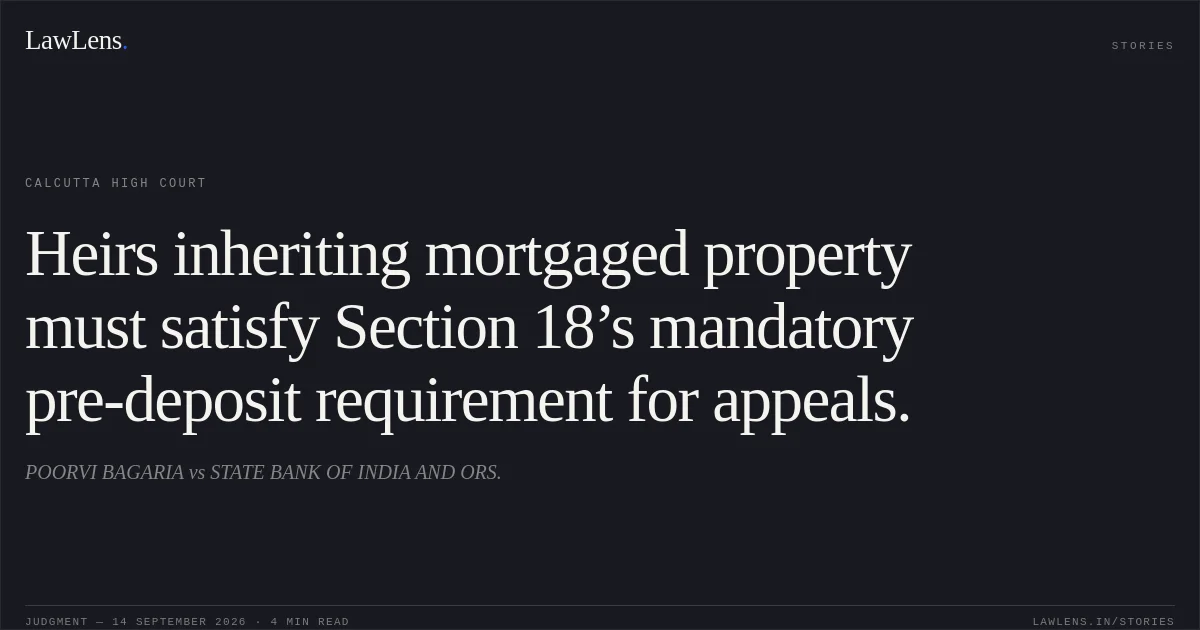
Facts
Merril Impex Private Limited availed credit facilities from the State Bank of India in 2007. The company was subsequently renamed Global Metcoke Private Limited and thereafter Janmani International Private Limited. The credit limits were enhanced from time to time, ultimately reaching ₹59.99 crore under a sanction letter dated 29 January 2013.
Source reference: para. 4(a)–(e)The loan was secured by an equitable mortgage over duplex flats at premises no. 6, Asoka Road, Alipore, Kolkata, created by deposit of four title deeds standing in the names of Uttam Kumar Bagaria, Mamta Bagaria and Gita Bagaria.
Source reference: paras. 5(a), 14–15Uttam Kumar Bagaria, the petitioner’s deceased father, was alleged by the Bank to have stood as a guarantor and mortgagor. He died on 20 February 2012, after which his interest in the property devolved upon the petitioner and the other heirs and legal representatives.
Source reference: paras. 4(d), 16Following default and classification of the loan account as an NPA, the Bank issued a demand notice under Section 13(2) of the SARFAESI Act, 2002, followed by a possession notice dated 13 March 2023.
Source reference: paras. 4(f)–(g), 5(b)The Debts Recovery Tribunal-I, Kolkata dismissed the securitisation application by judgment dated 11 July 2025 and upheld the demand and possession notices.
Source reference: para. 6The petitioner filed an appeal before the Debts Recovery Appellate Tribunal along with an application seeking waiver of the statutory pre-deposit under Section 18 of the SARFAESI Act. The DRAT directed her to deposit 50% of ₹1,12,12,58,945.
Source reference: paras. 1–2, 7–8Issues
Whether the petitioner, as the legal representative and heir of the deceased guarantor/mortgagor, was required to comply with the pre-deposit condition under the second proviso to Section 18(1) of the SARFAESI Act in order to maintain an appeal before the DRAT
Source reference: paras. 25–33Whether the DRAT could completely waive the statutory pre-deposit, or whether it could reduce the deposit only to a minimum of 25% of the debt due after recording reasons in writing
Source reference: paras. 27–30Whether the DRAT’s finding that Uttam Kumar Bagaria was a guarantor suffered from perversity warranting interference under Article 227 of the Constitution
Source reference: paras. 17–21, 34Law Applied
The Court applied Section 2(1)(f) of the SARFAESI Act, 2002, which defines “borrower” broadly to include a person who has given a guarantee or created a mortgage or pledge as security for financial assistance.
Source reference: para. 22Under the second proviso to Section 18(1), an appeal by a borrower cannot be entertained unless 50% of the debt due, as claimed by the secured creditor or determined by the DRT, whichever is less, is deposited; under the third proviso, the DRAT may reduce the amount only for recorded reasons and not below 25%.
Source reference: para. 25In Narayan Chandra Ghosh v. UCO Bank, (2011) 4 SCC 548, the Supreme Court held that the pre-deposit is mandatory, that complete waiver is impermissible, and that the DRAT can reduce the deposit only to a minimum of 25%.
Source reference: para. 30In Union of India v. Rajat Infrastructure Pvt. Ltd., (2020) 3 SCC 770, the Supreme Court held that a guarantor or mortgagor who secures repayment of a loan stands on the same footing as a borrower for purposes of Section 18.
Source reference: para. 31Reasoning
The Court held that the materials disclosed an equitable mortgage over the duplex flats through deposit of four title deeds and that Uttam Kumar Bagaria’s alleged personal guarantees had not been effectively disproved.
Source reference: paras. 17–23The letters relied upon by the petitioner were issued after his death and therefore did not establish that he had never acted as a guarantor; the petitioner also failed to produce relevant guarantee documents executed before his death, justifying an adverse inference.
Source reference: paras. 17–23Since the petitioner inherited her father’s mortgaged property and succeeded to his legal position and liabilities, she fell within the expanded statutory concept of “borrower” under Section 2(1)(f), notwithstanding that she had not personally borrowed the money or executed the original security documents.
Source reference: paras. 24, 32–33The mandatory nature of Section 18 meant that the DRAT could not grant a complete waiver. Its direction to require a 50% deposit was therefore legally permissible, particularly as the statutory framework allowed reduction only to 25% and not total waiver.
Source reference: paras. 27–30No perversity or jurisdictional error was shown warranting interference under Article 227.
Source reference: para. 34Holding
The High Court dismissed the application under Article 227 and declined to interfere with the DRAT’s order directing the petitioner to deposit 50% of ₹1,12,12,58,945 as a condition for maintaining her appeal under Section 18 of the SARFAESI Act.
It held that, as the legal representative and heir of the deceased guarantor/mortgagor, the petitioner could not avoid the statutory pre-deposit requirement, and that complete waiver was impermissible.
Source reference: para. 35The matter was dismissed without any order as to costs.
Source reference: para. 35Acts & Sections Cited
4 provisions across 1 statute referred to in this judgment. Each provision opens on LawLens.
Securitisation and Reconstruction of Financial Assets and Enforcement of Security Interest Act, 20024
Original Court PDF
POORVI BAGARIAvsSTATE BANK OF INDIA AND ORS.
Click to open original judgment
Original judgment, available to read, download and summarize on LawLens.in
![Similarly situated Laboratory Attendants are entitled to equivalent pay-scale and ACP benefits, subject to eligibility.. Chaman Lall vs Education. CAT - ['Kolkata']. LawLens](/stories/thumbnails/similarly-situated-laboratory-attendants-are-entitled-to-equivalent-pay-scale-and-acp-bene-888ed0be7a204600a029e484ddf5176a.webp)